Pages

Tuesday, May 9, 2006

WCI and DHOM / Let's do the Math

Bizjournals is reporting Dominion Homes loses $3.9M in 1Q, predicts loss for year.
Dominion Homes Inc. lost $3.9 million in the first quarter as the homebuilder's sales and building activity continued to slow.

It blamed the loss on finishing fewer homes than expected and a 5.5 percent drop in profit margins because of "competitive pricing pressure" from the slowdown in new home sales in Central Ohio and Kentucky. It said that was especially true in the Columbus area, as several competing homebuilders have been offering steep discounts. Dominion also builds in the Lexington and Louisville, Ky., areas.

The loss would have been worse, but the company recorded a $1.8 million gain from its new Centennial Home Mortgage LLC mortgage-banking joint venture with Des Moines, Iowa-based Wells Fargo Home Mortgage Inc. The joint venture takes over Dominion's mortgage-origination business from Dominion Homes Financial Services Ltd., which has come under regulatory scrutiny for a high level of defaults by Dominion home buyers.

Dominion's revenue in the first quarter dropped by a third to $61.8 million, from $92.6 million a year ago, as the number of homes it completed fell to 315, from 478 last year.

The company's backlog of homes under contract for construction stood at 590, with a sales value of $118.2 million, versus a backlog of 780 homes worth $157.8 million at the end of the first quarter 2005.

Dominion's sales were also down in the quarter. The company signed 475 new contracts, down 24 percent from 626 contracts a year ago. The average sale price fell as well to $188,000, from $193,000 last year.

That doesn't bode well for the remainder of the year. Dominion CEO Douglas G. Borror said in the earnings release that he expects to finish 2006 in the red.

"Based on the level of sales we are currently experiencing, we do not expect that 2006 will be a profitable year," he said.
That doesn't bode well for the remainder of the year. Dominion CEO Douglas G. Borror said in the earnings release that he expects to finish 2006 in the red.

Why should it bode well for anyone in the second half of the year?
Nonetheless that did not stop WCI from putting out a nonsensical story starting with this headline:

WCI Reports First Quarter 2006 Earnings Up 142%.
"Because we are experiencing lower overall demand for our Florida active adult communities, tower residences and our higher-priced Mid-Atlantic homes, we are lowering our EPS guidance for the year to $4.50 to $5.00, which represents a 12% to 25% increase over 2005 reported EPS. Upside to this estimate may be possible if demand improves or incremental land sales are closed."

Current Guidance

For 2006, the company currently projects the following:
  • Total revenues of $2.8 to $3.0 billion
  • EPS of $4.50 to $5.00, which includes approximately $0.15 of impact from the expensing of stock-based compensation
  • EPS for the second quarter of 2006 to range between $0.75 to $0.85
  • EPS for the third quarter of 2006 to range between $0.85 to $0.95
  • Traditional Homebuilding Division gross margins between 22% and 23%
  • Tower Homebuilding Division gross margins between 25% and 28%
  • New orders approximately equal to 2005
Let's see if I have this straight.
First quarter EPS was $0.89 - up 154.3%
EPS for the second quarter of 2006 to range between $0.75 to $0.85
EPS for the third quarter of 2006 to range between $0.85 to $0.95
First quarter new orders were $334.8 million - down 46.7%

Now, let's do the math giving WCI the benefit of the doubt on the high end.
.89 + .85 + .95 = $2.69.
Hmmm WCI is projecting $4.50 to $5.00 earnings for the year?
Once again giving WCI the benefit of the doubt, this time on the low end my math says WCI is projecting $4.50 - $2.69 or $1.81 in earnings for the 4th quarter(doubling any other projected quarter) in spite of the fact that new orders are down 47%.

I am now being flooded with telepathic questions.
"What the hell are they smoking?"
There is absolutely no way in hell WCI can make those numbers in spite of the fact I gave them every benefit of the doubt on all of their range forecasts.

Also note that During the quarter, WCI repurchased one million shares of the company's common stock at an average price of $25.48 per share. In October 2005, the company's Board of Directors approved the repurchase of an additional five million shares of WCI's common stock, from time to time, based on certain parameters. After this quarter's purchases, WCI is authorized to repurchase an additional four million shares based on the current Board approval.

What a waste of money. Unless of course you are an insider with lots of stock options bailing your personal shares as the company buys them back from you.

PBernhardt on Yahoo message boards had these notes on the conference call.
  • Will sell amenities to free up cash. Some may be profitable sales, some not. No clear answer.
  • Reducing budget for land acquisition by half.
  • Going to use options more than they have in the past to acquire land.
  • Instead will use cash to buy back stock. Bought back 1M last Q at $25 and change.
  • Balance sheet is weakening.
  • Currently cash flow negative.
  • Currently trading at close to book value (as are many HBs right now). Suggest that book value may be even higher, but restricted by accounting regulations. Note that half their capitalization is tied to land values. They would not break out what % is recently purchased.
  • No planned land write-offs, but definitely left door open.
  • Ratio of debt ratio to net cap climbed to 58% -- not good.
  • Cancellations returning to historic norm (have been historically low for HBs in last 2 years).
  • Admit they are going into preservation mode.
  • Margins declining.
  • Incentives up to 4% from 1% in past.
  • Reduced guidance still depends on very optimistic projections.
  • Even though they reported increase in EPS, shareholder's equity rose a tiny fraction (this will turn south unless the market turns around for this company).
PBerhardt offered these comments:

The only thing in my view that is keeping this stock from dropping on today's report is the fact that it is trading at book. They were asked if this didn't make them an attractive take over candidate. They said they would do what is best for the shareholders (of course), but does anyone believe a company this highly leveraged is a good acquisition candidate? I don't.

I expect the company will not only sell amenities, but also land to try to make up for lost home sales in an attempt to meet their numbers going forward.


Based on those Conference Call notes I have two questions:
  1. Since when does "Survival Mode" mean wasting money buying back shares?
  2. Is it really in share holder's interest to waste money that way?
What would a homebuilder post be without a few comments from Mike Morgan at MorganFlorida? Here goes, from Mike:
Of all the builders in Florida, WCI is facing the most problems. They are concentrated in the most overvalued markets that are seeing 75%+ drops in sales. I’ve made some notes below in red along side excerpts from this morning’s release.

With traffic levels off approximately 50% in Florida, we also have delayed the release of several towers from the first and second quarters to later in the year, and have reduced the number of towers that we expect to introduce to the market this year to 11 to 13 compared with our initial expectations of 15 to 17.

The 50% drop in traffic levels is what I have been reporting on for quite some time now. This is not something unique to WCI, but WCI will suffer far more than other builders. WCI concentrates on towers. This is where we have seen the most speculation and the largest number of speculators. Moreover, the rise in prices for this product has been unrealistically driven up by investors. Who are the investors going to flip to if sales are off 50%? And who does WCI think they are going to sell new towers to if previous buyers (flippers) have thousands of units they will need to sell . . . at any price to avoid foreclosure.? You can’t rent these things for anywhere near carrying costs. Let’s not forget the 70,000 units being built in Miami with just a 2,500 a year absorption rate. If you’ve forgotten you high school supply and demand lessons, this would be a great time to rethink that stuff. Naples numbers are even worse.

Note the comment that they are canceling projects in response to the weak market. I can assure you that they are going to have major problems with projects they have already started and cannot sell out. They can’t stop building. They must complete these units and pay the carrying costs on towers with 50-75% vacancies. I say 50-75, because they will see huge numbers of flippers walk away from contracts as the closing date approaches. Most astute investors will cut their losses, even if that means walking away from a $100,000 deposit or face a $250,000 loss if they close. I have clients walking away form $50,000 deposits on $500,000 homes. They don’t even bat an eye. It is far worse in the condo market since inventory is far more overwhelming.

By the way, WCI is the major player in the Naples area, and this is the most overvalued market in the US.

Even with first quarter incentives during our peak selling season, orders fell off the face of the earth with a 51.5% decline. The incentives from other builders are increasing. Moreover, the inventory buildup in the hands of flippers is staggering. This will be the biggest problem facing builders moving forward. There is no way to compete with desperate amateurs. They do not have the luxury of carrying these homes until the market corrects. They must sell or be foreclosed. Irrational exuberance will become irrational sales prices on the downside.

As condos go so will home sales. Cancellations do not occur until closing is demanded by the builders. My clients don’t walk from deposits until the last minute. WCI will see huge cancellation rates. First, why would a flipper close and lose more money holding a unit they can’t sell? Second, even if these units are primary residences, why close when you can buy an identical unit for less? Primary buyers can actually walk from a deposit and buy another unit on the secondary market that will make up for the lost deposit and save them a pocket full of money. As Horton said on their conference call, when buyers decide to cancel, the first thing Horton does is to true to drop the price and do whatever it takes to close the deal. The boss said they will “not be blown out of the water.” True. They will be torpedoed in the water and sink with inventory.

Add to the problems, the death of three workers buried alive in concrete this past week in Miami. OSHA has shut down construction on this project, which is WCI’s largest. You can bet the owner of the unit where the men died will cancel. And with disclosure of this to the other buyers, I imagine you will see huge cancellation. How many people want to live in a building where three men were buried alive in concrete.

The home building industry has faced a huge labor problem and even bigger problem with incompetent labor. The three men killed were all immigrants. One man had two dollar bills in his pockets. Illegal immigrants are common on construction sites here. And immigrants willing to work for low wages are the norm. In order to squeeze margins, the builders are looking the other way when subcontractors hire incompetent labor and build inferior product.

We have the biggest story to hit the Street involving one of the top 5 home builders. They are building homes that are riddled with serious code violations. One home we inspected came back with a 33 page report. The second home 36 pages. We are in the initial stages of litigation that could open up the biggest can of worms that this industry has seen. I expect this builder, as others, to cave in . . . settle . . . and demand signed confidentiality agreements from the parties and their agents. If not, you’ll be seeing it on 60 Minutes or Dateline in the next few months.

One builder just ripped the roof off a home that they insisted was fine. Well, the roof was defective, as are dozens of other things in these homes. This is just one home. They have hundreds built the same way in just this one development. The roof was installed improperly to save a couple of rows of tile. Multiply that by several hundred homes, and that can represent the squeezed profits for the sub. It is still the builder’s responsibility to sign affidavits swearing that the product meets code. I hate to use the “F” word, but these construction defects are either gross negligence or intentional fraud. There is no in between here.

Mike
I offer a tip of the hat once again to Mike Morgan and also to Yahoo poster PBernhardt.

Mike Shedlock / Mish
http://globaleconomicanalysis.blogspot.com/

Jobs, are they as good as they seem?

Bloomberg reported April Payrolls Rose 138,000
Employers in the U.S. added fewer jobs than expected last month, and wages jumped by the most in almost five years, government figures showed today. The unemployment rate held at 4.7 percent.

The 138,000 gain in payrolls for April followed a revised 200,000 increase the month before and was the smallest increase since October, the Labor Department reported today in Washington. Average wages were up 3.8 percent from April 2005, the biggest gain since August 2001.

The slowdown in hiring suggests record gasoline prices and rising borrowing costs are forcing companies to rein in costs to maintain profits. Hourly earnings increased as factories, which tend to pay higher wages than service providers such as retailers, added the most jobs in almost two years. Retail employment dropped by the most since September.

"Average hourly wages are rising but it's because of the shift" in demand for employees in higher-paying jobs, Anthony Chan, chief economist at JP Morgan Private Client Services in Columbus, Ohio, said before the report.

Economists expected payrolls to rise by 200,000, according to the median of 71 forecasts in a Bloomberg News survey, after an originally reported 211,000 gain in March. Estimates ranged from increases of 165,000 to 250,000. Economists at Stone & McCarthy Research Associates in Princeton said a typical range between the low and high forecast is about 150,000.

The labor force participation rate, which measures the percentage of the working-age population that is employed or seeking employment, held at 66.1 percent for a third month, today's report showed.

Federal Reserve Bank of Atlanta President Jack Guynn said on May 1 that there is "little if any measurable correlation between tight labor markets and inflation." The central bank's interest-rate policy is "very close" to a level that's "properly calibrated" to the outlook for moderating economic growth, Guynn said.
Perhaps the reason why there is "little if any measurable correlation between tight labor markets and inflation" is because the job numbers are pure fiction. Then again, one sure can make a case that the inflation numbers are pure fiction as well. What I want to know is if anything the government reports can be believed.

Birth/Death Model

Following is a chart of jobs that were not measured but "assumed" to have been created for each month in 2006. For those not familiar with "assumed jobs" it works like this. The government has a "birth/death" model that says at this stage in a recovery many new businesses (as opposed to people) are being created that are not yet in our actual survey so we "assume" such and such number of jobs were created as a result. Then twice a year the government adjusts those numbers (almost always downward) taking back some of their original silly assumptions. The methodology is explained here and following is the chart.


One can see that 193,000 jobs were subtracted from January assumptions (or previous lies whichever you prefer) but 271,000 jobs were added in April. Given that only 138,000 jobs were created as shown in the opening paragraph of this blog, one might think that it would be easy to say that we really lost 133,000 jobs in April (138,000 reported minus 271,000 assumed). Unfortunately it is more complicated than that (perhaps on purpose) because one set of numbers is seasonally adjusted and the other is not. Sheeesh!

Anyway, the numbers in the table above shows 271,000 jobs were assumed by the government to have been created in April. Let's take a look at some of the more suspect numbers in those assumptions.

Construction Jobs

Supposedly construction added 36,000 jobs not cptured by official reporting.
Now this is in spite of extremely weak reports from Toll Brothers, Hovnanian, and Centex.

I reported on this in Dwindling speculators Dwindling jobs.
Here is a recap of Toll Brothers:

Reuters is reporting Toll Brothers 2nd quarter orders drop 32 percent.
Toll Brothers Inc. (TOL) on Friday cut its forecast for the number of homes it expects to sell in fiscal 2006, as quarterly orders fell 32 percent.

The decline in orders reflects softening demand and a build up of homes on the market, especially by speculators who are unloading their investments as their anticipated profit evaporates. "Speculative buyers are no longer fueling demand," Robert Toll, chairman and chief executive, said in a statement. "Instead they're putting the homes they've recently acquired back on the market, or are canceling contracts in mid-construction."
In McCabe Research April 2006 I reported that although McCabe Research specializes in Florida and the Southeast US, CEO Jack McCabe is telling me of cancellations and lawsuits in Las Vegas, San Diego, Chicago, Boston, New York, and Los Angeles."

The LA Times can back some of that up with an April 30th article entitled Highrollers are folding in Sin City.
First, the Icon Las Vegas was derailed, then the Hard Rock Hotel and Casino expansion and now the Curve. What's up with Sin City's luxury high-rise condo market?

In the last several months, at least seven marquee Las Vegas condo projects have either been canceled or put on hold, causing a dust storm of rumors to swirl through the city and elsewhere as investors wonder if this is a harbinger of a slowdown. The reasons for the projects' retreats don't bode well for the larger picture: lack of buyer interest and escalating land, construction and labor costs.
On May 2nd Smart Money reported Hovnanian Warning Spells Trouble for Builders.
Hovnanian on Monday cut fiscal second-quarter and 2006 earnings guidance and said it plans to take writedowns in connection with falling land values as the company struggles with a faster-than-expected drop in the housing market.

Hovnanian cited a surge in cancellation rates, a slowdown in demand, delays in certain deliveries, building-material price increases and heavier use of incentives and discounts for the weaker earnings outlook.

"Our anticipated results for our second quarter and the remainder of fiscal 2006 reflect smaller year-over-year increases in earnings than we had anticipated," President and Chief Executive Ara Hovnanian said in a statement. He noted that orders plummeted 20% in the company's fiscal second quarter.

Wachovia Securities analyst Carl Reichardt said that 20% order decline was far worse than the 5% increase he had been expecting.

"Hovnanian is the first builder to report a quarter than includes April orders (since its fiscal quarter ended April 30), perhaps demonstrating that April continues to be weak," said Reichardt.
Given that home builders are collapsing, does it make any sense for government models to be adding 36,000 construction jobs?

Financial Jobs

I also see that the BLS added a mythical 19,000 Financial jobs. Does that compute with Ameriquest’s owner lays off 3,800?
The parent company of Ameriquest Mortgage Co. and Town and Country Credit laid off 3,800 workers nationally at retail mortgage subsidiaries and closed 229 branch offices yesterday.
Does it make much sense to assume extra financial jobs when companies like Washington Mutual and Ameriquest are closing offices and getting rid of thousands of employees or with companies like Merit (a subprime lender going bust and firing everyone) as I reported on Friday in Dwindling speculators Dwindling jobs?

Lesiure and Hospitality Jobs

On that note the telepathic question lines are now open.

Hmmmm. It seems that enquiring minds are wondering about the 85,000 leisure and hospitality jobs assumed by the BLS. That of course is a very good question.

For a solution please consider Consumer Credit. Just released today May 5th (so the data is somewhat stale) is this Dow Jones report that Consumer Credit Expanded $2.5 Billion In March.
U.S. consumer credit reached a record high in March, but grew at the slowest pace since November, the Federal Reserve said Friday.

Consumer credit outstanding rose about $2.5 billion in March to $2.161 trillion, according to the latest report from the Fed. That followed a $4.5 billion consumer credit increase in February, previously estimated as a $3.3 billion expansion.

March credit expansion was less than Wall Street estimates that consumer credit had expanded $4.1 billion during the month.
Let's see if I have this correct. Credit rose $2.5 billion but was expected to rise $4.1 billion. It seems to me as if consumers are attempting to rein in discretionary spending. Also remember that gas prices (often charged) have been soaring. So once again we have a number that does not make much sense, at least to me.

Please consider the Dow Jones news report APPLEBEE's: 5% Of Casual-Dining Sector's Patrons Gone.
Applebee's International Inc. (APPB), which continues to suffer from guest-count declines, said its research indicates that about 5% of the category's usual customers have stopped patronizing casual-dining restaurants in recent months.

The largest chain in the grill-and-bar segment, Applebee's attributed that dropoff primarily to economic factors. After seeing a temporary lift in traffic early in the year, figures for March and April fell again as "gas prices and other macroeconomic conditions reared their ugly heads," President Dave Goebel said on a conference call.

The company also predicted a slowdown in new-store development by many in the industry next year. Several analysts have been arguing for months that casual-dining is overbuilt.

"We're more stingy on approving sites than we ever have been, based on the macro environment," said Chief Financial Officer Steve Lumpkin.
Of course it is silly to point to a single chain as a systemic problem but the general complaint made by Applebees seems to run true (at least to me): overbuilt sector, rising gas prices, predicted slowdown in growth. Not only is this a warning bell for leisure and hospitality jobs (supposedly for which 85,000 were just assumed), it also says something about construction jobs.

Can it be that the "Hurricane Stimulus" has run its course? Can it be a last ditch effort by builders to finish projects before all hell breaks loose? Can it be that that the numbers are just plain fallacious?

Manipulating the Masses

On the latter note, please consider the Daily Reckoning article Manipulating the Masses.
If you believe the government, annual inflation is running less than 3.5%, unemployment is less than 5%, annual GDP growth is about 3.5%, and the 2005 federal deficit was $318 billion.

In reality, however, annual inflation is over 8%, unemployment is around 12%, and annual GDP growth is flat. Not only does common experience support the latter set of numbers, but also taking a close look at how government economic reporting has been manipulated over time. What will surprise many, though, is that the annual 2005 federal deficit was $3.5 trillion (not billion). That extraordinary number is as reported by the U.S. Treasury, using generally accepted accounting principles.

For several years, I conducted surveys among business economists as to how they viewed the quality of government economic data. The following were actual comments:

The senior economist of a major retail company told me, "Quality varies. The retail sales numbers are terrible, but money supply data are great."

The senior economist at a major bank offered, "There's a problem with money supply, but I think retail sales are pretty good."

The point is that when an economist knows a sector well, he also recognizes the limitations and distortions of related economic reporting.

Gathering and reporting accurate information on a timely (one-month) basis for components of the U.S. economy is nearly impossible. Nonetheless, most career government statisticians in Washington work diligently to provide the best information possible within the limits of the existing reporting system. A number of reporting distortions, however, are not accidental.

The popularly followed economic series are subject to two forms of manipulation. First is the event-driven alteration of data, where specific employment numbers, for example are massaged to help political circumstances. Such is the nature of what appears to be happening at present, with presidential approval ratings doing some historical bottom bouncing.

The second type of manipulation is more insidious, though, where reporting methodologies are altered so as to build reporting biases into a series.

Changes in CPI weighting methodology during the Clinton administration (and as proposed by the earlier Bush administration), for example, were designed to understate the CPI so as to cheat social security recipients out of some of their cost of living adjustments. That purpose was espoused particularly by former Fed Chairman Alan Greenspan.

Here is how of the reporting system shenanigans have evolved over time......
Gross Distortions

Since I do not want to repeat the entire article, please click on the above link to see for yourself what is happening. You also may be interested in a piece I wrote called Grossly Distorted Procedures.

The bottom line is that every number from the government is suspect from the start. The meaning of GDP, unemployment, deficit spending, etc, have all dramatically changed over time. If we computed the CPI or unemployment the way we did 20 years ago the numbers would look dramatically different. In addition, off book reporting of military spending and entitlements have dramatically increased over time.

The answer to the original question should by now be easy enough. The answer is no. Job numbers as well as any other statistics reported by the government are likely nowhere near as good as reported. Then again, perhaps you believe in the CPI, perhaps you still believe Rumsfeld when he said "We know where they are", and perhaps you still believe in the tooth fairy or the fairy tale mushroom cloud story presented by Condoleezza Rice.

The government lies for one of two reasons.
  1. They think they can get away with it.
  2. You can't handle the truth.
Mike Shedlock / Mish
http://globaleconomicanalysis.blogspot.com/

Monday, May 8, 2006

Foreclosures, the IRS, and Donuts

RealtyTrac is reporting Foreclosures Up 72 Percent From Last Year.
Georgia, Colorado and Indiana Post Nation’s Highest First-Quarter Foreclosure Rates

National foreclosure filings continued to climb in the first three months of 2006, evidence that more U.S. homeowners are struggling to stay current on their monthly mortgage payments.

A total of 323,102 properties nationwide entered some stage of foreclosure in the first quarter of 2006, a 72 percent year-over-year increase from the first quarter of 2005 and a 38 percent increase from the previous quarter, according to the RealtyTrac™ U.S. Foreclosure Market Report. The nation’s quarterly foreclosure rate of one new foreclosure for every 358 U.S. households was higher than in any quarter of last year.

Georgia, Colorado and Indiana post highest foreclosure rates
Despite a 19 percent decrease in new foreclosures in March, Georgia documented the highest state foreclosure rate in the first quarter of 2006 — one new foreclosure for every 127 households. The state reported 24,419 properties entering some stage of foreclosure, more than two times the number reported in the previous quarter and nearly three times the number reported in the first quarter of 2005.

Colorado’s quarterly foreclosure rate of one new foreclosure for every 138 households registered as the nation’s second highest state foreclosure rate. The state reported a total of 13,267 properties entering some stage of foreclosure in the first quarter of 2006, more than twice the number reported in the previous quarter and a 96 percent increase from the first quarter of 2005.

With one new foreclosure for every 165 households, Indiana documented the nation’s third highest state foreclosure rate in the first quarter of 2006. The state reported 15,261 properties entering some stage of foreclosure, an 84 percent increase from the previous quarter and more than twice the number reported in the first quarter of 2005.

Other states with first-quarter foreclosure rates ranking among the nation’s 10 highest included Nevada, Michigan, Texas, Ohio, Tennessee, Utah and Florida.

Texas, Florida and California report most foreclosures
Texas reported the most first-quarter foreclosures of any state, 40,236, and Florida reported the second most with 29,636. California was a close third with 29,537 properties entering some stage of foreclosure in the first quarter of 2006, but the state’s quarterly foreclosure rate of one foreclosure for every 414 households was below the national average.

“Foreclosures have now increased in four consecutive quarters and are on track to go above 1.2 million in 2006, which would push the nation’s annual foreclosure rate to more than 1 percent of U.S. households.” The following chart says it all.

Speaking about foreclosures, Mike Morgan at MorganFlorida had this to say:
Builders are already trying to compete with all of the flippers they greedily sold homes to over the past few years. Now they face a huge wave of new competition from foreclosures. Here is a link to a blog that picks up some of my ramblings: A Tsunami Wave of Foreclosures The blogger does his homework, and this piece just touches the subject of foreclosures. We’ve seen a 300% increase in foreclosures, and even a hire number of pre-filings for foreclosures.

I keep telling myself that I maybe am too negative. How can it be this bad and no one in the media is hitting it on the head? But then some report comes out that demonstrates I am too conservative. If you look at the numbers and consider the fundamentals, we are facing a very bleak housing market. The sales drops reported by builders are just the beginning. As speculators start to realize they are still writing mortgage and tax checks on empty properties with prices dropping, more of these people will start dropping price. As foreclosures start to flood the market, prices will drop even faster. Banks will “absolutely” not hold property. They will sell at auction, no matter what the price is. This process takes time, but look for mind boggling foreclosure numbers this Summer.

A year ago I analogized the coming housing bubble to the room of 1,000 donuts. Even if they are free, how many can you eat before you get a belly ache? Even if they are all hot, fresh Krispy Kremes . . . and they are not! Well, now add to the 1,000 donuts another 1,000 donuts from foreclosures, and your stomach should start turning just from the thought. It is no different in the housing market. When you have built tens of thousands of homes for people that are NOT going to use them, you have a bloated market without enough end users . . . at any price.

Add to the problem an increase in mortgage rates and a hit to the budget for gasoline, and home buyers have lost a huge number of their buying power.

I can’t imagine builders even hitting 50% of their numbers from last year in regard to NET sales. I’d like to say they will be off more than 75% within the next 6 months, but my friends tell me I am to negative.

Am I?
Mike
Default Research is reporting Los Angeles Foreclosures Increase Dramatically in the First Quarter Of 2006.

The number of foreclosures in Los Angeles County increased by 63 percent in the first quarter of 2006 compared to 2005, according to Default Research, the rapidly growing real estate research company for foreclosure properties.

"With rising interest rates, the economy slowing down in that part of California, and a quarter of L.A. residents working at jobs that do not pay a living wage, the significant increase in foreclosures is a very alarming trend in the largest county in the nation," said Serdar Bankaci, president and chief executive officer of Default Research, Inc.

Bankaci also noted that single family homes and duplexes were hit the hardest, increasing 77 percent and 88 percent respectively, underscoring the tough battle that the average L.A. homeowner faces to retain their property.

"The rising foreclosures are due to the 'average Joe' buying a house he cannot afford because of inflated home prices. Then, with the rising interest rates, he cannot pay for the mortgage," said Bankaci. "Many of the homeowners used 'aggressive financing' to buy homes they could not afford."

With Default Research's timely leads, their customers are able to approach and assist homeowners in distress, often allowing them to stay in their homes and overcome foreclosure.

"Our leads erase that financial problem and help both parties realize financial success in the process," said Bankaci, whose company provides foreclosure data that arrive two to three weeks ahead of the competition.

Default Research is the national leader in real estate research. Their clients include real estate investors, mortgage brokers and bankruptcy attorneys. More information about Default Research can be found at their website: www.defaultresearch.com.

Default Research is adding a "monster of the midway" county next month -- Cook County in Illinois. The expansion continues for the rapidly growing real estate research company Default Research which will begin offering leads for Cook County next month. With the addition of Cook County in Illinois, Default Research now covers eight of the ten largest counties in the nation.
If homebuilders did not have enough trouble already, please consider IRS Limits Home Down-Payment Gifts.
In the past five years, a number of large nonprofit organizations -- including Nehemiah Corp. of America, of Sacramento, Calif., and AmeriDream Inc., of Gaithersburg, Md. -- have doled out hundreds of millions of dollars of cash down-payment assistance to mostly low- and moderate-income home buyers. According to industry estimates, as many as 625,000 people were assisted by charities with their down payments between 2000-05. The programs have been widely viewed as helping to increase the nation's homeownership rates, which rose to 69% last year from 67% in 1999.

The programs have been contentious because in an effort to increase sales, the money for the down-payment assistance came mainly from large home builders and individuals selling their homes.

In its ruling yesterday, the IRS said charities funded largely by home builders and other sellers no longer qualify for tax-exempt status because the benefits of the programs are going to sellers and profit-making entities. In its statement, the IRS said it has found "that organizations claiming to be charities are being used to funnel down-payment assistance from sellers to buyers through self-serving, circular-financing arrangements."

The ruling could shut down some of these charities, unless they can find new ways to fund their giving. An IRS official said in an interview yesterday that the agency could seek to obtain back taxes from some of these seller-funded programs.
If this ruling is enforced, home builders will no longer be able to provide down payment “gifts” to questionable buyers for the explicit purpose of buying their homes at unquestionably inflated prices. Attempting to collect back taxes would add insult to injury.

Fact's to Consider
  1. Foreclosures are adding to supply.
  2. Flippers are adding to supply.
  3. Home builders are still adding to supply.
  4. An IRS ruling may reduce demand.
  5. Investor psychology has changed, reducing demand.
Here is the Mish question of the day, with thanks to Mike Morgan.
You are in a room with 1,000 donuts and fresh deliveries are coming every day.
How many can you eat?

Mike Shedlock / Mish
http://globaleconomicanalysis.blogspot.com/
Sunday, May 7, 2006

Abandon Ship

The Washington Post is writing Sold or Not: When Home Buyers Walk.
Some Will Give Up Thousands to Get Out of This Market.

As the housing market cools, builders are reporting that more people are walking away from contracts and from tens of thousands of dollars in deposits.

Wall Street analysts say the Washington market is among those seeing the highest percentages of buyers abandoning ship -- more than double last year's rate, according to one research firm, and perhaps as high as one in three new-home buyers in some places. And nationally, some big builders are beginning to report cancellation rates upward of 25 percent.

Typically, buyers of new homes pay upfront deposits calculated either as flat amounts as low as $1,000 or as a percentage of the price, generally about 5 percent of the home price. In recent years, some builders increased deposits to discourage speculators and get more upfront cash from desperate buyers. Some require deposits of 7.5 to 10 percent.

Despite the pain of giving up that much money, some buyers are canceling to cut their losses because builders are pricing the same houses for so much less, Alexandria lawyer James C. "Beau" Brincefield Jr. said.

"I have seen people literally walk away from $125,000 deposits rather than go forward with the closing because the value of a house identical to their own was being sold by the builder for $100,000 less," said Brincefield, who is preparing litigation for buyers who want to sue builders to get their deposits back.

And builders are trying to make it harder for people to split, lawyers and real estate agents said. While contracts "always favor the builder" and are always hard to contest, now that it is harder to resell, "builders are fighting attempts to get the deposit back tooth and nail," Washington lawyer John Gerardo said.

"It's getting really kind of scary right now because builders are waving their sabers," said Christine Cormack, owner of brokerage Keller Williams Realty in Ashburn and a real estate investor. "They're holding people to contracts." That can include going to court to force closings.

Credit Suisse First Boston stock analyst Ivy Zelman this week said big builders nationally are reporting cancellation percentage rates in the mid- to high 20s, compared with the mid- to high teens of a year ago. Executives from Pulte Homes, for example, said in an April 27 conference call with analysts that cancellations reached 27 percent in the most recent quarter, vs. 18 percent a year ago.
Now that speculators are abandoning ship, the question to ask is "are there enough lifeboats for ebveryone to fit into"? I think not. The lucky ones bailed at the first sign of trouble. Others are still stuck on a sinking Titanic. While cancellation rates are soaring to 20-30% home builders are still building. That is why in spite of what appears to be rock bottom PE ratios, these stocks remain a sell. We have seen a couple of bankruptcies already. More are coming.

Mike Morgan at MorganFlorida had this to say.
I have 43 clients walking away from deposits that range from $35,000 to $80,000. That’s 43 out of 43, and we were very careful to buy the very lowest price per square foot and the best amenities. None of these buyers are in condos or even in areas where there are condos. You’re not seeing the real story in the press. Agents don’t want to talk about it.

In one local project built by Lennar there are 184 units. About 120 of them are pre-sold with deliveries starting this summer. They have been unable to sell the remaining 64 units, even though they have lowered prices by 10-20%. They are spending a great deal more on marketing and advertising, as well as double commissions. Lower prices and higher selling costs, not to mention increasing cost of raw materials.

Of the 120 units that have been sold, at least 110 are speculators. Within a couple of miles there are other projects under construction or recently built with more than 400 similar units on the market . . . all speculators that can’t sell. For our market, that represents at least a three year supply.

Just 10 miles North of this market is Port St. Lucie, which was one of the fastest growing cities in the country. There are thousands of new homes for sale in Port St. Lucie that are now selling for less than initial sales prices. The smaller non-public builders are seeing sales off by 75-100%. The public builders’ sales are off 75%, and most of their current sales are of homes that they are reselling for buyers that have walked away from contracts. With current cancellations increasing, all of these builders are seeing negative sales. We will see a dramatic increase in cancellations as homes purchased 10-24 months ago are finally being finished and ready to close. So you have not seen the peak of cancellations yet. That will come in the next 6-10 months. Toll Brothers was being honest with their cancellation rate, but you can expect it to skyrocket for Toll and all of the other builders as they attempt to close. Their only option is costly litigation. Even if they win, they still have to execute their Judgment. That cost more time and money while the builders try to chase assets of speculators. Many of these speculators have multiple spec homes, so there is not enough assets to cover the builders’ Judgments, even if they win in court.

The Street numbers and reality are at odds. If more analysts and reporters were out in the field, they would be asking tougher questions and reporting a dramatically different story. There are still many real estate agents that think this market will “turn on a dime.” Unfortunately, these are the agents that are completely clueless to market dynamics. In Florida we have one licensed real estate agents for every 57 residents. Most of these agents do not understand the most very basic fundamentals. In fact, agents are still promoting “investments.” Marshall Reddick, a national figure that puts on seminars for speculators is still pushing Port St. Lucie as a hot investment market. I received several calls this week from out of State investors that were researching Reddick claims before they plunked down money. The saddest part is this. Guys like Reddick are out of town promoters. They do not understand local markets and they are motivated by huge commissions from builders stuck with inventory they cannot sell. Much of what Reddick promotes was built by low quality builders and builders that built on the fringes . . . alongside busy roads and other areas that primary homeowners don’t want at any price.

One client from England called me with a desperate plea to help him. Reddick sold him a home from a low end builder that was on a busy road. Reddick had never seen the property, and the builder had the audacity to tell this gentleman form England that the home was on a dead end street. That fraudulent statement was enough to get the client out of the contract . . . immediately. They bank on the fact that the speculators never see the homes or the area the homes are in. These guys are simply feeding on the frenzy with misleading claims, omissions and incomplete disclosure, and outright fraudulent statements.

A final thought on condo sales. Look for mind boggling cancellation numbers 6-18 months down the road. These projects take longer to build, so there is no reason for a speculator to walk away from a contract. They will wait until the builder demands a closing. Word on the street in our markets is scary. It appears more than half of the condo projects under development will either be cancelled, and half of those that do make it to completion will see vacancy rates of more than 50%. WCI has the most projects under development for any public builder. Their numbers will stun analysts. Moreover, they are carrying all of this inventory at inflated rates . . . not to mention the costs of carrying stalled and cancelled projects.

The saddest thing developing right now? I’m starting to get a lot of calls from speculators that think we’ve seen the worst. We will not see the worst of it till mid to end 2007.

WCI has a conference call on Tuesday. Hopefully, someone has done their homework and will ask the tough questions. It’s a shame Ivy Zelman has not been on the last few calls. Maybe she is so far ahead of the pack, that she doesn’t want to tip off the rest of the analysts. In listening to the last dozen or so conference calls, it sounds almost as though the analysts work for the builders. Do the math. In Miami alone there are 70,000 condos under development with a 2,500 a year absorbtion rate. Sounds ugly? Well we can’t even get hard numbers for Florida’s Gulf Coast, but that market is in far worse shape than Miami. Most of the WCI projects are on the West Coast of Florida, and these are unrealistic seven figure condos. This end of the market has not slowed . . . it has stopped, and is now going in reverse with more cancellations than orders.

Another problem is facing home builders. The labor shortage has been compounded by inexperienced labor, illegal immigrants with absolutely no experience, and contractors cutting corners. Of the 43 clients I have that are going to walk from deposits, I will most likely be able to get all of their deposits back due to code violations in the construction. I have a 10 for 10 batting average so far. The builders only have to hear my name, and they ask . . . what do you want in exchange for signing a confidentially agreement.

On my desk are two inspection reports. One is 33 pages and one is 36 pages packed with State, County and Federal violations. I have another report on the way. One of these homes has already had three inspections. The builder has ripped the entire roof off and the home is still not up to code!

WCI has another problem, as the three condo workers that were buried alive in concrete this week, were on a WCI project.

You can bet your last dollar this will stop this project and slow down all other projects.
The Miami Helarld is reporting 3 workers buried alive in construction accident.
Buried in drying concrete, three construction workers died when part of the roof of a condominium collapsed.

A macabre construction accident claimed three lives Saturday when the roof of a condominium project partially collapsed, burying and pinning workers in quick-drying concrete that ultimately crushed them, authorities said.

Hours after the accident, workers tethered above the victims swung pickaxes and hammers to chip away at three-foot-deep concrete so they could remove the bodies.

"These people were basically buried alive in concrete," Miami-Dade Fire-Rescue Lt. Eric Baum said as he stood at the 26-story construction site on Collins Avenue, just south of Haulover Inlet in Bal Harbour.

Public documents identified the construction company as Boran Craig Barber Engel Construction Inc. of Naples. The owner and developer of the site was identified as WCI Communities, Inc., based in Bonita Springs.

The site was the home of the Harbour House, which was razed a few years ago.

According to WCI's website, the project includes a 26-story building with luxury "tower estates and grand penthouses [that] will range from approximately 2,000 to 8,000 square feet and offer spectacular views of the ocean." Next to the tower the company is building a "five-star quality hotel," the Regent Bal Harbor, which will be managed by Regent International Hotels.

In a statement, officials of WCI said they "will work closely with local officials to determine the cause of today's event."
The Ocean City Dispatch is reporting Condo Glut Leads To Calls For More Tourism Spending.
Further evidence of a softening real estate market surfaced this week when business leaders discussed the glut of new condominium units for sale in Ocean City and the need to move forward with an aggressive tourism marketing campaign to remain competitive with the resort’s neighbors.

During the monthly meeting of the town’s Economic Development Committee (EDC) on Wednesday, resort business leaders learned the once-flourishing real estate market has cooled somewhat, due largely to the simple economic theory of supply and demand. Coastal Association of Realtor president Pat Terrill told EDC members the supply side of the equation was currently outdistancing the demand side.

"If we’re going to sell 3,500 units, we have to continue to find ways to get people here," said Berger. "There’s nothing worse than a bunch of empty condo buildings. That’s not going to help us at all."
In city after city the real estate rising tide kept workers employed and revenues pouring in. The tide is now going out and speculators are abandoning ship. In the wake will be an increasing numbers of lawsuits, a flood of bankruptcies, and bunch of half finished condo projects standing as a testimony to reckless over expansion.

Mike Shedlock / Mish
http://globaleconomicanalysis.blogspot.com/
Friday, May 5, 2006

Dwindling speculators Dwindling jobs

Reuters is reporting Toll Brothers 2nd quarter orders drop 32 percent.
Toll Brothers Inc. (TOL) on Friday cut its forecast for the number of homes it expects to sell in fiscal 2006, as quarterly orders fell 32 percent.

The decline in orders reflects softening demand and a build up of homes on the market, especially by speculators who are unloading their investments as their anticipated profit evaporates. "Speculative buyers are no longer fueling demand," Robert Toll, chairman and chief executive, said in a statement. "Instead they're putting the homes they've recently acquired back on the market, or are canceling contracts in mid-construction."

He added that the oversupply is being "aggressively discounted by others."

Would-be buyers also were spooked, as the cancellation rate for the quarter was 8.5 percent, above Toll's historic average of 7 percent, the company said.
Toll Conference Call Notes

Mike Morgan at MorganFlorida listened to the Toll Brothers conference call and offered these comments:
Robert I. Toll, chairman and chief executive officer, stated: ``We are entering our ninth month of slower sales in most of our markets. Looking at the market in general, I offer the following comments: Speculative buyers are no longer fueling demand; instead they're putting the homes they've recently acquired back on the market or are canceling contracts in mid-construction. Additional supply is also coming from speculative homes started by other builders, as well as from their ''non-spec-buyer`` cancellations. Much of the oversupply described above is now being aggressively discounted by others. Generally we do not sell to speculators nor build spec homes, but we have certainly been impacted by the overall increase in supply.

That’s all folks. Finally we hear an almost true statement from a major home builder that puts the supply problem in perspective. However, the last sentence in his release is misleading. I can assure you that most of their buyers have been speculators during the past two years. If you take a look at how many of their homes have been flipped prior to closing or within a few months of closing, you will be shocked. Yesterday the President of the Florida division for a top 5 builder called me to explain that they were returning to the “old fashioned” way of doing business. No speculators, and they will build model homes. They offered me (exclusively) all of their models. They offered to sell them to my HNW investors at a deep discount and to pay market rents with 12-24 month leases.

In any event, Toll’s guidance of 9000-9700 units is still unrealistic considering how many homes speculators have on the market. If they sell 8000 homes, I will be surprised. Would you buy a million dollar home form a builder with a $100,000 incentive, or would you buy the same home from a desperate flipper for $800,000? The builders have built their own competition . . . and the builders cannot compete.

Job growth is slowing down, and the largest sector of job growth has been real estate related industries. Personally, I’m seeing real estate agents, mortgage brokers, suppliers and subcontractors losing jobs, lots of jobs. A year ago we could not find a subcontractor to do repairs or renovations. Now they call us. If you read Chris’s story . . . and eliminate the outside Spin Masters, you’ll see that most economists are banking on job growth to support the crashing housing market. That’s an unrealistic view, as job growth is suffering in the sector that supported job growth for the last 5 years.

Jim Cramer recently said people will start fixing up homes versus buying new, so Home Depot is a Mad Money Buy. Well, he fails to realize a major portion of Home Depot’s sales are from contractors. The first sector to get hit here are all the subcontractors and small builders that line up at Home Depot every morning. See the comment below from the Midwest building supply company. If they are laying off staff in the heartland . . . which many say is not effected by this mess . . . you can bet your last donut the hot markets are suffering even worse.

Also consider this. A year ago mortgages at 5%. 6.5% right now. On a $500,000 home that means $2684.13 a month last year and $3,160.35 this year. Looking at this another way, last year they could afford a $500,000 house but this year they can only afford a $426,000 house if they want to keep it to the same payment. That’s a 15% haircut. This worked in reverse for the past few years, and that is one big reason prices rose.

With oil taking a big bite out of consumers’ budgets, they can’t even afford the $426,000 house anymore. Our savings rate is already zero, so unless they give up the $5 coffee at Starbucks every morning, they are not going to be able to buy these homes at these prices. I think Starbucks numbers supported the fact that some people are starting to give up the coffee. On a recent visit to a Starbucks, there was no line. First time I’ve ever been in a Starbucks with no line.

And there is all of the inventory we have, where tens of thousands of gamblers are going to lose gazillions of dollars, because they went to the ATM machines and mortgaged their primary residences to the hilt to gamble. With ARM rates rising, this will sink in fast. Maybe . . . just maybe . . . that’s why the refinance numbers are up so high. And for many that bought flip properties with real savings, they are now forced to mortgage their homes in order to carry the flip homes.

If you sit down and put this all to paper, it is very, very ugly.
Ameriquest Layoffs

Yesterday we reported Ameriquest’s owner lays off 3,800.
The parent company of Ameriquest Mortgage Co. and Town and Country Credit laid off 3,800 workers nationally at retail mortgage subsidiaries and closed 229 branch offices yesterday. It has 10 Massachusetts branches.

Orange, Calif.-based ACC Capital Holdings said it’s centralizing the operations into regional mortgage production centers in California, Arizona, Illinois and Connecticut and consolidating corporate functions at its headquarters.

The announcement follows a $325 million January settlement between 49 states, including Massachusetts, and Ameriquest, the nation’s top subprime lender. The states alleged that Ameriquest used predatory lending practices.

Industry Job Losses

Reuters is reporting US mortgage industry may lose more jobs.
The decision by the parent of Ameriquest Mortgage Co. to fire one-third of its employees may be the most sweeping recent overhaul by a mortgage lender as rates rise and borrowers retreat.

It may not be the last.

The announcement by Ameriquest's parent ACC Capital to fire 3,800 people and shutter 229 branches reflects an industry groaning as loan growth slows, competition rises, margins narrow -- and some 500,000 people hope to keep their jobs.

"A year from now, I expect employment in this industry to be 20 to 25 percent lower," said Michael Moskowitz, president of Equity Now, a New York lender. "This will be driven by a need for increased efficiency, and lower production."

"We think 40 percent of the people who are buying homes are merely speculators," said David Olson, co-founder of Wholesale Access in Columbia, Maryland, which tracks the industry. "It would be good for prices to burst, because sooner or later no one will be able to afford a house."

Seattle's Washington Mutual Inc. (WM), the No. 3 lender, in February said it would lay off 2,500 mortgage employees. A year earlier, it wrapped up a downsizing that eliminated 8,600 mortgage jobs.
Let me see if I have this straight. A year ago WM "wrapped up" downsizing by eliminating 8,600 mortgage jobs. Now it seems they are getting rid of 2,500 more. Is that the bow tie on the package or are there more packages to come? Somehow I expect more packages and more bow ties.

Merit Financial Bankruptcy

The Seattle Times is reporting Merit Financial considers bankruptcy.
Kirkland-based mortgage company Merit Financial will meet with its 300 employees this morning to let most of them go as executives decide whether to file for bankruptcy, according to two people familiar with the company's plans.

Merit Financial will keep a skeleton staff to process loans in progress, but otherwise will be working to liquidate the company, said the sources.

Merit was founded in 2001, making residential loans during a hot real-estate market. It grew quickly from a company with 12 employees and $50 million in loan volume its first year to passing the $2 billion mark in cumulative loans last May, after just four years in business, according to the company's Web site. At that time, it had 430 employees and planned to hire more.

Like others in the mortgage business, Merit fell on hard times as the refinancing market dried up. Six months ago, it laid off about 20 people in its lending division and stopped making loans itself, acting only as a broker.

The problems at Merit are peaking just two days after Ameriquest, one of the country's largest lenders to people with blemished credit, announced the elimination of about a third of its work force — 3,800 people.

Rising interest rates and declining demand for mortgages are expected to lead to more job losses at mortgage firms.
Is Merit a package, a bow tie or simply a harbinger of more housing woes to come?

Comments on Merit

David Donhoff at No Bull Mortgage had this to say about Merit:
KerTHUNKKK! Sayonara Merit Financial

One after another every company with business models relying on the "easy money" of dropping-rate refinancing is shuttering its doors, kissing off its employees, and "becoming one with the ages."

Scott Greenlaw, CEO and founder of Merit Financial, just finished delivering a tearful acknowledgement of failure and filing of Chapter 11 Bankruptcy to a morning meeting of the remaining employees that showed up to work today (despite the broken rumor yesterday of the impending collapse.)

Merit was a significant regional poster child "Flash-In-The-Pan" operation modeling itself on the AmeriQuest business plan. It comes as no surprise to industry veterans that their collapse comes just two days after it's icon's fall.

The news sent immediate tremors through the local young "loan officer grapevine" who've never known anything EXCEPT the lending business in a dropping rate environment. There was no surprise, however, among the veteran professionals who had privately been wagering when (not if) AmeriQuest, Merit and a few satellite copycats would collapse.

The mortgage financing business is rapidly reverting to the "ancient, old-school, old-fashioned" business model of reliability-and-trust-centric relationship development. Relentless cold telemarketing for slam dunk rate-and-term refinancing is officially dead, for the greater foreseeable future, anyway.
Fannie Mae "Free Daylight Credit" by the Fed comes to a close

Even as the housing bubble is clearly popping, the Fed is still attempting to rein in Fannie Mae and Freddie Mac. Clearly the Fed is spooked and is acting on its own since Congress seems reluctant to do so. Please ponder a Fed announcement under the name Alternative Arrangements for the Distribution of Intraday Liquidity.
In July 2006, the Federal Reserve will end its provision of free daylight credit to government-sponsored enterprises (GSEs), financial services corporations created by Congress to establish a secondary market in mortgages and other consumer loans. To meet their payments to investors, the GSEs can use a wide variety of alternative funding arrangements. While such arrangements can in theory distribute liquidity efficiently, a decline in the intraday funds in circulation following the Fed’s move may lead to some slowing in payments by both the GSEs and commercial banks.
Boston Condo Prices

Mish is there anything else that is dwindling? Good question.
Please check out prices on Boston Waterfront Condos.

The Boston Herald is reporting Skydiving prices on waterfront condo.
Boston’s waterfront, the epicenter of a high-rise condo building boom, is starting to see a trend that might make even the most bullish real estate investor flinch - skydiving prices.

The average price of a harborside condo perch plunged nearly 40 percent during the first quarter compared to the same period last year, falling to an average of $564,944, according to the Listing Information Network, or LINK.

That’s down from $902,644 in the first three months of 2005, widely considered to be the high-water-mark of the recent, record run-up in real estate prices, statistics show. The price declines came even as the number of waterfront condos sold more than doubled, to 86.

The disturbing data, though, emerges against a backdrop of frenzied construction activity, with developers racing to open a pair of glitzy new waterfront towers, one near Rowes Wharf and the other on the North End’s harborfront.
It's only a matter of time before California catches up with Boston, Washington DC, and Florida. Even though speculators and jobs are dwindling, there are a couple of things that are rising: home inventories and foreclosures.

Rising Defaults in California

The LA Times is reporting Mortgage Defaults Rise in California.
The number of California homeowners who received mortgage default notices increased in the first quarter to the highest level in more than two years, a real estate research firm said Tuesday.

Lenders sent 18,668 default notices to homeowners from January to March — a 23.4% increase from the fourth quarter of 2005 and a 28.7% rise from the year-earlier period, according to La Jolla-based DataQuick Information Systems.

The rate of change in the six-county Southern California region was higher, DataQuick said. The number of defaults rose 33% year over year to 11,102 from 8,330. San Diego and Riverside counties saw the biggest jumps in defaults, more than 50%.

The notices serve as an early indicator of possible foreclosures and signal a shift in housing market trends.

The hike in first-quarter default notices coincided with a slowing in the state's annual rate of home-price appreciation.
No one seems alarmed (yet) as the numbers are still historically low. But on a percentage basis it is clear to see that trend reversal is not good. Foreclosures and defaults are normally a lagging indicator so that is exceptionally bad news in places like Denver and Ohio where the numbers do not look good on any basis. By the way, California is a mirage, defaults are only low because people have been able to consume their houses. Once appreciation stalls (and it has), along with it will be a cascade of lost jobs and defaults.

Sign On San Diego is reporting Mortgage default notices increase.
The number of homeowners in San Diego County who fell behind on their mortgage payments increased in the third quarter, reversing a years-long trend of declining mortgage defaults.

Lenders filed 906 notices of default against borrowers in the county during the third quarter, up from 649 notices for the same period last year, according to a survey by DataQuick Information Systems, a housing research firm in La Jolla.

While default notices remain far below levels seen during the county's housing bust in the early-1990s, the third quarter's 39.5 percent increase is only the second time the number of defaults has increased year-over-year since the end of 2002.
Denver

The Rocky Mountain News is reporting Foreclosures bury Denver metro area in unsold inventory.
The number of unsold homes on the Denver-area market hit a record 29,045 in April, according to reports released Thursday.

Rising foreclosures were the driving force for the skyrocketing inventory, which is 19.2 percent higher than a year ago, experts said.

April typically sees more homes on the market as sellers try to unload properties during the summer school break, and the foreclosures - more than 4,700 in the metro area in the first three months of this year - added to the number.

"There's a glut of unsold homes on the market," said Doug Pierce, owner of Pierce Realty Co., a Metro Broker company. And that is extending the length of time to sell homes, he added.

"There's a glut of unsold homes on the market," said Doug Pierce, owner of Pierce Realty Co., a Metro Broker company. And that is extending the length of time to sell homes, he added.

Pierce said that the Denver-area market increasingly has become a two-tiered one composed of the haves and have-nots.

He noted two homes in Cherry Hills Village recently came on the market in the high $900,000s, and within a week they were both under contract for full-price cash offers, with others standing in line to buy them.

"Flying in the face of that activity, I have a listing in south Aurora," Pierce said. "The house is in good shape and has been updated. It was on the market in the $180,000s last summer and it didn't sell. We now have it at $164,900. We have not even had a showing in 10 days."

The lesson from those two scenarios is simple, he said: "The super-rich do not have any problems. The little guys are worried about their jobs and seem to be suffering."

Ed Jalowsky, principal of Classic Advantage Realty, said 50 percent of the homes priced less than $300,000 in his office are either in foreclosure or facing foreclosure.

Despite the glut of unsold homes, the average price of a single-family home rose to $318,949 in April, compared with $313,339 in March and $303,152 a year earlier.

And the median, or middle, price was $250,000, up from $247,500 in March and $241,687 last year.

Prices are up because of the mix of homes being sold and because the Metrolist data overstates the sale prices to an unknown extent. That's because it doesn't adjust the sale prices for seller incentives, such as down payment assistance, according to real estate agents.
Read that last sentence carefully. It is something that I have talked about many times. "Sales prices are overstated" by an "unknown percent". That is especially true in places like Florida where Centex is knocking off $100,000 or more on $400,000 house. So you see it is not just Florida, but Denver, Boston, and California. Rising median prices at this point are a mirage at best and in many places a blatant distortion of the truth, sometimes by as much as 20%.

What's Dwindling / What's Not
  • Dwindling Speculators
  • Dwindling Jobs
  • Dwindling Home Prices
  • Rising Inventories
  • Rising Foreclosures
  • Rising Interest Rates
Mike Shedlock / Mish
http://globaleconomicanalysis.blogspot.com/

Thursday, May 4, 2006

Flipper Anomalies and a Flight from ARMs

Reuters reported on May 3rd US home loan demand rises despite higher rates.
U.S. mortgage applications rose for the first time in four weeks, led by a rebound in home purchase loans despite interest rates hitting their highest this year, an industry trade group said on Wednesday.

The Mortgage Bankers Association said its seasonally adjusted index of mortgage application activity for the week ended April 28 increased 8.8 percent to 596.8 from the previous week's 548.6.

The MBA's seasonally adjusted purchase mortgage index rose 11.3 percent to 433.3 from the previous week's 389.4, which was its lowest level since November 2003.

However, the index -- considered a timely gauge of U.S. home sales -- was below its year-ago level of 482.5.

"The jump in activity was a little surprising given that mortgage rates have been rising, but on a week-to-week basis the index can be volatile," said David Sloan, senior economist at 4CAST Ltd. in New York. "Higher rates will eventually send the index lower."
I thought the jump in activity was a little surprising as well, although as Sloan says the "index can be volatile". I asked Mike Morgan at MorganFlorida if he could step outside Florida and comment on the numbers. Here was his reply:
A year ago most speculators did not have to close on homes. They could simply flip their contracts prior to closing. No need to apply for a mortgage. That was shut down starting about a year ago. So we actually have a double counting of mortgage applications being reported now. The flippers that never had to get a mortgage before now have to get a mortgage and close, even if they are flipping the property the same day and the new buyer has to get a mortgage. So not only are mortgage applications not realistically up, but they are substantially down. The Fed and MBA is double counting mortgage apps for those flippers that only need the mortgages to close.

The builders are not selling more homes. Take out the flippers and you have a horrible decrease in “true” mortgage applications. The real year-to-year numbers will not show up for another year. There is no soft landing to this housing market. The smart money knows this and is positioning accordingly. The money that sits on the Street and does not make a trip out in the field is still star struck by the numbers based on misleading foundations.

I’ve had a few analysts and media people fly down and tour the area. Their responses have been amusing. One big analyst cut his trip short after seeing the number of houses for sale in new developments and the number of high-rise condos going up. He said he had seen enough and started calling clients on our way back to my office!

The Street needs to get out in the field and see the thousands of homes for sale in active developments, where builders are competing with the flippers that have are desperate to sell their properties. There is no way for the builders to compete with these guys, unless the builders want to slash margins by 25-35%. If they slash margins to compete, they will lose money.
That is one possible explanation and a tip of the hat to Mike Morgan for explaining "flipper anomalies". A flight from ARMs is yet another reason for the recent uptick in total activity.

The Washington Post is reporting Reasons Change for Refinancing.
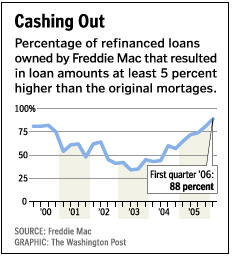
A greater proportion of mortgage refinancers tapped their home equity for cash in the first three months of this year than in any other quarter in the past 15 years, according to the latest quarterly review of loans owned by Freddie Mac.

About 88 percent of people refinancing their homes took out loans for at least 5 percent more than their original balances.

The percentage of cash-out refinancings in the first quarter was the highest since the third quarter of 1990, about the time the real estate boom of the late 1980s ended, according to Freddie Mac.

In addition, more than half took loans at higher interest rates than they previously paid. In years past, refinancers chased lower rates.

Ira Rheingold, general counsel of the National Association of Consumer Advocates, said he feared that some people are spending too much of their equity, which could leave them financially exposed.

"I don't want to sound like Chicken Little here, but we're heading for a big fall," Rheingold said. "Our policy of using our homes as our banks is bad public policy, and we need to think of the long-term implications of the debt we have. It's a homeownership economy where people don't really own their homes."
Gee do we need to add Chicken Little to Bird Sounds?
Is it possible to have an ownership society where no one really owns a thing?
For the answer to those questions please consider the Methuselah of mortgages.
The Methuselah of mortgages has arrived: the 50-year home loan. Statewide Bancorp of Rancho Cucamonga began offering the loan in late March, to California residents.

Half of first-time home buyers are 32 or older, according to the National Association of Realtors. If those buyers get 50-year mortgages and never refinance or make extra payments, they won't pay off their loans until they're well into their 80s. Would they be crazy to get loans that amortize or pay off the balance over 50 years instead of the standard 30 years? Not at all, Diaz says.

Getting a 50-year loan is a perfectly rational way to avoid an interest-only or payment-option adjustable-rate mortgage, he says. "Payment-option ARMs and interest-onlies have been so popular, we wanted to come out with a longer-term, fully amortizing loan for people who don't want to go negative," Diaz says.

Regulators and consumers worry that foreclosures will surge in coming years, especially among homeowners who got interest-only and payment-option ARMs. The 50-year loan is a lifeline for them, Diaz says.

"There are two markets for this," he says. "One is if they're looking to purchase a home, because of how expensive housing is, they'll consider this loan. And the other is payment-option ARMs -- borrowers are making minimum payments and they're starting to panic a little bit and look for vehicles to get out of these loans."

About a quarter of new mortgages in California are 40-year loans. This is the next logical step, Diaz believes.
According to Diaz, the 50-year loan is a "lifeline" as well as "the next logical step". If that step fails what is the next logical step after that, 75-year loans to save an extra $50 a month? Mr. Diaz I think you have something ass backwards. Getting a 50-year loan is NOT a perfectly rational way to avoid an interest-only or payment-option adjustable-rate mortgage. What would be perfectly rational would be not buying a house if a 50 year loan was the only way someone could afford it. What you are peddling is "perfect rationalization" of a product that makes little practical since just so you can sell a few more loans.

Let's do a little math shall we?
Actually I do not have to since it is right from the article. Here goes:
But just for grins, let's compare a 30-year fixed-rate loan with a mythical 50-year fixed. For a 30-year loan of $300,000 at 6.5 percent, principal and interest cost $1,896.20 per month. A 50-year loan for the same amount and at the same rate costs $1,691.15 per month in principal and interest.

The 50-year loan costs $205 less per month, but the payments stretch out for 20 years longer and will cost a total of $332,058 more.
Does that sound like a good deal? For who? Of course most people don't plan on living in a home for 50 years. But is that a good excuse for paying nothing down and practically nothing but interest for close to the life of the loan? Actually loans like these may have the effect of trapping some people in their homes for years.

A housing slump will put many people underwater. Anyone in that situation would not be able to sell unless they could bring cash to the table at closing. Those are the very same people now stretching to get into houses on these new 40 and 50 year loans. Will they be trapped or will they have cash to bring to the table?

The latest numbers prove that people are still trying to live off home equity in spite of rising rates and falling home prices. "The percentage of cash-out refinancings in the first quarter was the highest since the third quarter of 1990, about the time the real estate boom of the late 1980s ended".

The hangover from this party is going to be a doozie.

Mike Shedlock / Mish
http://globaleconomicanalysis.blogspot.com/
Wednesday, May 3, 2006

Top 10 Bird Sounds

In Canaries at the Periphery we discussed the plunging stock markets in the Mideast, the Icelandic Krona and the New Zealand dollar. The latter two currencies were blowups in the carry trade. Today the canaries are chirping closer to home. Not only that but the geese are honking and the turkeys are gobbling. Let's take a look at some of these birds, starting off with a few canaries.

The Boston Herald is reporting Ameriquest’s owner lays off 3,800.
The parent company of Ameriquest Mortgage Co. and Town and Country Credit laid off 3,800 workers nationally at retail mortgage subsidiaries and closed 229 branch offices yesterday. It has 10 Massachusetts branches.

Orange, Calif.-based ACC Capital Holdings said it’s centralizing the operations into regional mortgage production centers in California, Arizona, Illinois and Connecticut and consolidating corporate functions at its headquarters.

The announcement follows a $325 million January settlement between 49 states, including Massachusetts, and Ameriquest, the nation’s top subprime lender. The states alleged that Ameriquest used predatory lending practices.

ACC Capital would not disclose how many Massachusetts workers lost their jobs yesterday.

“Ameriquest failed to give state regulatory authorities advance notice of its branch closures and has yet to file a closure application with the Division of Banks, which is required under state law,” state Attorney General Tom Reilly said in a statement yesterday.
The New York Post wrote about Ameriquest's Ambassador of Doom
Ameriquest was hit earlier this year with charges by 49 state attorneys general that his company used bait-and-switch schemes to cheat customers into taking out more costly loans.

Billionaire Roland Arnall, who built Ameriquest into the largest mortgage lender for poor credit risks, is shutting down most of his company to focus on being the new U.S. ambassador to the Netherlands.

The embattled firm yesterday said it's closing 229 branch offices, firing 3,800 mortgage staffers, and consolidating into just five call centers.
The only thing that I can see holding up his ambassadorship is his less than perfect track record. Only 49 out of 50 states filed suit againt his bait and switch lending tactics. Had it been a perfect 50 for 50 I am sure it would all be smooth sailing. Otherwise, Lord knows he fits right in with this administration.

SmartMoney is reporting Hovnanian Warning Spells Trouble for Builders.
The Red Bank, N.J., builder said it will fall short of Wall Street's expectations in its fiscal second quarter as it now expects earnings in the range of $1.40 to $1.50 a share for the second quarter that ended April 30. Thomson First Call had pegged the company's earnings at $1.68 a share.

The builder also slashed its fiscal-2006 projection to a range of $7.20 to $7.40 a share, from previous guidance of $8.05 to $8.40 a share.

Hovnanian cited a surge in cancellation rates, a slowdown in demand, delays in certain deliveries, building-material price increases and heavier use of incentives and discounts for the weaker earnings outlook.

In another sign that the housing market is pulling back faster than expected, Hovnanian became the second major builder to take write downs in connection with land. Last week, rival Centex Corp. (CTX) took a charge of 14 cents a share in connection with the write down of certain option deposits and land parcels in Washington, D.C., Sacramento and San Diego. The write downs sent up red flags for investors, who worried this was a sign that land values were sharply deteriorating, which could mean the housing market was falling fast.

Hovnanian said it plans to take $5 million of write offs in connection with option deposits related to land.

"Although we have not needed to use this tactic as much in recent years, we have employed it successfully in prior slowdowns," Hovnanian said.
Both Centex and Hovnarian are reporting falling land prices.
When did they start making land? I must have missed the announcement.

I have two questions for Hovnarian:
  • Why is writing off land prices considered a "successful tactic"?
  • How much more of these kinds of successful tactics are you going to employ?
Let's take a look at a few charts.

It seems that Hov along with all other homebuilders with the exception of William Lyon Homes (WLS) have fallen on hard times. William Lyon has lost his mind and is attempting to take the company private at ever escalating price offers.


St. Joe is a real estate operating company based out of Florida that develops towns, resorts, commercial, and industrial properties in the United States. St. Joe also engages in land sales.


The following charts are from Berson's Weekly Commentary. Berson is an economist with Fannie Mae.

Month's Supply of Homes


Actual Inventory Supplies


If the months supply of homes does not seem that bad, it is because sales although falling sharply are still at historic levels, for now anyway. Meanwhile sentiment has clearly turned and is very unlikely to turn back anytime soon. That is the nature of supertankers, and housing is the supertanker that kept this economy going for so long.

CNN Money is reporting Rising Home Vacancies.
Experts who say the housing market is cooling, but won't implode, argue that solid job growth should be enough to prevent a collapse in home prices. But others who see a housing "bubble" ready to pop say a developing slowdown in home building itself could hurt job growth enough to put a big dent in housing.

Recent government figures show that about 1.5 million homes were vacant in the first quarter, most of those presumably up for sale, a 17 percent increase from a year earlier. The 2.1 percent vacancy rate was the highest on record since the government began tracking it in 1994. It was also the fourth straight quarterly increase.

"When you see it increasing quarter after quarter, there seems to be something going on here," Baker said. "We're building more homes than are being filled."

Among those most worried about the real estate market are home builders themselves. The National Association of Home Builders saw its index of builder confidence sink last month to the lowest level since 1995, save for two months right after Sept. 11.

But some economists say that while housing will cool as mortgages continue to rise, home sales and prices won't collapse, due mostly to strength in the job market.

One of those worried is James McShirley, owner of Sulphur Lumber near Indianapolis. He's already laying off staff and not filling open positions due to a slowdown in orders from his builder clients.

"We're holding off as much as we can because qualified people are hard to find," he said. "But there will come a point where we have to face that (more layoffs) and it could be soon."

McShirley said when he sees his clients cutting staff, and a local mortgage broker with 100 employees go out of business, he grows more worried.

"Those people losing their jobs are the classic home owners. This could be a vicious circle," he said.
Housing will not collapse because of strong jobs, huh? Did it ever occur to these economic genuises that jobs have been strong because of housing? It is an interesting anecdote that a lumber supplier in Indian is laying off good "qualified people" because he simply has no choice. This trend will escalate.

It seems the PPI is spiraling out of control. But enquiring minds might be wondering if those prices being passed on? Dow Jones is reporting Cooper Swings To Loss on Rising Rubber,Oil Prices.
Cooper Tire & Rubber Co. (CTB) said Wednesday it swung to a first-quarter loss as price increases failed to offset rising raw-material costs.

Shares of Cooper Tire fell 0.7% to $12.60 in early trading.

The Findlay, Ohio, tire maker reported a loss of $5.2 million, or 8 cents a share, compared with net income of $5.2 million, or 7 cents, a year earlier. Sales rose 16% to $596.6 million from $514.1 million on better pricing and improved product mix, the company said.
It would seem to me that the only reason to sell for a loss is because you can't raise prices.

Not only are the canaries chirping but so are the geese. An astute question was asked by "Shades" on Silicon Investor. It goes something like this: Why sell the goose if it still laying golden eggs? We are of course talking about the upcoming MasterCard IPO .
Credit card issuer MasterCard Inc. plans to price its IPO between $40 and $43 a share when it sells a $2.8 billion stake in the company later this month.

A total of 61.5 million shares of Class A common stock, or 46% of the company's stock, is slated for the initial public offering some time in the fourth week of May. If there is sufficient demand, an additional 4.6 million shares will be sold in an over-allotment tranche, according to an updated prospectus filed by the company Wednesday.

If MasterCard succeeds at pricing its deal at the high end of its range, the Purchase, N.Y., company would be valued at $5.8 billion.

All but $650 million of the money raised in the IPO will be used to buy a portion of the Class B common stock stakes held by current owners of the closely held cooperative, who are members or affiliates of MasterCard's credit card network. About 30% of the proceeds will go to members and affiliates who are also underwriting the deal - including Wall Street underwriters JP Morgan Chase & Co. (JPM) and Citigroup Inc. (C). The remaining $650 million will be used to increase the company's capital, defend it in legal and regulatory proceedings, and for other general corporate purposes.

The deal, which is being lead-managed by Goldman Sachs Group Inc. (GS), will trade under the symbol MA on the New York Stock Exchange.
So insiders are bailing via IPO to the public. There are lots of potential reasons for this.
  • Rising default rates
  • Rising bankruptcies
  • Fear of what a Democratic Congress might do to the bankruptcy law
  • Fear of what a Democratic Congress might do to maximum allowed card rates
Just like home builders bailing on their own companies in mass, if insiders want out, it is generally bad business to want in.

It is now time to "talk turkey".
Many people, myself included, commented on the capitulation of long time bear Stephen Roach. No one summed up the situation better than Peter Schiff writing on FinancialSense about "COOL HAND STEVE".
The most interesting aspect of his fox-hole conversion is his timing. Never before has his doomsday scenario been so close to unfolding or his bearishness so close to vindication. With the dollar resuming its fall, foreign central banks raising rates and seeking to diversify their reserves, housing supply overwhelming demand, and gold and other commodity prices soaring out of control, one would think Mr. Roach would finally be in the enviable position of saying "I told you so." Instead he has changed his tune, and now sings in near perfect harmony with the Wall Street's "All Bulls Choir."

Not only are the economic imbalances to which Stephen Roach repeatedly referenced still present, they loom larger than ever. Rather than swallowing their medicine, Americans continue choking on it. Roach can see this as clearly as I can, making his new stance difficult to understand. For my money Wall Street's most popular bear finally turning bullish is as bearish an indicator as I have ever seen, and may go down as the most ill-time capitulation in market history.
Lifelong bears turning bullish is a classic "chirping sound". Roach is now doomed to become roast turkey. We could see it coming too. For the last six months Stephen Roach has been all over the map. I commented on that on Silicon Investor as well as the Motley FOOL. Well he now finally capitulated just as a housing collapse is getting underway. The double dip recession that he called for in 2003 is now on its way.

Mish Top 10 Bird Sounds

#10 Carry trades blowing up in New Zealand and Iceland
#09 Mideast stock markets crashing
#08 Home inventories and vacancies are skyrocketing
#07 St. Joe falling off a cliff
#06 MasterCard IPO
#05 Land prices being written off by two home builders
#04 Ameriquest firing close to 4,000 workers
#03 Inability of manufacturers to pass on skyrocketing costs
#02 The rise of gold and silver

Drum Roll Please.........

#01 The capitulation of Stephen Roach

Mish Addendum.
I posted the above earlier tonight but shortly thereafter I was able to discuss the above ideas on a podcast at HoweStreet. For those that are interested in an audio version with a few additional comments on oil and gold, please tune in to Chirping Birds.

Mike Shedlock / Mish
http://globaleconomicanalysis.blogspot.com/