Pages

Friday, June 4, 2010

Dollar Soars; Euro, Euro/Swiss, Forint Hit New Low; Hungary’s Prime Minister says Economy in "Very Grave Situation, Default Talk Not an Exaggeration"

The situation in Europe is taking a turn for the worse as the Prime Minister of Hungary says Hungarian economy is in a "very grave situation and talk of a default is not an exaggeration".

Please consider Hungary’s Forint Weakens to 12-Month Low; Bonds, Stocks Plunge
Hungary’s forint weakened to the lowest level in a year, the nation’s stocks plunged and government bond yields had the biggest increase since November 2008 after a spokesman for Prime Minister Viktor Orban said the economy is in a “very grave situation.”

The forint depreciated 2.1 percent to 287.73 per euro at 2:28 p.m. in Budapest, the weakest level since June 2009. The extra yield investors demand to own Hungary’s debt over U.S. Treasuries rose 93 basis points, the most since November 2008, to 4.12 percentage points, according to JPMorgan Chase & Co.’s EMBI Global Index. The BUX Index of equities tumbled 7 percent.

Hungary’s economy is in a “very grave situation” because the previous government manipulated figures and lied about the state of the economy, Orban’s spokesman Peter Szijjarto said at a press conference in Budapest today. Talk of a default is “not an exaggeration,” Szijjarto said. European equities and U.S. stock-index futures fell after the comments.

Hungary secured a 20 billion-euro ($24 billion) loan from the IMF, the European Union and the World Bank in October 2008 to avoid default as the global financial crisis spurred investors to avoid the country and sent the economy into a recession.

Orban, who took over May 29 after winning elections by pledging to cut taxes and stimulate the economy, yesterday failed to get EU approval for looser fiscal policy.
Whatever You Do, Don't Tell The Truth!

Here is an interesting quote from the article.

The new government needs to think a bit more clearly about communication with the market. You simply cannot talk like this in these markets” said Timothy Ash, head of emerging-market research at Royal Bank of Scotland Group Plc, in an e-mailed comment.

Translation "No matter what the problem is ... please don't tell the truth!"

US$ Index Weekly


Euro vs. Dollar Weekly Chart


On news of the "Save the Euro Plan" the Euro bounced all the way up to 1.31 (see previous red candle). However, the Euro could not hold the gains for even a few days.

Now, the Euro is making fresh new lows.

Euro Swiss Weekly


This is a chart of the Euro vs. the Swiss Franc. I think it is the most interesting of the lot because the Swiss Central Bank has openly intervened in the currency markets in an attempt to suppress the Swiss Franc.

Swiss franc intervention cost a billion a day in April

Inquiring minds are reading a May 21, 2010 Financial Times Alphaville article Swiss franc intervention cost a billion a day in April
Data just released show that the SNB increased its holdings of foreign currency by an extraordinary CHF28.5 billion in April – almost CHF1 billion a day. This means that, in the first four months of this year, Herr Hildebrand had gobbled up CHF58.9 billion of a money nobody else much wanted to own – on top of which we have to add what is likely to be a sizeable sum of flight capital ‘absorbed’ in the first turbulent weeks of May (€9.5 billion on Wednesday morning alone, according to market rumour).

Making a simple estimate that the overall intervention this month has at least matched that undertaken in April (a decidedly conservative guess), the Bank will have amassed around CHF80 billion so far this year, a total of which the mighty PBoC would not be ashamed and one, even more remarkably, equivalent to around 45% of the Confederation’s entire private national income for the period.

Not only has the SNB therefore seriously diluted its existing citizen-shareholders’ equity stake in their own country (think about it), it has gone some good way into turning the Swissy into the Hong Kong Dollar of Europe, since fast approaching 70% of the asset side of its balance sheet is currently being held in the form of forex (160% of the monetary base, 38% of M1), putting the once-proud Swissy well on track to degenerating to mere currency board status.

With Hildebrand maintaining the stance in the Swiss press that reserves were, if anything, too low, before his shopping spree – and with the ECB’s ability to create extra Euros being both essentially limitless and in inverse proportion to its Northern members’ desire to hold them – the Swiss are in danger of selling out their remaining economic and monetary independence in the name of a mercantilist desire to buffer their admittedly important exporters from the malfeasance of their neighbours’ governments.
Alphaville attributed the above snip to Sean Corrigan of Diapason Commodities.

Currency Intervention Simply Does Not Work

As I have said before many times. Currency intervention simply does not work.

For a look at Japan's currency intervention in 2003-2004, and other currency intervention madness, please consider Currency Intervention And Other Conspiracies

Once again the results speak for themselves.

Swiss Franc Libor Falls; SNB May Curtail Intervention

After amassing billions in Euros in a foolish as well as losing attempt to suppress the Swiss Franc vs. the Euro, I find myself laughing at this Bloomberg headline just yesterday: Swiss Franc Libor Falls; SNB May Curtail Intervention.
The rate banks say they pay for three-month loans in Swiss francs fell to a record low, potentially sparking inflation and compel the nation’s policy makers to let the currency rise, according to Citigroup Inc.

The Swiss National Bank has intervened to curb the currency’s gains by pumping francs into the market, said Michael Hart, a foreign-exchange strategist at Citigroup in London. That risks stoking inflation, which accelerated a more-than-forecast 1.4 percent in April, he said. The SNB says consumer-price growth may be 2.2 percent in 2012.

“It indicates they will need to tighten policy and stop intervention over the coming months,” Hart said yesterday in a phone interview. “The SNB has flooded the market with liquidity as a result of the interventions.”

The Swiss franc was little changed at 1.4153 per euro as of 11:50 a.m. in London.
As of right now, the Euro fell to 1.40 vs. the Swiss Franc after touching a new low for the move this morning at 1.393.

I think Michael Hart, Citigroup's foreign-exchange strategist in London is off his rocker in suggesting the Swiss national Bank is about to tighten. However, if they do, the Swiss Franc will go soaring vs. the Euro.

Look at the holes central bankers dig attempting to defeat the markets. The track record of central bankers learning anything from the failures of other central bankers is a perfect zero percent.

Mike "Mish" Shedlock
http://globaleconomicanalysis.blogspot.com
Click Here To Scroll Thru My Recent Post List

Jobs Increase by 431,000, only 20,000 Excluding Census; Unemployment Rate Drops to 9.7%; A Look at the Details

This morning the BLS reported an increase of 431,000 jobs. 411,000 of those jobs were temporary workers for Census 2010. Headline unemployment fell .2% to 9.7%.

Hidden beneath the surface the BLS Black Box - Birth Death Model added 215,000 jobs.

However, as I have pointed out many times before, the Birth/Death numbers cannot be subtracted straight up to get a raw number. It contributed to this month's employment total for sure, but the BLS will not disclose by how much.

In addition to census hiring, temporary help services employment added 31,000 jobs. temporary help services employment has risen by 362,000 since September 2009.

On the whole, this was a very weak jobs report especially with all the hype coming from various administration officials and economic cheerleaders.

Both the birth/death numbers and temporary help jobs are problematic.

The drop in the unemployment rate will all be taken back by August when the census workers are let go.

As I said last month, I still do not think the top in the unemployment rate is in and expect it may rise substantially June through August, and keep rising at a modest pace thereafter for most of the rest of the year. Time will tell.

Employment and Recessions

Calculated risk has a great chart showing the effects of census hiring as well as the extremely weak hiring in this recovery.


click on chart for sharper image

The dotted lines tell the real story about how pathetic a jobs recovery this has been. Bear in mind it has taken $trillions in stimulus to produce this.

May 2010 Report

Please consider the Bureau of Labor Statistics (BLS) May 2010 Employment Report.

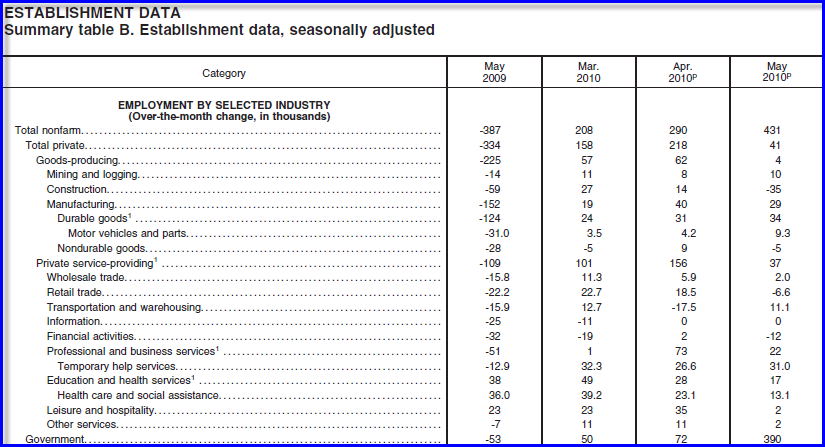
Total nonfarm payroll employment grew by 431,000 in May, reflecting the hiring of 411,000 temporary employees to work on Census 2010, the U.S. Bureau of Labor Statistics reported today. Private-sector employment changed little (+41,000). Manufacturing, temporary help services, and mining added jobs, while construction employment declined. The unemployment rate edged down to 9.7 percent.

Unemployment Rate - Seasonally Adjusted


Nonfarm Payroll Employment - Seasonally Adjusted

Since September 2009, temporary help services employment has risen by 362,000.

Establishment Data


click on chart for sharper image

Highlights

  • 431,000 jobs were added
  • 35,000 construction jobs were lost
  • 29,000 manufacturing jobs were added
  • 37,000 service providing jobs were added
  • 6,000 retail trade jobs were lost
  • 22,000 professional and business services jobs were added
  • 17,000 education and health services jobs were added
  • 2,000 leisure and hospitality jobs were added
  • 390,000 government jobs were added
Note: some of the above categories overlap as shown in the preceding chart, so do not attempt to total them up.

Index of Aggregate Weekly Hours

Production and non-supervisory work hours rose one tick to 33.5 hours and average hourly earnings rose 4 cents.

Birth Death Model Revisions 2009


click on chart for sharper image

Birth Death Model Revisions 2010


click on chart for sharper image

Birth/Death Model Revisions

The BLS Birth/Death Model methodology is so screwed up and there have been so many revisions and up it is pointless to further comment other than to repeat a few general statements.

Please note that one cannot subtract or add birth death revisions to the reported totals and get a meaningful answer. One set of numbers is seasonally adjusted the other is not. In the black box the BLS combines the two coming out with a total. The Birth Death numbers influence the overall totals but the math is not as simple as it appears and the effect is nowhere near as big as it might logically appear at first glance.

The BLS added massive numbers of jobs every month to its model, all through the recession. Those jobs never existed. Last month the BLS made those revisions to job totals to reflect errors in its Birth/Death model.

BLS Black Box

For those unfamiliar with the birth/death model, monthly jobs adjustments are made by the BLS based on economic assumptions about the birth and death of businesses (not individuals).

Birth/Death assumptions are supposedly made according to estimates of where the BLS thinks we are in the economic cycle. Theory is one thing practice is clearly another.

Household Data
The number of unemployed persons was 15.0 million in May. The unemployment rate edged down to 9.7 percent, the same rate as in the first 3 months of 2010.

The number of long-term unemployed (those jobless for 27 weeks and over) was about unchanged at 6.8 million. These individuals made up 46.0 percent of unemployed persons, about the same as in April.

The number of unemployed reentrants to the labor force fell by 286,000 in May, offsetting an increase in April.

The civilian labor force participation rate edged down by 0.2 percentage point to 65.0 percent.

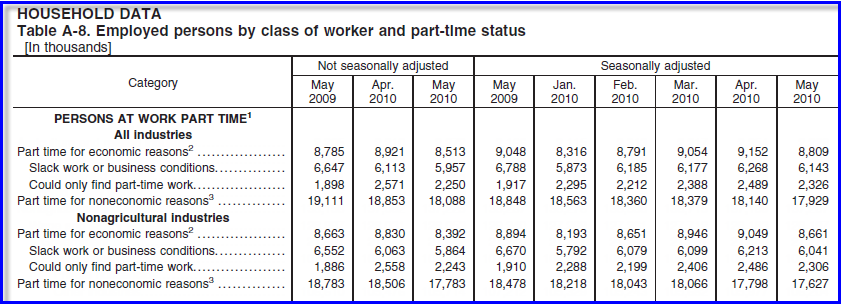
The number of persons employed part time for economic reasons (sometimes referred to as involuntary part-time workers) declined by 343,000 in May to 8.8 million. These individuals were working part time because their hours had been cut back or because they were unable to find a full-time job.

[Mish Note: In January the number was 8.3 million]

Persons Not in the Labor Force

About 2.2 million persons were marginally attached to the labor force in May, unchanged from a year earlier. These individuals were not in the labor force, wanted and were available for work, and had looked for a job sometime in the prior 12 months. They were not counted as unemployed because they had not searched for work in the 4 weeks preceding the survey.
Table A-8 Part Time Status


click on chart for sharper image

The key take-away is there are 8,809,00 of workers whose hours may rise before those companies start hiring more workers.

Table A-15

Table A-15 is where one can find a better approximation of what the unemployment rate really is.


click on chart for sharper image

Grim Statistics

The official unemployment rate is 9.7%. However, if you start counting all the people that want a job but gave up, all the people with part-time jobs that want a full-time job, all the people who dropped off the unemployment rolls because their unemployment benefits ran out, etc., you get a closer picture of what the unemployment rate is. That number is in the last row labeled U-6.

It reflects how unemployment feels to the average Joe on the street. U-6 is 16.6%.

Looking ahead, there is no driver for jobs. Moreover, states are in forced cutback mode on account of shrinking revenues and unfunded pension obligations. Shrinking government jobs and benefits at the state and local level is a much needed adjustment. Those cutbacks will weigh on employment and consumer spending for quite some time.

Expect to see structurally high unemployment for years to come.

Keep in mind that huge cuts in public sector jobs and benefits at the city, county, and state level are on the way. These are badly needed adjustments. However, the union parasites will not see it that way, nor will the politicians.

All things considered, this report looks anemic on the surface and even worse with a close inspection of the details.

Mike "Mish" Shedlock
http://globaleconomicanalysis.blogspot.com
Click Here To Scroll Thru My Recent Post List

Thursday, June 3, 2010

Video Exposes Systemic Fraud by Census Bureau Supervisors

Conservative activist James O'Keefe alleges fraud by Census Bureau


The video shows three levels of supervisors promoting or ignoring the padding of hours by census employees.

Hiring and Firing of Census Employees Multiple Times

Many people sent me articles or videos about the hiring and firing of census workers multiple times to pad the employment report.

I cannot address whether or not the hiring and firing of the same employee multiple times is taking place.

However, I can state that it will not do a damn thing for the unemployment stats. The unemployment numbers come from a phone survey not from repetitive hirings and firings.

Even the headline jobs number would not be affected. That number comes from the establishment survey. One is either on the payroll or not.

The only issues at play that I can think are:

1. If someone goes through training twice and gets paid for it.
2. If supervisors are being paid on the basis of how many hires they have made.

I do not know if either of those apply, but the idea that supervisors are hiring and firing census workers to pad the employment numbers simply does not fly.

Mike "Mish" Shedlock
http://globaleconomicanalysis.blogspot.com
Click Here To Scroll Thru My Recent Post List

San Carlos California Ponders Dissolving Police Department, Outsourcing Duties; Redwood City Mayor says "It's the Wave of the Future"

Three cheers for San Carlos California for starting to face the reality that unions are sucking the city dry. It's not a done deal yet, but San Carlos considers outsourcing police duties.
The city of San Carlos, facing a multimillion-dollar budget deficit brought on by the recession and rising employee costs, is considering a money-saving measure that is all but unheard of in the Bay Area - dissolving its Police Department and outsourcing the job of law enforcement.

After 85 years of having its own police force, supporters of the idea say, it's time for San Carlos to hand the job either to the San Mateo County Sheriff's Office or to neighboring Redwood City to eliminate nearly two-thirds of next year's $3.5 million deficit.

San Carlos is not a high-intensity policing assignment. The number of violent crimes in an average year is 27, and there have been only three homicides in the city of 28,000 over the past decade.

In May, the San Carlos City Council held a special session to review policing proposals by the sheriff's office and Redwood City police. The city is expected to decide this month whether to disband the force and select one of the agencies.

"We have two attractive offers from two professional organizations," said Mayor Randy Royce, who believes the city should scrap its force. "I am just elated to have two great proposals. We can't go wrong either way."
Can't Go Wrong

I concur with Mayor Randy Royce. My only question for Royce is "What took you so long?"

I am still waiting for some major city like San Diego, or LA to decide the same thing.

Taxpayers will kiss you.

Mike "Mish" Shedlock
http://globaleconomicanalysis.blogspot.com
Click Here To Scroll Thru My Recent Post List
MasterCard Study Says Consumer Spending Has Taken A Break

Michael McNamara, Vice President, Research and Analysis for SpendingPulse, observes Consumer Takes a Respite as Spending in Many Sectors Declines.
The momentum in consumer spending that was building through the first quarter, seems to be taking a breather in the second quarter of 2010, at least so far. Financial volatility in the capital markets and ongoing macroeconomic issues could account for this shadow cast over the recovery in consumer spending. Some sectors seem to be responding to specific disruptive events, such as the expiration of the Federal housing tax credits, where previously we'd noticed a beneficial "echo" effect on housing related categories such as Furniture and Furnishings.

In addition, Memorial Day occurring a week later than it did last year, could have pushed some spending into June, 2010. Nevertheless, we continue to see strength in pricing, and in most categories, we are registering solid increases in the SpendingPulse Price Index, indicating that inventories continue to be aligned to demand, and retailers have not had to return to steep discounting.
Price Wars

In response to Michael McNamara's statement "retailers have not had to return to steep discounting" I counter with Foreclosure Life Raft; Price Wars at Walmart; Electrical Demand Drops Two Straight Years, First Since 1949.

Wal-Mart, Target, Costco, others are clearly in the midst of price wars hoping to capture market share.

YouTube Commentary From McNamara

Here’s a short YouTube video with additional commentary from Michael McNamara.


Factors in Spending Respite

McNamara discusses several factors in the spending respite.

  • Some Memorial Day sales falling into June instead of May. This may benefit June sales.
  • Financial market volatility impacts big ticket items and durable goods.
  • The end of $8,000 housing tax credits pushed forward big ticket spending items like furniture and appliance.

Spending Trends

Interestingly, apparel sales and footwear showed a significant decline although online apparel sales were up 20-30% depending on category.

Furniture sales were down 9% compared to a year ago. This was in spite of a mini-rush to buy housing ahead of the expiring tax credit. Perhaps we see a bump in furniture and appliance sales in June or July after some of those home purchases close, but that will be the last hurrah in my opinion.

Luxury retail spending showed an increase of 9.7% compared to May of last year. Luxury sales reflect a recovery in the financial markets as opposed to the real world job loss recovery that most experience.

Moreover, comparisons for luxury sales going forward start to get harder going forward.

Finally, McNamara notes that "eCommerce growth is moving well ahead of brick and mortar sales at +13.7% year over year". Sales tax avoidance anyone?

Expect to see more weakness going forward as housing tax credits expire and other stimulus efforts diminish just in time for the November elections.

Mike "Mish" Shedlock
http://globaleconomicanalysis.blogspot.com
Click Here To Scroll Thru My Recent Post List

Public Union Parasites Move To Bar California Bankruptcies

Outrageously overpaid California public union parasites have every intention of sucking the last drop of blood out every taxpayer.

Regardless of the cost to taxpayers, and even though their bloated benefit programs vastly exceed what the private sector gets, nothing will get in the union's way of protecting the overgenerous benefits they have, while still demanding more money from taxpayers, no matter what fiscal shape any of the cities are in because of those contracts.

Assembly Bill 155 Places Hurdles On Bankruptcies

Sadly, California's corrupt politicians, bought and paid for by the unions, are all too willing to go along with a Scheme to Bar City Bankruptcies.
A bill that clamps down on municipal bankruptcy filings is headed for Gov. Schwarzenegger's desk, which is bad news for Los Angeles and other cash-strapped California cities.

It the governor signs Assembly Bill 155, it would place a hurdle in the path of filing for Chapter 9 municipal bankruptcy. The bill stipulates that a city may only file for bankruptcy with the approval of the California Debt Investment Advisory Commission, which provides information on debt to public agencies.

"California's taxpayers who rely on public safety, senior, park and library services, as well as those who own and operate businesses in our communities, deserve every effort that state and local government can make to avoid the long-term devastation of bankruptcy," the bill says.

In particular, the bill says it intends to protect retirement pensions and health benefits for public employees, which would be disrupted and renegotiated in the wake of bankruptcy.

This could have a direct impact on the state's largest city, Los Angeles, which is facing a huge budget shortfall. The city's former mayor, Richard Riordan, is calling for bankruptcy as the current mayor, Antonio Villaraigosa, is proposing deep cuts to city payrolls, according to news reports.
Union Parasites and Corrupt Politicians Cause Devastation

Bankruptcy does not cause long-term devastation. Forever increasing taxes to support union parasites does.

Given that one cannot negotiate with parasites, mosquitoes, termites or other pestilence, the only reasonable solution is to exterminate them. Public unions need to be made illegal, and every service imaginable immediately outsourced to non-union shops.

Public unions are the problem and bankruptcies are one solution. If Schwarzenegger has an ounce of common sense he will veto this bill.

Mike "Mish" Shedlock
http://globaleconomicanalysis.blogspot.com
Click Here To Scroll Thru My Recent Post List

Disputing the Alleged "Checkmark Recovery"

One of the silliest cases I have seen to date regarding the alleged recovery comes from James Altucher, president of Formula Capital.

Altucher Says It's Not a 'V', It's Even Better, Look for New Highs by 2012


Partial Transcript

Aaron Task: Joining me now is James Altucher who says, not only is the recovery not over, and not only is it a "V Shaped Revovery, it's checkmark shaped recovery. James you are wildly optimistic on the US economy right now?

James Altucher: I don't want to say "wildly" because that sounds almost insane, and everyone is going to comment on these message boards that I'm completely whacko. At the same time if you look at all the data, go to the federal reserve website and look at every single chart of economic data, nonfarm payrolls, retail sales, inventories, it's all a "V" or a checkmark. ... The Debate is over. It's already been a "V" the question is "Does it continue?" I think it does.

Completely Whacko

Yes James, you are completely whacko. I did go to the Fed website as you suggested and here are some charts to consider.

Civilian Unemployment


In terms of civilian employment there was a fast checkmark in the 70's 80's and 90's but there is no sign of a "V" now, let alone a checkmark.

Auto Sales


Auto sales are now back to where they were in early 1980. This is the most miserable auto sector recovery ever in terms of actual numbers. Moreover, the data worse than it looks if one factors in population growth.

Looking for a checkmark? If you hold up the chart and look in a mirror you might see a nice one now, but the real one from 1980 vanishes.

Total Consumer Credit


With consumer credit, there is no "V" nor checkmark, nor any recognizable improvement, rather an unprecedented plunge dating all the way back to 1940.

Total Bank Credit


Total bank credit has had a recovery of sorts off an unprecedented plunge. However it is not anything one should properly call a "V".

Housing Starts


Housing starts is one of the few genuinely leading indicators. 1990 and 2000 certainly had "V" shaped recoveries. However the chart clearly shows it it preposterous to call the current blip a "V" shaped recovery. Housing starts are still below every trough all the way back to 1960.

Moreover, it has taken repeat $8,000 tax credits to even get that little blip.

As with auto sales, the proper way of viewing this is on a population adjusted basis (not shown), which would make that miserable chart look far worse.

Sick Mortgage Market

Finally, Fannie, Freddie, and the FHA now account for 90% of mortgage market. Please see FHA Volume is Sign of ‘Very Sick System’ for details.

Recovery? Please be serious. We have had a recovery in financial assets reflecting a $trillion thrown at anything that would move, and those anemic charts are all we have to show for it.

So where does Altucher get his checkmark theory?

This chart will show how.

Housing Starts Percent Change From Year Ago


There's your checkmark. Please compare to the previous chart.

If you believe that constitutes a checkmark recovery (or even a "V" shaped recovery), then you are only fooling yourself.

Addendum:

Flashback July 10, 2008.

Forget Your Fears: 'Everything Is Cheap,' James Altucher Says
James Altucher, managing partner of Formula Capital, says "fear of the unknown" is obscuring opportunity for investors.

On an enterprise value/cash flow basis, almost "everything is cheap," Altucher says, recommending investors buy index ETFs to get exposure to a market the author, columnist and investor believes is "dirt cheap."


Mike "Mish" Shedlock
http://globaleconomicanalysis.blogspot.com
Click Here To Scroll Thru My Recent Post List