Pages

Thursday, July 13, 2006

Madame Zalora

I asked Madame Zalora what she thought of Centex's latest sales pitch.


Her Crystal Ball replied a sarcastic "big deal".
Her more detailed response (that I had to pay extra for) was:

A 30-40 day price guarantee? Who cares?
Besides that is listing price which is unlikely to move as much as discounted prices and incentives.

She also admonished me.
"You really did not need a crystal ball to answer that, now did you?"

"How long will it be before they give a one year price guarantee?" I responded.

"Sorry, Madame Zalora only answers one question a day per customer" was all she said.

Mike Shedlock / Mish
http://globaleconomicanalysis.blogspot.com/

Wednesday, July 12, 2006

What is GM worth?

I have been wondering what GM is worth.
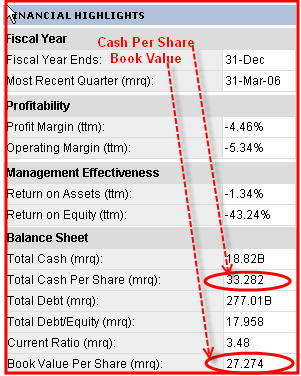
One measure is book value and that is currently sitting at $27.27.
GM is also sitting outright on $33.28 in cash per share as the following chart shows.


Aren't companies supposed to be a great buy at book value?
Perhaps, but what if book value is exaggerated?
Let's dissect GM's latest annual report and see what we can find.

Balance Sheet


Right off the bat we see that assets minus liabilities show GM to be worth approximately $15 billion. With various small adjustments the annual report shows shareholder equity to be $14.597 billion.

That is yet another possible answer for what GM is worth.
But wait a second.
What about all of those footnotes?
What do they mean?

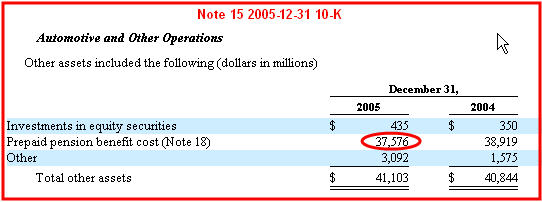
Please consider Note 15.


The above is only a portion of Note 15, but the part that is of the most interest.
The actual report has other asset categories and the total of all of them is indeed 58,086 as shown in the first chart. The figure to make note of is pension assets of 37,576.

Liabilities


Pension assets were hidden in note 15, but liabilities were hidden in note 18. Notice that GM broke this out by type of obligation and country of obligation. If you add all of those liabilities up you see that GM has whopping pension and post retirement liabilities of $69.258 billion. $60.899 billion of that is "US Other Benefits".

Wait a second. Don't the first two chart show that GM declared those liabilities to be $45.301 billion and the declared assets to be $37.576 billion? That difference is a negative $7.725 billion (45.301-37.576). Note 18 shows otherwise. The stated fair value of those assets is $125.457 billion (95.250+9.925+20.282) while the benefit obligation is $194.715 billion (89.13+20.641+81.181+3.760). The difference between $194.715 billion and $125.457 billion is $69.258 billion, yet the balance sheet only accounts for $7.725 billion of it.

If the balance sheet properly reflected the true state of its pension plan you should subtract another $61.533 billion (69.258-7.725) from shareholder equity. That calculation puts shareholder equity at roughly a NEGATIVE $46.936 billion dollars (14.597-61.533).

Enquiring minds might be asking "How much longer can GM get away with this nonsense?"
The answer it seems may not be much longer. Please consider Reforms to U.S. Pension Funding and Accounting Rules.
Serious pension underfunding is in large part due to funding targets are not based on mark-to-market measures of pension assets and liabilities. Instead, reported asset values are typically an average of past mark-to-market measures, and reported liabilities are computed using an average of the long-term interest rate over the previous four years. When long-term interest rates are declining, as they have been since 2000 until recently, reported pension liabilities understate true liabilities. In addition, plan liabilities are understated because they don't properly account for early retirement and lump-sum payout options.

Not only do current funding rules allow funding targets to move slowly toward their correct values, they also allow measured funding shortfalls to be closed too slowly. This is especially true for funding shortfalls arising from plan amendments that raise pension benefit levels. Under current law, these shortfalls are amortized over periods as long as 30 years. Not surprisingly, many plans have taken advantage of this rule by specifying dollar pension benefit levels in the pension agreement and making frequent amendments raising benefit levels. A large share of current underfunding is attributable to such plans.

Recently FASB undertook a two-phase project reviewing its accounting guidance for pensions and post-retirement benefits. Phase 1 has resulted in a draft rule that is now open for comment. That rule dictates that reported pension liabilities take account of projected benefits as opposed to already-accrued benefits, and that pension assets and liabilities be reported on company balance sheets rather than just in footnotes as is currently the case. A final rule is expected by year-end. Phase two of the project, a joint initiative with the International Accounting Standards Board, is more ambitious and is expected to last three years or longer. That phase will consider advising that companies value pension assets and liabilities at fair market value rather than allowing them smoothing mechanisms, and that any changes in the fair market value of net pension obligations flow more directly to earnings.
Obviously GM has been getting away with murder and Wall Street is far too happy to play along. As long as GM can sell billions of dollars in worthless bonds at lucrative fees and as long as there are trillions of dollars to be made betting for or against its bankruptcy, the game will continue. Right now the market says GM is worth $29.50+- so that simply must be the current arbiter of what GM is worth.

Perhaps a more pertinent question for investment purposes is what GM is likely to be worth some three to five years into the future. Assets minus liabilities are a negative $47 billion and that will be impossible to make up. GM is arguably surviving right now only because of cash on hand. The latest rally in GM from roughly $18 to $29+ is explainable as well. There were simply too many people betting too heavily against GM (via put options expiring in 2007), and now they are taking those bets off realizing they were wrong. Unwinding of massive numbers of GM puts creates an underlying bid and GM rallied.

The Ecommerce Times is reporting Thousands Making Early Exit at GM, Delphi.
The nation's largest automaker said it expects to save $5 billion in structural costs in 2006, with a substantial portion coming due to the announced buyouts and retirements. Chairman and CEO Rick Wagoner said the exodus will allow GM to dramatically reduce the number of workers in the "jobs bank," where laid-off workers get most of their pay and benefits even when they're not working.

Based on preliminary numbers from GM, about 4,600 employees accepted buyouts and about 30,400 chose to retire. It is expected that most will retire or leave the company by the end of the year, GM said.

GM offered buyouts of US$140,000 for workers with at least 10 years of service, while those with less than 10 years would receive $70,000. The workers would cut nearly all ties with the company except for vested pension benefits.

Wagoner said the exodus will allow GM to dramatically reduce the number of workers in the "jobs bank," where laid-off workers get most of their pay and benefits even when they're not working.
A close look at the above pictures shows GM's recent buyouts to be little more than short term salary relief as opposed to doing much of anything for its long term medical and pension problems. Those pension benefits were reduced by a mere 4,600 workers. Long term it seems that GM still has severe pension/medical problem that may very well eat them alive over time.

Mish notes:

The above analysis is a good hard looked at GM solely on the basis of pension plan assets and liabilities. I made no attempt to decide the breakup value or worth of various components such as GMAC nor is it possible to decipher the value (if any) of recently proposed synergies between GM and Renault-Nissan that CEO Wagner calls "interesting".

Still the details of this proposed alliance are sketchy and perhaps nothing more than an attempt to drive up share price temporarily rather than expectations of achieving some kind of significant lasting benefit.

Long term I fail to see how GM has significantly addressed their medical/pension problems or their cost disadvantages to other auto makers. Add in a consumer led recession and the odds of GM's long term survival are questionable at best.

GM is currently sitting on $30+ billion in cash. How long will that cash last in a severe recession? At one time Delta Air Lines was sitting on a huge pile of cash too. Eventually Delta drained all its cash reserves before filing for Chapter 11. Unless and until GM addresses its long term structural problems, it is likely to eventually follow suit.

Addendum:

No sooner than I finish the above notes do I see an article citing GM CEO WAGONER GM doesn't need a white knight.
General Motors Corp. Chairman Rick Wagoner defended his turnaround Tuesday and said the automaker isn't seeking a "white knight" to ride to its rescue.

In his first interview since shareholder Kirk Kerkorian urged GM to consider an alliance with industry superstar Carlos Ghosn's Renault-Nissan alliance, Wagoner said GM management will study the blockbuster proposal with an open mind even as it forges ahead with the revival of its core business.

"We didn't build our turnaround plan on the basis that a white knight would come in at the 11th hour and bail us out," Wagoner told me Tuesday. "Because my experience in life is when you bet on somebody saving you, that's a pretty risky business.

For now, Wagoner isn't betraying whatever bias he may have. He says he knows Ghosn and respects him. He says GM has done alliances before, learned from the successes and the missteps -- some of them very costly in dollars and lost reputation.

He says leaks of boardroom discussions "is not constructive at all" and "it's a very unfortunate trend in recent months."
Hmmm. There are "leaks of boardroom discussions". Does that smack of some sort of power play to unseat Wagoner? If so is that a good thing, a bad thing, or a meaningless sideshow? I think the latter. Unless and until GM can eliminate its long term structural disadvantages in costs, eliminate its pension and medical liabilities, deal with falling market share, get consumers to like its cars, and survive a nasty consumer led recession in the face of rising costs of debt, board power plays are likely meaningless. GM may have taken steps to do some of the above, and may have even accomplished far more that Wall Street expected, but in the grand scheme of things it is likely a case of "too little, too late".

Mike Shedlock / Mish
http://globaleconomicanalysis.blogspot.com/

Medical Tourism

Why have routine (and not so routine) medical and dental services performed in the US when you can have them done cheaper elsewhere and get a free vacation out of it to boot?

Medical Tourism India is a developing concept whereby people from world over visit India for their medical and relaxation needs. Most common treatments are heart surgery, knee transplant, cosmetic surgery and dental care. The reason India is a favourable destination is because of it's infrastructure and technology in which is in par with those in USA, UK and Europe. India has some of the best hospitals and treatment centers in the world with the best facilities.

Dental Services


Heart Surgery


A heart care surgery which costs in the region of USD 30,000 in USA can cost as low as USD 8,000 in India.
Cardiac care has become a speciality in India with institutions like the Escorts Heart Institute and Research Centre, All India Institute of Medical Sciences and Apollo Hospital becoming names to reckon with. They combine the latest innovations in medical electronics with unmatched expertise in leading cardiologists and cardo-thoracic surgeons. These centers have the distinction of providing comprehensive cardiac care spanning from basic facilities in preventive cardiology to the most sophisticated curative technology. The technology is contemporary and world class and the volumes handled match global benchmarks. They also specialise in offering surgery to high risk patients with the introduction of innovative techniques like minimally invasive and robotic surgery.

Renowned Indian hospitals like Apollo and Escorts Heart Institute are equipped to handle all phases of heart diseases from the elementary to the latest clinical procedures like interventional cardiac catherisation and surgical cardiac transplants. Their success rate at an average of 98.50% is at par with leading cardiac centers around the world.

Leading heart centers like The Escorts Heart Institute have Cardiac Care Units with sophisticated equipment and investigative facilities like Echocardiography with coloured Doppler, Nuclear Scanning and Coronary Angiography. The Jayadeva Institute of Cardiology in Bangalore, the Cardiology Hospital in Kanpur, the Heart Hospital in Calicut and the Sree Sudihindra Medical Mission Hospital in Cochin are some hospitals in India devoted exclusively to cardiac treatment.
Elective Surgeries By World-Class Doctors At Third-World Prices

On September 4th 2005, 60 Minutes did a documentary entitled Vacation, Adventure And Surgery?
This summer, millions headed out to foreign lands for vacation, adventure, tourism, or just a beautiful beach.

But how about hip surgery or a multiple bypass or a facelift?

A growing number of tourists are doing just that, combining holidays with health care, and that's because a growing number of countries are offering first-rate medical care at Third-World prices. Many of these medical tourists can't afford health care at home (the 40 million uninsured Americans, for example). Others are going for procedures not covered by their insurance: cosmetic surgery or infertility treatment, for example.

Thailand is an exotic vacation spot known for its Buddhas, its beaches, its brothels, and the bustle of Bangkok.

But for people needing medical care, it’s known increasingly for Bumrungrad Hospital, a luxurious place that claims to have more foreign patients than any other hospital in the world. It’s like a United Nations of patients here, and they’re cared for by more than 500 doctors, most with international training.

The hospital has state-of-the-art technology, and here’s the clincher: the price. Treatment here costs about one-eighth what it does in the United States. It's the No. 1 international hospital in the world.

"It’s sort of Ground Zero. I haven’t heard anybody yet who’s told us that they take more than 350,000 international patients a year," says Curt Schroeder, CEO of Bumrungrad.

One patient is Byron Bonnewell, who lives 12,000 miles away in Shreveport, La., where he owns and runs a campground for RVs. A year-and-a-half ago, he had a heart attack, and his doctor told him he really needed bypass surgery.

"They told me I was gonna die," says Bonnewell, who didn't have insurance.

He estimates he would have had to pay over $100,000 out of his own pocket for the operation he needed, a complicated quintuple bypass.

But Bonnewell says his health was deteriorating quickly, when he read about Bumrungrad Hospital: "I was in my doctor's office one day having some tests done, and there was a copy of Business Week magazine there. And there was an article in Business Week magazine about Bumrungrad Hospital. And I came home and went on the Internet and made an appointment, and away I went to Thailand."

He made that appointment after he learned that the bypass would cost him about $12,000.

But three days after walking into the hospital, he was on the operating table. Two weeks later, he was home.

How does he feel? "Wonderful. I wish I’d found them sooner," says Bonnewell. "Because I went through a year – I was in bad shape. I couldn’t walk across the room."

"I found it so strange in Thailand, because they were all registered nurses. Being in a hospital in the United States, we see all kinds of orderlies, all kinds of aides, maybe one RN on duty on the whole floor of the hospital," says Bonnewell. "In Thailand, I bet I had eight RNs just on my section of the floor alone. First-class care."

Stephanie Sedlmayr didn’t want to spend the tens of thousands of dollars it would take to get the hip surgery she needed. And she didn’t have insurance, either. So with her daughter by her side, she flew from Vero Beach, Fla., to the Apollo Hospital in Chennai. She’d never been to India before, but she already knew quite a bit about Indian doctors

"My doctor, actually, in Vero Beach, she's an Indian doctor. So, why not go where they come from?" asks Sedlmayr, who says her friends questioned her decision. "Hardly anybody said, 'Oh, great idea.'"

But she didn’t just come here to save money; she came for an operation she couldn’t get at home. It’s called hip resurfacing, and it has changed people’s lives.

It hasn’t been approved yet by the FDA, but in India, Dr. Vijay Bose has performed over 300 of them. He showed 60 Minutes the difference between a hip resurfacing and hip replacement, which is the standard operation performed in the United States. He says his patients usually recover faster because his procedure is far less radical and doesn’t involve cutting the thighbone.

Instead, Bose fits a metal cap over the end, which fits into a metal socket in the hip. The result, he says, is that patients end up with enough mobility to do virtually anything.

"So my patients, you know, play football, basketball, whatever you want. Not a problem," says Bose.

Until the FDA approves it, the only way to have this operation in the United States is by getting into a clinical trial. But be warned: It isn’t cheap.

How much does it cost in the States?

"I believe it costs something from $28,000 to $32,000 U.S. dollars," says Bose.

And in India, Sedlmayr says it costs $5,800: "Private nurse after surgery. And, feeling always that they were just totally attentive. If you rang the bell next to your bed, whoop, somebody was there immediately."
Thailand

Thailand Travel Expenses
Travel expenses, including the cost of air fare to Thailand & 3 star Bangkok Hotel, are off set by savings.

2006 costs & expenses for a couple different procedures
Diagnostic: MRI: 10, 000Thb, US$200. EU170., AUD$265.
Economy airfare from the US or Europe to Thailand is usually available for less than $700
add to the transpacific round trip 4 nights in a tourist hotel and $200.
expense for MRI US$1000 MRI with free transpacific airfare & 4 nights 3 star hotel.

Dental: Root canal & cap front tooth: 14,000Thb US$354. AUD$481. EU284
Dental Tourism is a no brainer.
The savings on one major tooth repair, on 1 (one) tooth, can pay for a vacation.
Multiple teeth & it's money in the bank + the vacation.
When you can fly to India or Thailand and get world class care for 20% of the US cost, saving $80,000 on a heart operation something has to give. That something is US prices for goods and services.

How much longer will it be before some HMOs require someone to fly to India or Thailand for treatment? Better yet will be an HMO that offers reduced prices for those willing to do so. Obviously if you are in an accident and need services immediately there is no choice. But on major dental work or elective procedures, or even scheduled heart transplants, for those in the know it may be foolish to have those procedures performed in the US.

Globalization has just begun in many respects. We keep moving up the ladder from manufacturing, to research and development, and now to medical operations. The Fed can pump all it wants, but if the cost is low enough somewhere else the cost of that service simply must come down.

By the way, deflation is not a bad thing as the Fed wants you to believe. Falling prices are a great thing (provided of course you are not over leveraged to your house, credit cards, or other things). Unfortunately the average person is indeed over leveraged to houses and other debt.

Nonetheless, the Fed's ability to inflate has run smack into a "Big No" from globalization (in addition to a housing bust that has just started). Simply put, it takes an ever increasing amount of debt to produce minor returns in the GDP at a time when the savings rate from cash strapped consumers is already an unprecedented negative 1.7%. In addition, a falling US dollar will only increase the number of jobs that can be outsourced and that only increases the wage problem. What you are witnessing is "Economic Zugzwang" but the Fed does not realize it yet.

Mike Shedlock / Mish
http://globaleconomicanalysis.blogspot.com/

Lennar Update

I talked with Mike Morgan recently and to no surprise, things are still extremely slow. Morgan told me he stopped sending out weekly updates to his clients because they were tired of hearing bad news (no sales and falling prices). He is also not accepting new clients unless they are willing to price their homes at what the market will bear.

One of his clients smartly backed out of a deal on a Lennar home under contract at $490,000. Because of defects, the would-be buyer got his deposit back. Lennar sold that home for $315,000. That is a 35.7% reduction in price. Another one of his clients has been "walking the market down" for one full year trying to unload a townhome. The client keeps wanting prices that he could have gotten two months ago. That client is now in the red and profit is no longer possible.

If you have not checked out Morgan's new website on Defective Lennar Homes, please do so. The inspection reports he has posted are amazing, particular the roof and stucco problems. But there were numerous fire safety hazards as well. Even after Lennar claimed to have fixed the problems, the homes failed the second inspection. It seems the easy stuff was fixed and the harder stuff (such as the roof) was ignored. To do the job right, entire roofs might have to be redone. Obviously that would be a huge expense to Lennar so it will be interesting to see how this finally shakes out.

We also discussed down payments and when the money could be used by the developer. Mike said it varies contract by contract but the standard contract allows those funds to be used as soon as ground is broken. In a few cases the money is held in escrow until final delivery.

There is a theoretical risk of a developer breaking ground just to have access to the funds with the developer then going bankrupt. In such a case the buyer would lose his down payment. The reason I said "theoretical risk" is because the smart person is going to walk away from his down payment anyway because home prices are dropping well in excess of any down payments that were made. It remains to be seen if there will be lawsuits attempting to force buyers to close.

I also talked with John Vergopia, Chairman of the Board & CEO of Veemac Corp.
Veemac is a framing subcontractor and I first talked about his plight in Prominent homebuilders failing to pay subcontractors.

There are other blogs out there, notably URGENT: WORKERS NEED HELP, placing the blame squarely on Veemac.

One of the first things out of Vergopia's mouth after a brief introduction about his business was the statement "I have to tell you right up front that I am an ex-convict guilty of money laundering. I may as well tell you that because if I don't you will find it out later anyway."

What follows is the rest of his story. Perhaps I am being conned but I do not think so. According to Vergopia, he built Veemac from nothing to a group of about 400 employees at the maximum point back in May. His largest projects were for U.S. Home (a division of Lennar), and Richmond American Homes. He is now 60 years old and has no desire to spend the rest of his life in prison.

He was building about 8 units a month before May when all of a sudden U.S. Home (Lennar) asked him to ramp up to 25 units a month on two projects "Skyline Ranch" in Queen Creek Arizona (about 25 miles east of Phoenix), and "Rancho Eldorado" in Maricopa Arizona (about 20 miles south of Phoenix).

Veemac also had increased work orders from Richmond American Homes. The Richmond projects were Dobbins Ranch in Laveen Arizona and Trianda Terrace in Goodyear. Both Richmond American Homes and U.S. Home allegedly stopped paying Veemac for work performed. Veemac ramped up from 100 workers to 400 workers to meet this need.

Obviously Veemac can not pay its employees if Veemac is not being paid. When you have 400 people not being paid you have a lot of angry workers. This was not a quality control issue as Vergopia emailed me recent statements from the builders praising Veemac's work. Here is one of them from Tony Zychowski, Senior Superintendent for Richmond American Homes:

I just wanted to make you aware that Arnulfo past three first time strap inspections today. That is just about inconceivable with today’s inspectors in Phoenix. Richmond American Homes could not be more impressed with Arnulfo’s performance!!!

Have a great day,

Tony Zychowski
Richmond American Homes
Senior Superintendent
Phoenix Central Division


The above answer was in response to:

From: john@veemac.com
Sent: Monday, May 08, 2006 1:29 PM
To: Bloyer, Brad

Subject: FW: Signature strap inspections

Hi, Brad, I’m just a little proud of my superintendent Arnulfo @ Dobbins Ranch, I hope that your satisfied with Veemac.


The whole thing is rather peculiar to say the least.
Why would Lennar ramp up units like this with demand falling off the cliff?

I suppose one answer would be to get out and get the units sold at any price because Lennar knows it will get less for them a few short months down the road. If that is the thinking it perhaps explains the silly ramp in home starts we saw a couple months back. Is panic completion of projects the story of the day?

Even if so, why would Lennar and Richmond American Homes stop paying a subcontractor for work performed? The story gets messier because Vergopia has placed a mechanics lien on 90 Lennar Homes (53 at Skyline Ranch and 37 at Rancho Eldorado) at and a mechanics lien on 47 Richmond American Homes (12 at Trianda Terrace and 35 at Dobbins Ranch) for completed work. Those homes can not close now without an escrow fund for the amounts owed Veemac put up by the respective builders ($1.4 Million for Richmond and $803,00 by Lennar).

Some of those 400 workers Veemac had hired are probably stretched to the limit as well. In yet another odd twist to this story a Spanish radio station in Phoenix was reporting that Lennar and Richmond would pay the workers directly via 1099s without withholding any taxes, except for supervisors and office personnel who would not be paid at all. This is odd for several reasons. Direct employees of corporations should not be paid via 1099s and more importantly Vergopia claims that neither homebuilder has an up to date list of what workers are owed what or even who those workers are. Does this not expose the builders to some fraud? Are the builders trying to make themselves out to be some sort of heroes to those workers?

Let me address one other point that was made in the "Workers Need Help" blog above.
Here is one comment as well as a response.

Comment:
"One would also wonder why John Vergopia bills himself as the President and CEO of Veemac, but isn’t listed as an officer of the company; or why anyone should trust or believe anything a convicted felon says."

Response:
Eric, the man has paid his debt to society.
I would suggest to you that a person currently on probation would do nothing that would violate that probation or he could be returned to jail. Seems like an excellent motivation to me.

After talking to both Vergopia and his attorney (his attorney did confirm those liens), and with Vergopia being 60 years old with a successful business and not wanting to go back to prison, I am inclined to agree with the above response. Furthermore Vergopia does not bill himself as the president of Veemac even though he is the CEO. Apparently this arrangement was acceptable to his parole officer.

According to Vergopia, a senior superintendent for Lennar on the Skyline project told Veemac's senior superintendent "I don't know why we are building all of these houses. Only eighteen are sold". That was as of early June with only 18 out of 82 homes under contract. If that is still the current situation, Lennar is sitting on a lot of homes they need to unload in a hurry.

Something about this story still does not add up, but I can not quite put my handle on it. All I know for sure is that Lennar seems to be involved in yet another mess. Let’s see how quickly and at what prices they can get rid of homes with mechanics liens on them.

Mike Shedlock / Mish
http://globaleconomicanalysis.blogspot.com/

Monday, July 10, 2006

Strike Three

For the third month in a row there was a huge miss in job gains vs. expectations.

On June 7th the Bureau of Labor Statistics reported the June 2006 employment numbers.
Nonfarm payroll employment rose by 121,000 in June, and the unemployment rate was unchanged at 4.6 percent, the Bureau of Labor Statistics of the U.S. Department of Labor reported today. Employment continued to trend upward in several service-providing industries and in mining. Average hourly earnings rose by 8 cents in June.

Total nonfarm payroll employment increased by 121,000 in June to 135.2 million. This increase followed job gains of 112,000 in April and 92,000 in May, as revised. The average monthly gain of 108,000 over this 3-month period compares with an average monthly gain of 169,000 over the 12-month period ending in March.

Local government employment was up 24,000 in June with most of the increase in functions other than education. Employment continued to trend up over the month in food services and in wholesale trade. Financial activities had little job growth for the second month in a row.

Average hourly earnings of production or nonsupervisory workers on private nonfarm payrolls rose by 8 cents in June to $16.70, seasonally adjusted. This followed increases of 10 cents in April and 1 cent in May. Average weekly earnings increased by 0.8 percent in June to $566.13. Over the year, average hourly earnings increased by 3.9 percent and average weekly earnings increased by 4.5 percent.
ADP Job Estimates

Expectations headed into the report were soaring on the basis of an ADP estimate calling for a job growth of 368,000.
The ADP National Employment Report was developed to help meet the need for additional timely and accurate estimates of short-term movements in the national labor market among economists, financial professionals, and government policy-makers.
In April ADP predicted 175,000 new jobs
In April the actual number was 131,000
A miss of 25%

In May ADP predicted 122,000 new jobs
In May the actual reported number was 74,000 jobs
A miss of 39%

In June ADP predicted 368,000 new jobs
In June the actual reported number was 121,000 jobs
A miss of 67%

Hmmm. Is there a pattern here?
Of course that is putting faith in government numbers which is in and of itself highly suspect.

Nonetheless, of those 121,000 jobs, 24,000 are pure waste (government jobs that probably should be eliminated). That makes the jobs growth closer to 97,000.

The Birth/Death Model


For those that have not yet heard of Birth/Death Model, it is a government estimation of jobs assumed to be created based on the birth or death of businesses (as opposed to individuals), based on where the government assumes we are in the business cycle.

The table above shows the government assumed 175,000 jobs were created in June.

If one subtracts the two numbers (121,000 - 175,000) we actually lost 54,000 jobs this month (that any one can really account for). Technically that statement is not correct because the other numbers are seasonally adjusted while the birth/death numbers are not. Of course this makes little sense but numbers from the government seldom do. What we can say for certain is there is a staggering disconnect between negative job growth and the ADP prediction of +368,000 jobs.

Birth/Death Model Notes:
  • The net birth/death figures are not seasonally adjusted, and are applied to not seasonally adjusted monthly employment links to determine the final estimate.
  • The most significant potential drawback to this or any model-based approach is that time series modeling assumes a predictable continuation of historical patterns and relationships and therefore is likely to have some difficulty producing reliable estimates at economic turning points or during periods when there are sudden changes in trend. BLS will continue researching alternative model-based techniques for the net birth/death component; it is likely to remain as the most problematic part of the estimation process.
Just for fun let's total the Birth/Death assumptions for the year.
-193 116 135 271 211 175 = +715

The government models are assuming 715,000 jobs were created that the government can not really account for. Maybe they exist and maybe they don't.

The actual reported numbers for 2006 are as follows:
154 200 175 112 92 121 = +854

So roughly speaking, of the 854,000 jobs created this year, 715,000 of them were assumed. That is a staggering 83.72% assumption.

Job Growth

The Economic Policy Institute is reporting Slow job growth in second quarter reflects pace of overall economy.
For the third month in a row, the nation's employers hired fewer workers than analysts expected, providing another month of evidence that the American job machine has downshifted. During the second quarter of the year, payrolls grew by 108,000 per month, well off the previous quarter's monthly rate of 176,000, and the slowest quarter since 2003Q3 (when the economy finally pulled out of the jobless recovery). According to today's report from the Bureau of Labor Statistics, the private sector added only 90,000 jobs last month—86,000 per month over the quarter—a clear sign that the economy is generating less labor demand.

An important hint from today's report, for example, shows that employment in residential construction fell 6,800 over the past two months, the sector's first back-to-back monthly losses since the spring of 2001. Thus far this year, residential construction employment is up 7,000, compared to an increase of 20,000 over the same six-month period last year. And while employment in real estate was up 5,000 last month, job growth among credit intermediaries and insurance carriers—so-called "downstream industries" from the housing sector—-has been notably flat over the past few months. In other words, there are many connections between the housing sector and other sectors in the job market, and the cooling of that sector has far-reaching implications.

Retailers also shed 7,000 jobs last month, led by a large 14,000 decline in general merchandisers. Employment is down 80,000 in retail this year, reflecting a general weakening in sales in recent months, and also perhaps a decline in hiring needs due to increased Internet purchases.

Changes in wages, on the other hand, tend to occur more gradually. That is, it takes a while—at least half of a year—for the momentum from the job market to begin to reach and effect wage trends. The chart below compares year-over-year growth rates in payroll employment to nominal hourly wages. Though employment began to accelerate in 2003, wages continued to grow more slowly until 2004, and did not accelerate much until the spring of 2005. In that regard, if the current slowdown in job growth sticks, we can expect wage growth to follow suit by declining sometime early next year.
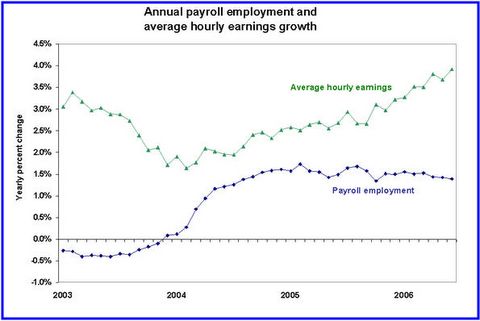


Summarizing, June's employment report added yet another month to a trend toward slower job growth that began earlier this year. The slowdown appears rooted in the same growth-dampening forces found in the overall economy, and in that sense, this cooling is likely to persist. While wages have accelerated of late, they are only now catching up to recent inflation rates, meaning workers' purchasing power is up only slightly (and still well below productivity growth). Moreover, the inherent lags in the employment/wage relationship suggest that, if the current slowdown in job growth continues, wage growth will also slow in coming months.
Given that conventional wisdom says the economy needs to create 150,000 jobs a month to keep up with the birth rate (the actual birth rate + immigration, not the BLS birth/death model we just talked about), what do you do if you are a government bureaucrat and you can not make those numbers even when you assume staggering numbers of jobs?

Chicago Fed to the Rescue

On June 2, 2006 Chicago Fed President Michael Moskow gave a speech on U.S. Economic Outlook and the Role of Inflation Inertia. Here is the key snip:

With overall population growth continuing to slow and labor force participation not expected to rise, we probably need to adjust our benchmarks for what level of employment growth is consistent with economic growth near potential and a steady unemployment rate. It used to be that increases in payroll employment that averaged 150,000 per month were consistent with flat unemployment. Now that number may be closer to 100,000.

Quite frankly it is absurd to suggest that a falling participation rate during an economic expansion is a normal state of affairs. That is just one of the reasons the stated unemployment rate is a total fabrication of reality.

Unemployment Numbers

Table A12 is a closer picture of reality but that too is probably off by some 10% government fudge factor (if not a lot more) which would put unemployment close to 10%.
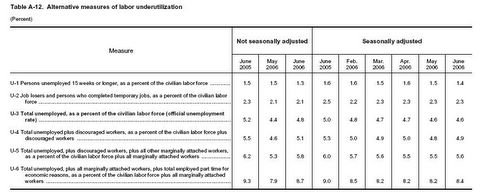


Notice the huge rise in both seasonally adjusted and seasonally unadjusted numbers on line U-6 (from 7.9% to 8.7% unadjusted, and from 8.2% to 8.4% adjusted). The former may have something to do with school vacations but the latter has not changed since March. The last seasonally adjusted change (February to March) was in the other direction.

Sentiment


Republican US House Representative Ron Paul is asking Why Are Americans So Angry?
I have been involved in politics for over 30 years and have never seen the American people so angry. It’s not unusual to sense a modest amount of outrage, but it seems the anger today is unusually intense and quite possibly worse than ever. It’s not easily explained, but I have some thoughts on this matter. Generally, anger and frustration among people are related to economic conditions; bread and butter issues. Yet today, according to government statistics, things are going well. We have low unemployment, low inflation, more homeowners than ever before, and abundant leisure with abundant luxuries. Even the poor have cell phones, televisions, and computers. Public school is free, and anyone can get free medical care at any emergency room in the country. Almost all taxes are paid by the top 50% of income earners. The lower 50% pay essentially no income taxes, yet general dissatisfaction and anger are commonplace. The old slogan “It’s the economy, stupid,” just doesn’t seem to explain things.

When people see a $600 million embassy being built in Baghdad, while funding for services here in the United States is hard to obtain, they become angry. They can’t understand why the money is being spent, especially when they are told by our government that we have no intention of remaining permanently in Iraq.

The bickering and anger will not subside soon, since victory in Iraq is not on the horizon and a change in policy is not likely either.

The neoconservative instigators of the war are angry at everyone: at the people who want to get out of Iraq; and especially at those prosecuting the war for not bombing more aggressively, sending in more troops, and expanding the war into Iran.

As our country becomes poorer due to the cost of the war, anger surely will escalate. Much of it will be justified.

It seems bizarre that it’s so unthinkable to change course if the current policy is failing. Our leaders are like a physician who makes a wrong diagnosis and prescribes the wrong medicine, but because of his ego can’t tell the patient he made a mistake. Instead he hopes the patient will get better on his own. But instead of improving, the patient gets worse from the medication wrongly prescribed. This would be abhorrent behavior in medicine, but tragically it is commonplace in politics.

If the truth is admitted, it would appear that the lives lost and the money spent have been in vain. Instead, more casualties must be sustained to prove a false premise. What a tragedy! If the truth is admitted, imagine the anger of all the families that already have suffered such a burden. That burden is softened when the families and the wounded are told their great sacrifice was worthy, and required to preserve our freedoms and our Constitution.

But no one is allowed to ask the obvious. How have the 2,500 plus deaths, and the 18,500 wounded, made us more free? What in the world does Iraq have to do with protecting our civil liberties here at home? What national security threat prompted America’s first pre-emptive war? How does our unilateral enforcement of UN resolutions enhance our freedoms?

These questions aren’t permitted. They are not politically correct. I agree that the truth hurts, and these questions are terribly hurtful to the families that have suffered so much. What a horrible thought it would be to find out the cause for which we fight is not quite so noble.

Yes Mr. Speaker, there is a lot of anger in this country. Much of it is justified; some of it is totally unnecessary and misdirected. The only thing that can lessen this anger is an informed public, a better understanding of economic principles, a rejection of foreign intervention, and a strict adherence to the constitutional rule of law. This will be difficult to achieve, but it’s not impossible and well worth the effort.
Mish notes:
  • Ron Paul is probably the only "True Conservative" in Congress.
  • He is a both a fiscal conservative and has opposed this war from the beginning.
  • Unlike some wishy-washy Democrats and Republicans flip-flopping depending on which way the wind was blowing, his views on this war have been consistently correct.
  • It is surprising he can be elected at any level. People with common sense seldom are.
  • I would vote for Ron Paul in one second flat for President.
  • Sad to say, he has as much chance as I do. (close to zero)
Please read that speech in its entirety. It will be time well spent.

As much as I agree with Ron Paul on the absolute stupidity of this war and the 1/2 Trillion dollars we have wasted on it (so far), I do not think that is the reason US citizens are angry. If the US economy was really booming and wages were rising in relation to costs people would feel good.

To me, Bush's 30% approval ratings (and the anger that Ron Paul sees) are a reflection on the Fed's failed attempt to reflate this economy. After three years of boom, with CEO pay skyrocketing, productivity soaring, real wages for the median worker are still falling. OK so Friday's numbers show a jump in wages at the tail end of a three year boom. That is too little, too late as we sail into the recession of 2007. If things deteriorate fast enough (a distinct possibility), that recession can start in 2006.

For many folks a recession has already started. Subtract total nonsense from the GDP and it would easily be two points lower as discussed in Grossly Distorted Procedures. Officially we will not recognize a recession until it is well underway and obvious to everyone.

Four Reasons People Are Angry
  1. People are angry because they majority of them are worse off than they were 4 years ago.
  2. People are angry because gasoline prices are rising faster than wages.
  3. People are angry because they are going deeper in debt and house prices have stopped rising.
  4. People are angry because they know deep down that they are being lied to by this administration about the CPI, about unemployment numbers, and about "the good times just around the corner" that somehow never seem to get much further than the top 15-20% of the population.
Would it be any different if Democrats were in charge? Probably not.

We might see a huge difference if someone like Ron Paul was in charge. At least he would lay it on straight about what is happening to the US dollar, government debt, the Fed, and a vast array of other problems as well. People need to hear his message but few do. Worse yet, most people do not even want to hear his message. They want to be told "good times are around the corner", there is a "free lunch", and other happy messages. Yet when those happy messages do not trickle down to the masses, the masses get angry. All of this makes Ron Paul unelectable (for president).

As it stands, we may as well not even have a Congress. All that matters to most of them is getting re-elected. To get re-elected they need contributions. This makes the bulk of Congress beholden to lobbyists and campaign contributions. The number of paid lobbyists is soaring and the amount they are being paid is soaring as well. Except for an isolated Ron Paul here or there, no one is looking out for the little guy. As it stands we may as well eliminate the middle man (Congress) and just elect lobbyists. They write the bills anyway.

Yes, the public is angry, but they really do not understand the root cause (fiscal irresponsibility of this administration and Congress), reckless foreign policy, and loose monetary policy by the Fed. Unfortunately there is little impetus for real change. People will elect representatives that offer a "free lunch".

The sad state of affairs is that everyone wants a "free lunch" for themselves (or their district) while insisting everyone else to pay "their fair share". As it stands, the "you scratch my back I'll scratch yours" pork barrel politics of elected officials beholden to lobbyists ensures we keep building bridges to nowhere that benefit no one but their corporate sponsors.

Yes, Ron Paul there is indeed anger but sad to say, stupid decisions like Iraq would be overlooked if there was some trickle down in benefits to the masses. There has not been that trickle down, and we are cruising for a long and hard recession led by a decline in consumer spending and housing, accompanied by mass layoffs in those sectors.

That is what Bush's numbers suggest, that is what the public senses, and that is what this anger is all about. Strike Three.

Mike Shedlock / Mish
http://globaleconomicanalysis.blogspot.com/

Sunday, July 9, 2006

Sideline Cash Myth

John Hussman is writing There's No Such Thing as Idle Cash on the Sidelines.

I am a big fan of Hussman.
That said, it seems to me he took multiple paragraphs to state the obvious.

The simple reason there is no such thing as "sideline cash" is as follows:
For every buyer there is a seller so the net result will almost always be cash on the sidelines.

Think about it. If there is $1B in sideline cash and that buyer buys, the seller will be sitting on exactly $1B in sideline cash.

There are exceptions to this of course, otherwise sideline cash would be a constant.
Those exceptions are IPOs (it takes real cash to buy an IPO), and corporate profits (profits sit as sideline cash until they are invested for expansions or mergers).

Let's go one further and look at why corporations are sitting on accumulated cash. The obvious answer it is because they recognize that expansion is NOT worth the risk.

Why expand into a slowdown? The fact that corporations are sitting on record amounts of cash is a BEARISH outlook not a positive outlook.

No doubt the permabulls would suggest that LOW cash positions were bullish for the very reasons I just stated. Now they are suggesting the exact opposite.

Given that there is a buyer for every seller (except for IPOs which would require real cash), buying and selling of stocks is net neutral. The amount sold will be equal to the amount bought.

The fact that corporations are willing to use cash to buy back shares rather than expand is a net negative. There is nothing positive about it at all. Take the homebuilders for example. They have been recklessly repurchasing shares rather than attempting to expand. They are supporting Earnings Per Share but to the detriment of their balance sheet. By recklessly, I am referring to share repurchases rather than the unwillingness to expand. Quite simply it is a waste of shareholder money to either expand or to repurchase shares at this point in time. In the meantime homebuilder insiders are (and have been) bailing out left and right.

In that light tell me how "sideline cash" is of any use (except for the insiders bailing out all the way down).

More to the point, if someone can tell me why corporations would want to expand into an obvious recession, I want to hear it.

Please consider MMM.


If you want one company that is best in class and perhaps best in the world that might be it. They just warned leaving an "island reversal" in its wake.

Is that a good sign?

Forget about "sideline cash" except as a corporate "time preference" that says cash is worth more than expansion. To the extent that cash is accumulating, that is a net negative. To the extent that corporations are buying back shares while insiders are bailing, that is a net negative.

Simply put, this sideline cash story is a total bunch of nonsense no matter how one looks at it.

Mike Shedlock / Mish
http://globaleconomicanalysis.blogspot.com/

Wednesday, July 5, 2006

23 Skidoo

Is this a rerun of the 70's and 80's?
Most seem to think so as the word on everyone's mind is "stagflation".
In Flationed Out I dismissed stagflation from an Austrian perspective but let's look at things from a then vs. now perspective to see what the similarities and differences are.

This is a practical exercise as opposed to a monetary exercise.

Similarities
  1. War in Vietnam war then vs. the war in Iraq now
  2. Rising oil and commodity prices
  3. Fed trying to crush inflation
  4. Rising interest rates
  5. Oil shock
  6. Social mood
Puplava made a case for similarities in Historical Rhythms and perhaps you can find some items to add to that list.

Differences
  1. Spiraling wages then vs. declining wages now
  2. Wage and price controls
  3. Debt levels
  4. Housing down payments
  5. Two family incomes
  6. The power of unions
  7. Pricing power of manufacturers
  8. Globalization
  9. Outsourcing
  10. Productivity
  11. The internet
  12. Wealth concentration
  13. Fighting the last war
  14. Oil shock
  15. Declining credit standards
  16. Downfall of communism
Rising commodity prices and a "guns and butter economy" are of course the most common parallels. Unfortunately most seem to stop right there and say "Yes, this is a rerun" without even bothering to look for differences. The differences noted above are staggering.

Are there any threats of "wage controls"? How many times did Snow tell us that rising wages were just around the corner? Flashback: My first job out of college was as a computer programmer for Chicago Title followed by another job at Harris Bank. Ten percent raises back then were common. Tack on another six percent for promotions. Seriously when was the last time "common folk" got a 16% raise?

In the seventies it took a single wage earner to support the family. If that person lost his or her job the other could get a temporary job and hope to make up some of the difference. Now both partners work and if EITHER of them has a problem (loss of income) there are enormous implications.

In the seventies you had to put 20% down on a house and prove where you got that down payment. Now you can put down a negative 15% (borrowing the down payment and then more to furnish the place) with few problems.

Unions in the seventies had enormous power compared to today. Defined benefit plans were the standard then. GM, FORD, IBM, CAT, and others are doing everything in their power now to scrap them.

Was there an internet in the seventies? How about global wage arbitrage? How about outsourcing manufacturing? How about outsourcing R&D? How about shipping X-rays over the internet to India for diagnosis for treatment to take place in the US?

What about productivity? China is now actually losing manufacturing jobs because of increased productivity.

Yes we had an oil shock in the seventies. That oil shock was caused by an embargo. The oil shock now is caused by peak oil. Is there a difference? Yes there is: In the former wages rose to meet rising costs. Are wages rising now because of peak oil? I think not. That is why I have "oil shock" in both columns.

The downfall of communism is an interesting item. We pressured Russia and China and other place to "do as we do" and support the freedom of capitalism. How odd is it that we are fighting more with China than ever before since they have embarked on free market policies? Yes we get cheap goods, but the result is we lose jobs. No longer can the US get the best of both worlds and we simply do not like that fact. Like it or not, outsourcing has NOT come to its logical conclusion. That means pressures on wages we did not see in the seventies will remain in play for quite some time.

The Gold Standard

Quite simply I do not know how to categorize this one. Yet I feel it is extremely important. Of course I am talking about the Gold Standard.

It was not the gold standard that was removed by Nixon, rather it was the 'gold exchange standard'. Only foreign central banks were allowed to demand gold for their dollars. In exchange they all agreed to keep dollars as their main reserve asset and agreed to the IMF rule that forbade IMF member nations to introduce a gold standard. This leads us to an important difference for US citizens. In the first half of the 70's owning gold was illegal for private citizens of the US (one of the worst scandals that remained as a legacy of FDR, aside from the welfare/warfare state).

The 'closing of the 'gold window' was a major factor in destroying the dollar's credibility in the period, thus dollar based prices (and eventually prices in all other fiat currencies) began a sharp rise, so oil was subject to a double whammy if you will. As of now, private citizens can at least guard against the coming debacle by owning gold outright.

Inflation Targeting

BC on Silicon Investor had these thoughts as well as a question that I want to share:
The trouble with targeting inflation or price levels with interest rates is that interest rates shift both aggregate demand and aggregate supply in the same direction simultaneously. Lower interest rates stimulate demand by increasing debt-based consumption, but they also stimulate supply by encouraging investment. Higher rates stifle demand, but also supply by cutting back on investment in factories and equipment.

Perhaps this is obvious, but for some reason I never see it stated. If one wants to control prices, one needs a lever that shifts one or the other, not both. The real problem with this present system is in guessing which factor of price is going to dominate. I guess you could tie it into Kondratieff here. In the first three K-seasons, debt is low enough that the demand-side pull on pricing dominates. Lower rates result in higher prices and higher rates in lower prices. However, when debt levels become unsustainably high and K-winter takes over, demand becomes relatively inelastic and unresponsive to shifts in interest rates. However, supply still responds via increased investment when rates are lowered. So, lower interest rates no longer support higher prices in K-winter. In fact, they make prices decline by boosting supply in the face of inelastic aggregate demand.

Why am I so alone in seeing this? Shouldn't the PhDs spending their days pondering this stuff have come to this conclusion long ago?

BC
23 Skidoo

BC that was a very good point, but all you are really doing is stating in a roundabout way that the Fed is forever chasing its own tail. The Fed can NEVER reach the natural interest rate as its rate manipulation itself constantly shifts this natural level. The lagging effect of their actions ensures they will miss the obvious.

You are not the first with this idea. However, what is new is the attempt to tie this into the K-cycle. As much as I am in favor of those cycles, the evidence suggests that K-cycles are NOT 'natural events' but rather very long term cycles created by interventionism of the Fed and governments. In short, inflationist policies work until they blow sky high. That time is here which of course means that everyone playing "That seventies show" reruns is going to instead see a rerun of the "23 skidoo small change" scenario.

Please remember the Fed always fights to the death the last major battle. The battle they should be fighting is the one before the last. The last major battle was against inflation in the seventies and eighties. Fighting the last minor battle (against deflation) in 2003 created the largest property bubble in the history of mankind as a result. It also sealed the Fed’s fate. What we see now is more like 1929 than 1979 and the differences noted above prove it.

Mike Shedlock / Mish
http://globaleconomicanalysis.blogspot.com/