Pages

Thursday, June 22, 2006

Martin County to Lennar: Fix the problems, or get out and don't come back

The Palm Beach post is reporting Martin officials rap Lennar over homeowner gripes.
STUART — After weeks of hearing homeowners complain about mold, leaky roofing tiles and shoddy workmanship, Martin County officials have had enough.

The county has told a national home builder to prove its homes meet county standards, fix the problems, or get out and don't come back.

"These horror stories just keep getting worse," said County Commission Chairman Susan Valliere after residents complained Tuesday of problems with homes built by the Miami-based Lennar Corp. "This is really getting upsetting."

Mike Morgan, a Stuart real estate agent, has been complaining to the commission for weeks about faulty electrical wiring, stucco wall and roof problems caused by shoddy building on Lennar's homes in the Martin's Crossing subdivision on Kanner Highway. On Tuesday, Morgan brought the five homeowners to the commission meeting and said he plans to bring 20 to the next meeting to voice their complaints.

"It's been a nightmare," said Rick Scimeca, who said his house has had problems with leaking roof tiles. Scimeca also said his neighbor had a plumbing leak that caused mildew inside her walls. "It's a brand-new house. These things shouldn't happen."

County Building Official Larry Massing met with Lennar officials on Tuesday about the homeowners allegations. Massing said he is requiring the company to inspect the homes with him present and to send him all its reports on roofing tiles, stucco and electrical wiring used in the homes. The county will require Lennar to do more inspections later.

"If I feel Lennar is not doing everything necessary, you'll be the first to know," Massing told the commissioners.

Mark Sustana, general counsel for Lennar, said the company has agreed to have Massing, an inspector hired by Lennar and a private inspector check the electrical wiring on several randomly selected homes at the same time on Friday.

But commissioners were so upset by the homeowner complaints that they suggested going further, such as banning Lennar from building new homes in the county.

"If their workmanship is shoddy, maybe we shouldn't allow them to work here," said Commissioner Michael DiTerlizzi.

Commissioner Sarah Heard also suggested shutting down Lennar's Martin County projects.

"I've heard enough," Heard said. "I think we should suspend operations out there and have them solely focus on bringing houses up to code."

Commissioner Lee Weberman said that if it turns out Lennar's workmanship is poor, he would support revoking its license to do business in the county.
By the way, I briefly spoke with Mike Morgan today and the intent is to take this forward, county by county. If that happens Lennar's problems have just begun.

With thanks to Highfructose on the Motley Fool here are Lennar's cash positions for the Febuary quarter endings from 2002-2006

Quarters ending February; cash in 000

2006 112,030
2005 509,068
2004 545,522
2003 500,227
2002 483,573

Got a little cash flow problem have we?
Sure seems like it to me.
I suspect this is not just a Lennar problem either.
All along many homebuilders have been meeting earnings targets by buying back shares at bloated prices. If cash flow problems have finally started to matter, then look for that "buyback support" to drop dramatically.

In the interest of fair disclosure I am not currently short Lennar or for that matter any other homebuilder. For technical reasons I played for a bounce that did not happen and have watched all of them just keep on sinking. Besides I was mainly short WCI anyway (not Lennar). My interest is in fair reporting and if Lennar wants to answer some questions and give me their point of view I will post it. Of course I reserve the right to buy or short Lennar at any time but I do not want anyone to think I am picking on Lennar or any other homebuilder because I am an "evil short".

Let me say however that "shorts" or "bad reporting" are not Lennar's big problem. The problem with homebuilders in general was overexpansion and greed and poor quality. It happens every cycle. Builders build because that's what they do.

They will keep building until they go broke. Many continued to buy land at insane prices (or options on land at insane prices), and are now struggling to get rid of it. A private company can close shop and scale down, but a public company builds until it goes bust (with the CEO cashing out stock options all the way down).

Given that none of the public companies pay dividends there was never any reason other than the greater fool theory to own any of them anyway. Seriously think about that. In fact, think about that in general as opposed to a statement about homebuilders. After the final crash takes place the companies remaining will probably all be paying huge dividends. That will be the time to look for growth, not now.

In the meantime please consider this silly question: Are Sickly Newspaper Revenues Behind Attacks On The Real Estate Industry?
Newspaper advertising doesn't work, according to many Realtors, so they've been putting their advertising dollars elsewhere, creating a slow drain on the revenues of newspapers across the country. Could falling revenues be behind recent large-scale newspaper editorial attacks on the real estate industry?

"From personal experience, I never get phone calls from classified ads on real estate for sale. It is a waste of money so I quit it," says Realtor Bill Barnes, Lake Havasu City, Arizona. "What works is an MLS listing. And 85 percent of homes sell through Realtors. It's free to a potential buyer, and buyers want to have an experienced person handle their transaction."

In recent months, the number of negative stories against the real estate industry has been staggering. From real estate commissions to the alleged real estate bubble to high home prices, the media has steadily given residential real estate, its practitioners, and its investors a hard time.

What's the reason behind the negative focus on residential real estate? Some believe it could be a power play to get more agents and/or for-sale-by-owners to buy ads since many former customers say they no longer buy ads, and they realize newspapers aren't their friends.

Recently, Tribune Company (owner of The Los Angeles Times and Chicago Tribune, among others) acquired ForSaleByOwner.com, causing many agents to assume that newspapers are drawing their line in the sand -- against agents. Tribune is also part of a cartel that owns Classified Ventures which recently purchased HomeGain, a company that "matches" homebuyers and sellers with agents willing to compete using their commissions.

Says Denver, Colorado, broker Judith Clausen, "I stopped advertising in newspapers about two years ago. I figured they were after us."
If ever I saw a bunch of self serving, bury your head in the sand, collection of total nonsense that was it.

It make me want to scream "Look you morons just what is it you do not understand about this housing bubble? Real wages are falling, prices relative to wages are four to five standard deviations above the norm (a good indication of a bubble), and you complain about reporting that for the most part has been favorable. Now please crawl back under your rock, listen to your top cheerleader Lereah (who will be totally disgraced before all is said and done), ignore the quality problems at Lennar and other places as if they do not exist, and go on pretending you are an ostrich".

That's what I want to say but the ostriches have their collective heads so deeply buried in the sand they could not possibly hear me no matter how loudly I scream.

The Chicago Tribune is part of a "cartel" against the industry. What a bunch of total nonsense. A note to ostriches everywhere: Your misery has just started. Wait until the MLS system collapses which it should and will do because of market forces, not because of an evil cartel.

Mike Shedlock / Mish
http://globaleconomicanalysis.blogspot.com/

Prominent homebuilders failing to pay subcontractors

The Arizona Republic is reporting Firm is failing to pay its carpenters. A closer look at the article shows that subcontractors are not paying workers because the subs are not being paid by the homebuilders. Let's take a look:
More than 100 workers at a Scottsdale construction framing company haven't been paid in several weeks, and that has Latino community advocates concerned that some employers are taking advantage of workers.

Veemac Framing Corp., a subcontractor for some of the Valley's top home builders, acknowledged that it has not paid the workers, who are owed three to five weeks of back pay.

Company officials blamed a financial dispute with two home builders and a third company that is hindering its cash flow. Veemac said it would pay the workers as soon as the dispute is worked out.

"We don't want to see this become contagious," said Alfredo Gutiérrez, a talk show host at Radio Campesina and former state legislator, who has taken up the workers' cause. "If you're in business, you're in business. Your first obligation is to pay your workers."

John Vergopia, Veemac's chairman and chief executive officer, referred questions to a company attorney.

The attorney, Greg Eagleburger, said the company plans to pay the workers as soon as it negotiates payment from two of its customers, U.S. Home and Richmond American Homes.

"It's only a delay," he said. "As soon as we are paid by our customers, we will continue to pay our workers, who we feel are the best."

The firm does subcontracting for some of the Valley's largest home builders, including Toll Brothers and U.S. Home, which is owned by Lennar Corp.

Several Veemac workers said they don't plan to return to the company and just want their money.

"We worked for promises," said Arturo Botello, a foreman who said he is owed five weeks of back pay. "They kept telling us they would pay us, so we kept showing up."

Others said they were unsure whether they would continue working, although most said they had stopped working for the company two weeks ago.

Botello added that he was not reimbursed for gas he put in company trucks nor for water and ice he bought his crews.

Under state law, employers are required to pay employees at least twice a month. But the State Labor Department has no ability to levy penalties if employers don't comply. It can only refer cases to prosecuting agencies.
Well how about that? It seems a subsidiary of Lennar is not paying its bills. If this is a quality or performance issue then it reflects on the quality of Lennar homes. On the other hand if this is a cash flow issue it speaks for bigger issues with the homebuilder itself. Without knowing how U.S. Home is structured it is entirely possible that Lennar is financially sheltered from responsibility but if they play that card, what would it say for the integrity of Lennar? With all of Lennar's other problems, including the lawsuit against Mike Morgan, I am somewhat surprised they would let something like this get out of hand.

The other company mentioned in the Arizona Republic article was Richmond American Homes.
MDC, whose subsidiaries build homes under the name "Richmond American Homes," is one of the largest homebuilders in the United States. The Company also provides mortgage financing, primarily for MDC's homebuyers, through its wholly owned subsidiary HomeAmerican Mortgage Corporation. MDC is a major regional homebuilder with a significant presence in some of the country's best housing markets. The Company is the largest homebuilder in Colorado; among the top five homebuilders in Northern Virginia, suburban Maryland, Jacksonville, Phoenix, Tucson, Las Vegas and Salt Lake City; and among the top ten homebuilders in Northern California and Southern California. MDC also has established operating divisions in West Florida, Philadelphia/Delaware Valley, Chicago, Dallas/Fort Worth and Houston.
Looking at that profile we see Richmond American Homes is the largest homebuilder is the biggest homebuilder in the state with the most foreclosures (Colorado), and we see extensive operations in many other bubble areas.

I have two questions for MDC and Lennar:
  1. Are you having a little cash flow problem?
  2. How much did you overpay for land or options in Phoenix, Las Vegas, and California?
By the way, is there such a thing as a "little cash flow problem"?

I will be on Charles Goyette Show 1100am KFNX News Talk Radio tomorrow at 6:00 AM (Pacific Time)to talk about various nonpayment issues such as this one, as well as Litigation Nightmare & Heartbreak Hotel.

You may also wish to tune into Wednesday's podcast on HoweStreet about Heartbreak Hotel, gold, the stock market, international housing and other things.

Jack McCabe of McCabe Research & Consulting will be on CNBC this Thursday evening at 8:00 PM Eastern to discuss housing in Florida. It seems things are starting to get quite interesting.

Mike Shedlock / Mish
http://globaleconomicanalysis.blogspot.com/

Wednesday, June 21, 2006

Litigation Nightmare & Heartbreak Hotel

I recently called Jack McCabe of McCabe Research & Consulting for an update on Florida housing. McCabe told me he is now bracing for a "Litigation Nightmare" over the next several years in the wake of the housing bust. Following are some of the items we discussed.

Litigation Items
  1. Buyers suing developers for non-performance
  2. Developers suing speculators for flipping properties in violation of contracts
  3. Subcontractors suing developers for non-payment
  4. Subcontractors suing general contractors for non-payment
  5. Class action lawsuits against single family homebuilders and condo developers for faulty roofing, HVAC, electrical, and plumbing systems
  6. Lawsuits against inspectors for not catching code violations
  7. Condo boards and individual homeowners suing developers for shoddy work
  8. Lawsuits against appraisers for inflated values
  9. Lawsuits against banks when project fundings are halted
  10. Lawsuits over completed condo units being substantially different in size, interior finishings, and quality than how they were represented pre-construction
  11. Lawsuits by anyone and everyone against anyone and everyone over various fraud allegations
  12. Of course we can’t forget countersuits by anyone and everyone against anyone and everyone over anything and everything
I think those 12 points pretty much sums it all up.

McCabe is telling me that speculators have totally vanished from the market which of course means there has been an enormous shift in the supply vs. demand ratio. To make matters worse, there are “approximately 25,000 condo units currently under construction in Miami-Dade County alone. Another 25,000 condo units have received building permits and about 50,000 more units have been announced.”

Financing has now dried up, but those 25,000 units under construction will likely be completed along with 75%-80% of the units with valid building permits. The vast majority of unapproved but announced projects will be cancelled. Even so, “the completion of 75,000 units or so could make for a 5-10 year supply of condos at a normal sales rates, and sales rates are far below normal.”

In addition, McCabe is expecting to see a "sharp increase" in prosecutions for mortgage and real estate fraud as well. Indeed bubbles have a way of exposing all kinds of fraud that people happily ignored as long as prices were rising. When the party ends, the lawsuits begin (and you can quote me on that one). We saw the same thing when the dot-com bubble burst. We will see it again over housing. “We are going to find a tremendous amount of abuses associated with this boom and the fallout will not be in the millions of dollars either. It will be in the billions”.

It's Not Just Florida

“What is happening in Florida, can and will happen in other markets such as Washington, DC, Las Vegas, San Diego, Phoenix and many other bubble markets with rising inventory.” said McCabe.

I am sure of that and I am sure McCabe is correct about the "Litigation Nightmare" as well.

Foreclosures Jump

In another nightmare of sorts, the Associated Press is reporting Foreclosures May Jump As ARMs Reset.
As more hybrid adjustable rate mortgages adjust upward and housing prices dip, many Americans can't refinance out of this squeeze. They are finding themselves trapped in too-high monthly payments, and some face foreclosures.

In the last several years, millions of Americans took equity out of their houses and refinanced when interest rates were at historical lows and housing prices were at record highs.

Many of them chose to refinance into hybrid ARMs that lenders were aggressively pushing. ARMs, which featured a low introductory interest rate that resets upward after a set period of time, were easier to qualify for than traditional fixed-rate loans.

ARMs are now starting to fall by the wayside as the difference in interest rates narrows. The average rate on a 30-year fixed rate loan in May was 6.60 percent compared to 5.63 percent on a one-year ARM, according to Freddie Mac. In 2003, rates on a 30-year fixed were at 6.54 percent, while ARMs carried a 3.76 percent rate.

This year, more than $300 billion worth of hybrid ARMs will readjust for the first time. That number will jump to approximately $1 trillion in 2007, according to the MBA. Monthly payments will leap too, many beyond what homeowners can afford.

"ARMs are a ticking time bomb," said Brad Geisen, president and chief executive of property tracker Foreclosure.com. "Through 2006 and 2007, I'm pretty sure we'll see a high volume of foreclosures."

Last year, foreclosures hit a historical low nationwide at about 50,000. But that number has more than doubled since then, according to Foreclosure.com.

And delinquency rates appear to be rising, as well. While delinquency rates fell for most types of loans from the fourth quarter of 2005 because of a stronger economy, delinquencies for both prime and subprime ARM loans increased year-over-year in the first quarter, according to the MBA.
A Mish Sing Along

Notice that the ARM time bomb is just now going off. The explosion will be over three times as big in 2007 with over one trillion dollars in loans resetting to much higher rates. Yet merrily we roll along with more and more rate hikes. On that note please sing along with Ben.


NAHB Sales Data

The National Association of Homebuilders released new data for 2006 on June 19th. Following are two charts from that release with colored highlights in red added by me.


Those charts show we are clearly rolling downhill as opposed to "merrily o'er the deep blue sea", but don't blame me I am just singing along with Bernanke.

Homebuilder Sentiment

Speaking on homebuilder sentiment NAHB President David Pressly and homebuilder from Statesville, North Carolina had this to say: “Looking at today’s numbers, it’s important to keep one thing in perspective. The HMI is a measure of builder sentiment – and attitudes may vary by a greater degree than actual market activity.”

Clearly David Pressly is singing a different tune.
Sales are falling off a cliff and traffic is back to 1990 levels. Talk about Denial.
Hmmm. That title sounds right but let's face it. Those lyrics totally suck.

With traffic crashing, inventories soaring, holding costs jumping, Bernanke hiking, rates resetting, and an economy slowing, it is very unlikely that stubborn sellers can hold on for their price much longer. Indeed some unfortunate KBH renters have had to return their "hotel keys" much sooner than expected. We now switch from David Pressly to Elvis Presley. What a difference in quality.

Heartbreak Hotel

The Denver Post is reporting Heartbreak along Mockingbird Lane .
Margie Ibarra worried about paying $160,500 for half a duplex. She knew she was buying it with no money down and a pair of home loans, one carrying a double-digit interest rate.

But she dreamed of spending her life on a peaceful street at the edge of Brighton - and of owning 710 Mockingbird Lane free and clear when she retired.

Instead, two years after she moved in, she lost the first home she ever bought to a foreclosure.

"I took the keys with me. I made sure the door was locked and the windows were shut. I cried when I was leaving. I loved my little townhouse," she said.

These are troubled times on Mockingbird Lane.

Mockingbird Lane curls beside a floodplain on the eastern bank of the South Platte River, land Brighton initially zoned for manufactured housing. Then a national builder, KB Home, showed up with a grander vision in the late 1990s: a community of 556 affordable homes along streets named for songbirds and waterfowl.

On Mockingbird Lane, many who moved into homes designed for first-time buyers put little or no money down. KB offered easy financing. So did other lenders.

Jim Spray, a Colorado mortgage broker who battled predatory lending practices, and his wife, Linda, a Realtor, reviewed foreclosures on Mockingbird Lane and Street at the request of The Denver Post.

They say they saw minimal down payments, and also refinancing loans, that left homeowners owing more than their homes were worth.

At foreclosure, some buyers owed $20,000 to $30,000 more than their original purchase price. "That's a killer," Linda Spray said.

Jim Spray hopes the new law will help.

But he worries what will happen when existing loans, especially "these 80-20s with no money down," kick into their adjustable- rate phases.

"We could well see another spike in foreclosures," he said. "It's nowhere near over."

In six years, lenders have foreclosed on 59 homes at Welby Hill, a condominium complex near Thornton, and 50 homes at View Point Condominiums in Thornton. On Mockingbird Lane and nearby streets where foreclosures are rampant, the homes are duplexes.

Since 1995, Adams County foreclosures have grown nearly eightfold, reaching a record 3,281 last year. This year the county is on pace to exceed 4,000.

Every one lands on the desk of Jeannie Reeser, the Adams County public trustee, who spends her days signing foreclosure papers.

"I want to be No. 1 in something different," she said. "There's a tragedy in every one of these files. I've had grown men cry on my shoulders, and there's nothing I can do."

On Mockingbird Lane and Mockingbird Street, records of 23 foreclosures - all of which were half a duplex - around a two- block loop show Ibarra's financing terms were not so unusual.

"I ended up getting a divorce, and I couldn't afford my house anymore," said Danielle Williams, who had two boys, a girl and no income after her husband moved out. She lost her home at 785 Mockingbird St. one year after they bought it.

Marilyn Sisti, the first of two homeowners foreclosed at 727 Mockingbird St., said she had a high-interest mortgage loan and lost her job. Her variable interest rate started at 10.4 percent and could have surpassed 16 percent.

Ernesto Rodriguez, who lost the house at 722 Mockingbird Lane, said he simply couldn't keep up with $1,400-a-month payments. He realized, too late, what a high price he paid: $161,900 for a house auctioned at $130,000 and later sold for $145,000.

KB Home representatives talked of a fishing lake "and a little swim beach," Langan recalled. They promised to fix any problems she found. They made borrowing easy. The builder had its own mortgage branch.

"So you don't even have to find a lender," she said they told her. "We'll take care of that."

She bought half a duplex in 2000 for $136,000. She said she put $6,000 down for the home, at 801 Mockingbird St., and borrowed the rest from KB Home's mortgage arm, which later sold the loan.

From the day she moved in, she said, her brand-new home had problems. Windows leaked. A drain spout laid a sheet of ice on her sidewalk. In her bedroom, she could hear the couple on the other side using the bathroom. They told her they could hear her snore.

"It was like living together," she said. "I could hear more than I ever wanted to hear."

Tom Dory, another resident who may sell, shares their concern.

"It's not going to be easy to dump," he said of the home he bought six years ago. "My son's a real estate agent. He even told me that. These things don't move very well."
The big question now on my mind is this: Is the above situation more like Heartbreak Hotel or Hotel California? I am discarding Mockingbird Hill for obvious reasons. Before voting please consider the following.

In Hotel California "You can check out any time you like but you can never leave".
In Hotel KBH on Mockingbird Lane "You can check in any time you like but you can never stay".

While singing along with Big Ben's Band please cast your ballots.
Write-Ins are allowed.

Mike Shedlock / Mish
http://globaleconomicanalysis.blogspot.com/

Home Builder Reviews

It is hard to get a descriptive title into a short line. I am not giving home builder reviews, but rather asking for them. More specifically, Mike Morgan at MorganFlorida is asking for them. The following is from Morgan.

Our new website was launched today: Builder Reviews
We will be adding to this site “daily.” Right now, my two assistants and I are overwhelmed with the number of responses we have received. I need a few days to catch up, but watch this site for up to the minute information about Lennar homes throughout the United States.

Last week we were contacted by a national class action litigation firm. Yesterday we were contacted by an insurance industry executive. The insurance industry executive found us. That’s six months ahead of schedule for my plans. Our goal is to stop the builders that are getting away with selling defective homes. The only ones with the resources needed to fight the builders, are the insurance executives. You’re going to see some very amazing things over the next two years.

What will a national builder say on a conference call, when the insurance industry refuses to insure their homes?

We’re moving forward with plans to take a Lennar home apart. We will be using an internationally recognized forensic engineering company, and every phase of the process will be documented by an investigative reporter for national broadcast. Stay tuned.

Mike
Here is a snip from Morgan's new website.
Southern California – I bought a home from Lennar at the end of October 2005. Since then it has been a living hell. Multiple water leaks and months to repair because they are too busy building other homes next door. They used green lumber that results in severely bowed walls, ceilings, doorways. So bad they moved me out for 2 weeks (me, wife, and 3 little girls-- oh yea 3800 in food and lodging that I had to front) they could try and fix it. When they opened the walls up to try and square things up they realized the entire house was sub standard work with studs that were split, twisted, bashed, splintered, uneven, moldy, and even broken in truss areas. They rushed to cover things back up as fast as possible, lied to my face about the repair to the framework. They have damaged my front yard concrete work, damaged my wood floors, terrible job even on the 2nd and 3rd attempts to correct. Now their answer is to move me out again, and again, until things are ok with me. Nearly 8 months later and I have yet to enjoy a finished product. Windows don't close right, my garage door literally crunched like a beer can under it's own operation, I have cracks in the foundation, stucco cracks like spider webs, etc. I am sending the photos I have, they are not much but surely capture the "un-workman like" fashion that these corner cutters produced. (Received from Lennar Home Owner - Posted June 20, 2006)
Mike Morgan encourages you to send your Lennar (and other homebuilder) experiences both good and bad to Reviews@BuilderReviews.org. Note: this post from Morgan is the perfect lead in to something I have been working on with Jack McCabe of McCabe Research & Consulting on litigations. Class actions lawsuits are just the beginning of a "Litigation Nightmare". Please stay tuned.

Mike Shedlock / Mish
http://globaleconomicanalysis.blogspot.com/

Tuesday, June 20, 2006

Flationed Out

I have been pondering the word "stagflation". Judging from the stock boards I post on, a vast majority seems to think we are in it or headed for it. What exactly does stagflation mean anyway?

Let's take a look at two definitions and a comment from dictionary.com.
  1. "Sluggish economic growth coupled with a high rate of inflation and unemployment."
  2. "A condition of slow economic growth and relatively high unemployment - a time of stagnation - accompanied by a rise in prices, or inflation."
  3. "Investopedia Commentary: Stagflation occurs when the economy isn't growing but prices are - not a good situation for a country to be in. This happened to a great extent during the 1970s, when world oil prices rose dramatically, fueling sharp inflation in developed countries. For these countries, including the U.S., the effects of inflation were considerably made worse because of this stagnation."
From above context, stagflation seems to be based on rising prices (instead of an expansion of credit), and furthermore the term seems to imply that rising prices are bad only in context of the "stag".

An Austrian View of "Flation"

Inflation - Expansion of money and credit
Deflation - Contraction of money and credit
Disinflation - Expansion of money and credit but at a declining pace
Hyperinflation - Rapid rise in inflation accompanied by a complete loss of confidence in currency

In Austrian terms I find little use for such a term.
Where exactly does it fit in?

Several days ago I sent an article that called for "stagflation" to a good friend of mine who posts under the name "Trotsky" on Kitco. We had not discussed that term before but knowing his Austrian leanings, his answer did not surprise me at all. It is as follows. Note: he does not capitalize his sentences and this is a verbatim quote.
what immediately comes to mind is that the term was coined with a Keynesian mindset - as if it were a new phenomenon that sort of 'just happens' without a sensible explanation at hand. at the time of the 1970's K-summer economists had been conditioned to associate economic downturns with deflation - the inflationary recession of the early 1920's was long forgotten. when suddenly recession coincided with the effects of the concurrent inflationary monetary policy becoming highly visible something happened that wasn't supposed to happen. so they thought it required a new term - 'stagflation' equaling recession cum inflation, the supposedly 'unnatural' state of affairs. obviously once you define inflation correctly (expansion of the fiat money supply) such a term makes no sense. especially considering that the Keynesian (as well as monetarist i might add) recipe for 'combating economic downturns' consists of deficit spending cum monetization, i.e. printing lots of money, as a matter of course!. perversely, application of this recipe leads only to bigger failures (proven by EVERY major application of it, including imo the most recent one, which only created yet another surge in malinvestment, namely the housing bubble).

the only reason why at times the inflation seemingly 'works' and at other times doesn't, is that the initial conditions, as defined by the K-seasons vary. imo there are two aspects that play a role - the state of the pool of real funding (if it is shrinking, no amount of monetary pumping can even create the illusion of a new boom - that's Japan from '89 onward) and the size of the private sector debt extant at the conclusion of the last boom.

note that the term 'boom' is actually a negative term, or should be. during the boom, which is itself a result of lax monetary policy , capital is malinvested and the economy's production structure damaged/distorted. the bust is the economy's attempt at RECTIFYING the mistakes of the boom by liquidating malinvested capital and redirecting those resources to their optimal use (usually that entails the realization that assumptions about future demand were simply wrong, as they are based on the illusion created by the credit expansion).

anyway, the rarer condition of deflation as we understand it in the context of the fiat system is simply a credit contraction so massive that it overwhelms the countervailing attempts of the CB to inflate. one must not forget the credit was largely created from thin air - in a deflation it simply goes back there.

in any event, ultimately 'stagflation' does not describe anything really...even though we know what it is meant to describe. simply put, it's the type of bust where the usual inflationary policy is noticed by everybody because prices and wages start to rise everywhere (because the debtberg is still able to expand further).
An Austrian Debate

Actually I think the origin is probably far simpler. Someone wanted to talk about "stagnation" and accidentally said "stagflation" or perhaps said "stagflation" purposely trying to be cute. In any case, the word stuck but as Trotsky pointed out, the word makes no real sense from an Austrian point of view, yet it is only from the Austrian point of view that I wish to debate anyone on inflation.

That last sentence is key and it has caused a lot of frustration recently. In addition, I keep responding to the same questions over and over again from emails and replies to blogs, many from people that do not know (or refuse to accept) what inflation is. In other cases people are just now finding my blog and just happen to be asking a question I have addressed elsewhere a dozen times. Here are some of the typical questions:

"Mish doesn't the rise in the price of oil prove you are wrong?"
"Mish you still haven't explained how we can have a falling US$ and deflation"
"Mish the US is not Japan"
"Mish how is your favorable view of gold consistent with deflation"?
"Mish isn't it about time for you to throw in the towel?"
"Mish inflation is our past present and future"
and so on and so forth with no one adding anything to the debate.

One of the problems I face is that people want to be a part of the debate, even though they refuse to accept the terms of the debate. Austrians in general would accept the "Flation" definitions above (or something reasonably close) others do not. Unless parties agree on definitions, however, there can be no meaningful debate. People keep telling me I am wrong when they do not agree to the terms of the debate.

Following are three people whom I believe do agree with those "Flation" terms as defined above.
  1. Marc Faber
  2. Steve Saville
  3. Robert Blumen
Note that I said they agree with those definitions. All of them disagree with my position. Taking the other side of a debate with Faber is dangerous, but we agree on far more things than we disagree about. Faber also admits deflation is possible (even if unlikely). Most inflationists will not even grant that.

Anyway I want to thank Robert Blumen for his piece MUST BERNANKE CHOOSE DEFLATION? simply because he not only agrees with the terms of debate but he also made a serious effort to understand what I am saying. Hardly anyone else has bothered to try. If you are new to this discussion not only do I ask you to read Blumen's article but to click on all the embedded links in his post and read those too. Unless you do that, you can not understand what I am saying or why.

Blumen disagrees with my position but there is nothing wrong with that. Should unanimous opinion ever form on something economically related I confidently predict we would all be wrong and probably sooner rather than later.

Questions Answered

I will reply later to his rebuttal, but for now I want to address some of those questions above.

Q: "Mish doesn't the dramatic rise in the price of oil prove you are wrong?"
A: No, the price of oil could be rising for many reasons and perhaps much of that price is related to peak oil, dwindling supplies, and geopolitical concerns rather than directly related to monetary expansion. One can not know for sure what causes any price increase and that is a key reason why attempting to define inflation by looking at prices is dead wrong. It simply can not be done. At any rate, prices rise and fall for many reasons so one simply can not look at prices to decide if there is inflation. My views on deflation are forward looking and in response to an expected credit collapse in housing. For now I freely admit there is inflation as credit and money supply are still expanding, but note that it is possible for oil prices to keep rising, perhaps dramatically, even during deflation on account of peak oil.

Q: "Mish you still haven't explained how we can have a falling US$ and deflation"
A: I have not explained how because a falling dollar is not part of the equation. Inflation is an expansion on money and credit. Rest assured there was inflation when the US$ index hit an all time of 120. Rest assured the US dollar can sink even in a contraction of money and credit. I am not saying the dollar will fall I am saying it could fall. More than likely the dollar will at hold its own. If it falls I have many reasons why it is unlikely to crash (any time soon). For starters it has already collapsed in just a few short years. Everyone thought the Euro was trash a few short years ago, now everyone seems to be a euro bull. That said, I do think the dollar could crash much later on down the road after debt is wiped clean. A dollar crash will probably occur after everyone gives up on it. In the meantime I expect savings will rise and in a worldwide economic debacle there will be safety in US treasuries. Note too that many other fiat currencies look just as bad from where we are now. Ideas about hyperinflation with a housing bust and loss of jobs and a worldwide economic bust seem rather silly to me. You are free to disagree of course. For a more complete discussion on the US dollar please consider Is the US dollar toast?

Q: "Mish the US is not Japan and besides Japan really did not have deflation anyway"
A: I never said the U.S. was Japan. And yes, there are big differences. In fact, I have outlined many of those differences between the Japan and the U.S. Some factors, such as demographics, favor the U.S. for avoiding deflation versus Japan. Other factors, most notably consumer debt, are a bigger problem here. Even though we are not Japan, I expect the deflation experience here will be quite similar. Part of that was addressed in Inflation: What the Heck Is It? And as for those who proclaim "Japan is a nation of savers" while the U.S. is not: That fact will actually make the snapback to the mean all the more vicious and the deflation cycle that much worse. The U.S. was once a nation of savers, and will likely be again.

Q: "Mish how is your favorable view of gold consistent with deflation"?
A: This question is really simple. If one view gold as money it will be hoarded in deflationary times. Housing and equities will both plunge relative to gold even if gold just manages to stay flat against the US dollar value. That is the key idea. I believe that gold will more than hold its own but there are no guarantees.

Q: "Mish isn't it about time for you to throw in the deflation towel?"
A: On the verge of victory? No chance. One of the conditions required for my deflation scenario to unfold was a housing bust, a loss of jobs and income, and rising bankruptcies. Housing is just starting to bust and eventually that will affect jobs and income. The scenario is just now finally starting to play out.

Q: "Mish inflation is our past present and future"
A: Spoken like a person that has not studied history. Yes 3/4th of the time those believing in inflation will be correct. K-Cycles are long cycles, lasting up to 80 years in length. By the time a deflationary winter is upon us, most people have known nothing but inflation all their lives. That is why no one sees deflation as a possibility. Memories of 1930 are long, long gone. Note too that length makes timing it a problem. In a 60-80 year cycle pinpointing the start is not that easy to do. If housing is the "bubble of last resort" as I believe it to be, we can be in a world of hurt over the next seven years or more.

Those questions and similar ones keep coming up again and again and again.
I thought I would address them all in one place and of course everyone is free to disagree with my conclusions. That said, one can not have a rational discussion unless one agrees to definitions and I choose to accept Austrian monetary definitions. In that regard, stagflation is simply not the answer to the "Flation" debate. It has too much to do with "stag" and too little to do with “flation” from my point of view.

Mish Addendum:
I started writing the above last Thursday. No sooner do I finish writing the article, (but right before posting it) a good friend of mine going by the name "Chispas" on Silicon Investor sent me a link to a Forbes article entitled It's Not Stagflation...

What are they doing reading my mind? Or can it be vice versa? Regardless, let's briefly consider If It's Not Stagflation...
It's not stagflation, but no one can seem to agree on the new term for an economy in which growth is slowing while inflation is rising, such as it is today.

Could it be "fearflation," a term that means it's all just fear rather than actual inflation that's driving the current economy? Maybe it's "bubblenomics," as the U.S. seems to be stuck in a bubble of higher prices, growing unemployment, high housing prices and a falling dollar. Then again, it could be "transflation," the cycle of high gas prices leading to higher inflation. Or how about "moderflation," a slowing down accompanied by inflation?

Of course if Bernanke is to be believed, it's not inflation we need to fear but expectations of inflation. So maybe we should describe the current economy as "Fedflation."
Eleven terms were submitted to Forbes to describe the current economy. Click on the above link to see them. YES I agree with Forbes that it's NOT stagflation (at least someone agrees with me) but NO we do not need another term for it. With that thought in mind I changed the title of this article from "Stagflation Anyone?" to the above title because quite frankly I am "Flationed Out".

Mike Shedlock / Mish
http://globaleconomicanalysis.blogspot.com/

Monday, June 19, 2006

Beazer Teaser

Here it is folks: The Beazer Teaser.


They call it the "Big Red" sale because you will be big in the red within a year after buying. Check out the teaser rates on these loans.


Beazer does not even have the decency to hold that rate for three years. Heck they did not even hold it for two years.

Anyone that needs 1.875 to qualify for a loan is a sucker who is probably going to regret buying in one short year. For that matter anyone that can not afford 6% probably has no business buying.

These kinds of programs are one of the reasons why foreclosure rates and bankruptcies are sky rocketing.

Mike Shedlock / Mish
http://globaleconomicanalysis.blogspot.com/

Saturday, June 17, 2006

Is the US dollar toast?

On June 8th there was a post made on my board on the Motley FOOL that "The US dollar is toast". I often hear the same sentiment expressed on Silicon Investor and numerous other message boards and blogs as well. Another often heard theme is "US Treasuries are toast" and indeed the overwhelming sentiment is that US Treasuries are in some sort of humongous bubble.

My usual response is to ask why, and then again ask against what.
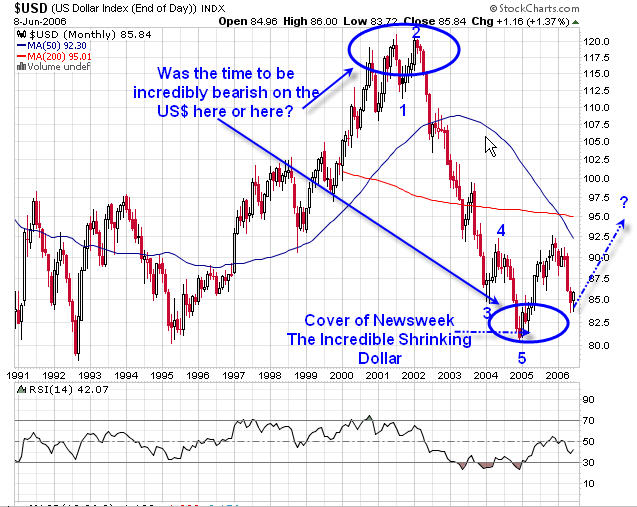
Most of the time I do not get an answer as to why. That of course means the person saying it is just repeating the common mantra of the day, just as the shoe shine boy was telling everyone to short the dollar back in March of 2005.

On March 18, 2005 I made the following post on my Global Economic Analysis Blog.


By the time you see covers like that, trends are well established. Where was the warning about the US$ two years ago or even 1 year ago? Indeed, big money is not often made on front page news. Big money is made on page 16 news that is headed to page 1. The Euro was probably on page 16 in 2002. Now look at it. "The Shrinking Dollar" has been on page one of the Wall Street Journal for months and just made the big time with the cover of Newsweek. Is there anyone out there that is not aware of the plight of the US dollar?
The dollar rallied to my target of 90 (and then some). Now what? That rally has stalled and immediately everyone is hopping on the short dollar bandwagon again. Is this yet another "sure thing?"

Reasons given why "the dollar is toast"

Following are the four most common reasons cited for the dollar being toast.
  1. The Balance of Trade
  2. The National Debt
  3. The Savings Rate
  4. Monetary Printing by the Fed
Let's take a look at each of these reasons in turn.

The Balance of Trade

The following chart shows the trade weighted exchange index of major currencies vs. the balance of payments. The US current account balance went negative in 1992 and has stayed there ever since. Trade weighted currencies (a chart nearly identical with the US$ index) show no correlation (that I can see) to the balance of trade. The proper conclusion is that currency trends may have little or nothing to do with trade balances. Note: I am not saying that the trade imbalance does not matter, I am just saying there is little reason to believe that there is going to be any correlation between the two for perhaps long periods of time. The chart below certainly show it is not a tradable event.


The National Debt


The above national debt chart is courtesy of Zfacts

I do not have the ability to superimpose the US$ index over that chart but if I could I am positive I would not find any meaningful correlation. However, if a sudden immediate correlation between National debt as a percent of GDP and currencies were to occur I am confident that dollar bears would not like it too much. For example, please consider Japan.

Ikjeld reported on September 24, 2005 Japan's National Debt Hits New High.

Japan's government debt ballooned to a record high of JPY 795.8 trillion (USD 7 trillion) at the end of June, according to a report released by the Japanese Finance Ministry. It was projected to be JPY 774 trillion for this fiscal year, so the national debt is growing faster than expected.

Japan has relied on government bond issues to make up for falling tax revenues. This has turned the nation into one of the world's most indebted countries. Japan's public debt burden is now almost 160 per cent of its GDP, which makes it the highest in the industrialized world.


Again I do not want to dismiss the problems of the US national debt, but given that Japan's national debt is 160% of GDP and the US national debt is under 70% of GDP, perhaps the US debt still has a ways to go before it matters. Of course one can argue that the US GDP is distorted (it is) and the debt is underreported (it probably is on the basis of future liabilities but then again so is Japan's) but the biggest objection I will probably hear will go something like this: "Japan is a nation of savers" so it does not matter as much. With that let's take a look at savings.

Savings

Following is a chart of the personal savings rate. It has been trending down since 1992 so again I see little correlation to the US$. But let's consider US treasuries for a second. People everywhere point out all of the foreign buying of US treasuries then confidently predict the dollar will collapse along with US treasuries when that support is dropped.

I have long maintained that support will come from US buyers. I am universally laughed at. The big question is "Where is that money going to come from?" But look at the following chart and perhaps you can answer the question yourself. After all where is the savings rate headed from here? Are people going to keep spending more than they are making forever? Are we closer to a top or a bottom on the savings rate. That spike and reversal is many standard deviations away from the norm. It roughly coincides with the blowoff top in the housing bubble. It's dangerous to make cause and effect relationships but for whatever reason there was a clear unprecedented panic out of holding dollars to buying things. I confidently predict a reversion to the mean on this "time preference" away from risk, perhaps even to the point of a panic reversal to the safety of US treasuries. Please note that US treasuries can only be purchased with US dollars.


The following chart shows the US was once a nation of savers. Once the housing bubble collapses, and people see what is happening to their only "savings vehicle" will there be a shift away from consumption toward savings? I think so.


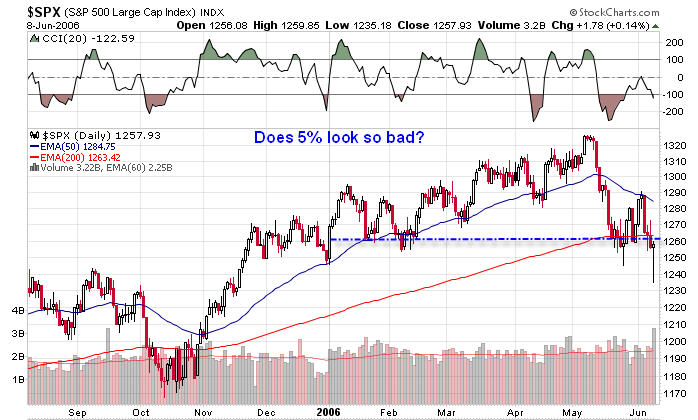
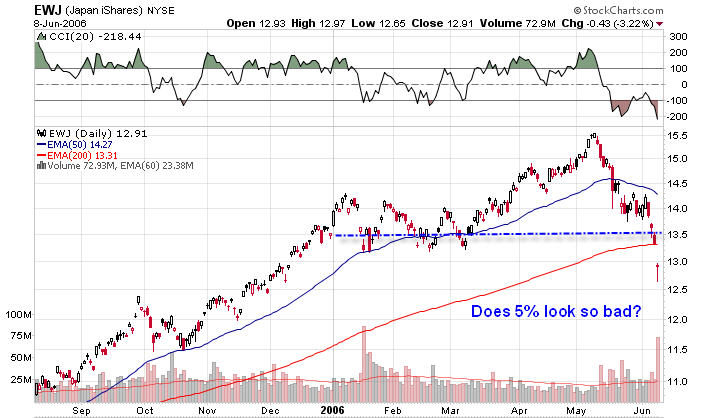
The next hurdle to get over is the CPI. People constantly point out that "the CPI is a joke and you are losing money at 5%". That may or may not be the case (and I have to admit that even I think the CPI is a crock yet I am far from being an inflation alarmist) but what if 5% is the best you can do. Is it better to lose 20% in the stock market (on top of whatever loss in money value there is) or is it better to do the best you can and just take 5% if offered? Let's take a look at that idea.

Does 5% look so bad?


Does 5% look so bad?


Does 5% look so bad?


In Point of Maximum Risk I pointed out that one measure of investor's willingness to take on risk is a measure of Treasury spreads to junk.


How much lower can junk spreads get? Corporations have been even going to the junk bond market to raise money for the sole purpose of stock buybacks. Imagine going in debt to buy back shares of stocks after a 3 year equity runup? Does that make any sense (except for insiders selling into those buybacks?). Is there a bubble in bonds? Yes, junk bonds. Is there a bubble in US treasuries? No way.

The Rand


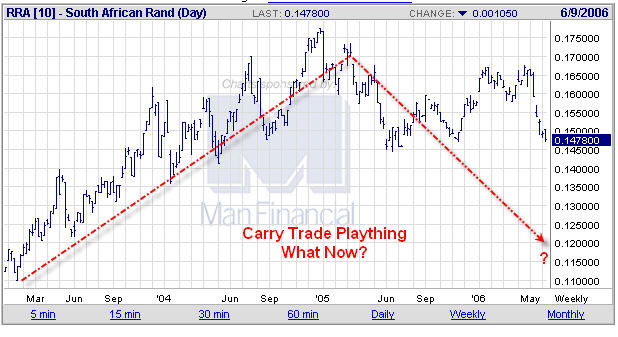
Various currency carry trades are blowing up all over the place. The Rand is one of them and the Icelandic Krona is another one. If there is some sort of "Credit Event" where do you want your money? Let's consider some "flight to safety" alternatives:
  • Chinese Renminbi
  • Indian Rupees
  • Malaysian Ringgits
  • Mexican Pesos
  • South African Rand
  • South Korean Won
  • Sri Lankan Rupees
  • Thai Baht
  • Iceland Krona
  • US Treasuries
Which one would you choose?

Monetary printing by the Fed

Make no mistake about it, the Fed has been printing. But it is not just the Fed. More to the point, credit is currently expanding much faster in Europe and China than the US. Monetary expansion in Europe is running at roughly an 8% rate right now (double that of the US) and it is one of the reasons the ECB is hiking.

Europe also has a huge demographic problem (more advanced than the US at this point). Finally, Europe is still struggling with relatively more tariffs than the US and that is hampering its growth. Not too long ago everyone thought the EURO would implode and the EU would break apart. A few short years later (after a huge runup in the EURO) everyone is a Euro bull.

Is the pound the savior? The UK arguably has a bigger pension problem than the US as well as a bigger housing bubble. What about the RMB? I have posted many times on my blog that the RMB would likely crash as oppose to rocket up if it was all of a sudden freely floated. My biggest reason for thinking that was near universal sentiment in favor of the RMB vs. the US dollar. A second reason was massive non performing loans in the Chinese banking system.

In 9th Inning Liquidity I made the case that the RMB was overvalued on account of monetary pumping.
Based on the huge trade surplus with the United States, which stood at $114 bill in 2005, most analysts have concluded that the current rate of exchange of 8.017 yuan to the US dollar is far too high. However, what matters for the currency rate of exchange is the pace of money expansion relative to real economic growth — not the state of the trade account. [I believe we have now proven the irrelevance of trade in previous charts]

After falling to negative 1.2% in March 2001 the yearly rate of growth of the [Chinese] central bank balance sheet (monetary pumping) relative to real economic activity climbed to 28.2% in September 2005. In February this year the yearly rate of growth of the relative pumping stood at 22.1%.

In contrast, the yearly rate of growth of the Fed's balance sheet in relation to real economic activity fell from 11.6% in September 2001 to 0.9% in March this year.

Since China's monetary expansion relative to real economic activity has been accelerating whilst in the United States relative pumping has been decelerating, it follows that China's yuan has to depreciate against the US dollar.
Let's look at one more factor, trade weighted relationships as presented by Hussman on January 3, 2006.

As I've noted before, the euro looks about fairly valued given the present constellation of international price levels, interest rates and inflation pressures, but the Japanese Yen and other Asian currencies still appear undervalued relative to the U.S. dollar (of course, this is why despite a certain amount of dollar weakness since 2000, certainly against the euro, we haven't seen much of a decline in the trade-weighted dollar).

In reference to "As I've noted before", let's take a look at what Hussman was saying December 20, 2004 in an article entitled Is the Dollar Really Overvalued?
Over the past couple of years, I've argued strongly and repeatedly that the deep and ongoing U.S. current account deficit will compromise growth in U.S. gross domestic investment for years to come. As the size of the U.S. current account deficit gradually receives more attention, it has become an article of faith that the U.S. dollar is overvalued.

Not so fast.

The basic assumption of the overvalued-dollar thesis is that the current account deficit is simply an import/export problem that will go away if prices (mainly currency valuations) are right. As I've argued before, this misdiagnoses the problem. The U.S. current account deficit is mainly a problem of woefully inadequate U.S. savings. I'll be the first to argue that a revaluation of the Chinese yuan is coming, and that a cheapening of the U.S. dollar relative to Asian currencies will help to “improve” the current account deficit. Unfortunately, this “improvement” will be similar to the improvement in gas mileage that a car gets when it rolls off the side of a cliff into the deep blue sea.

It's important to recognize that the dollar's valuation is neither the cause nor the solution of the U.S. current account deficit. Sure, if you think of a current account deficit as being caused by an overvalued dollar, it's simple enough to think that a future depreciation in the dollar will clear up the deficit. But if you think of the current account deficit as resulting from insufficient savings, then forcing the adjustment burden onto the dollar (rather than adjusting savings behavior and fiscal policy) can lead to a currency crisis.

In September 2000, with the euro worth about $0.85, I published a piece called Valuing Foreign Currencies that describes my approach to estimating currency valuations. Basically, a currency is both a means of payment and a store of value, which means that it has to be priced on the basis of what I call a “joint parity” involving both price levels and interest rates across countries. At the time of that article, I argued that the euro was substantially undervalued.

Since then, the euro has advanced by over 56% against the dollar, to a recent value of $1.33 per euro. [Mish note - remember this was written in Dec of 2004]. From the European standpoint, the U.S. dollar looks cheap (but could get even cheaper). Joint parity looks about $1.13 per euro.
Bingo. Hussman nailed it in BOTH directions. Who else did? I recommend clicking on the above links if you are really interested in currency trading. Note that I disagree with him about the RMB for reasons cited earlier, but then again a lot of time has elapsed so his position on the RMB may have changed. Let's now review the reasons for the US$ being toast.

Reasons cited for the dollar being toast:
  1. The Balance of Trade
  2. The National Debt
  3. The Savings Rate
  4. Monetary Printing by the Fed
Are any of them valid?
Number 4 was at one time but has it already been priced in?


Did not the dollar index correct 33% from top to bottom. Did not various countries currencies nearly double against the US dollar? How much more is left? Is the US$ going to fall in half again from here? Other than possibly gold (and that as of now is meaningless to the masses but not gold bugs), against what currency and why?

Final Thoughts: From Brian and Mish at the Survival Report:

Brian and I think the US dollar may have a ways to fall but arguably the dollar is much closer to the bottom than the top. In contrast to those that think "bonds are in a bubble" We think bonds EXCEPT US Treasuries are in a bubble. The problem is when most people say "bonds are in a bubble", they mean US Treasuries. We believe that that is simply wrong for reasons outlined above, and we are bullish on Treasuries.

As to the US dollar and gold, neither of us is really a dollar bull or gold bear, but rather we are somewhat agnostic towards the dollar yet long term bullish on both gold and energies (but not right now as various carry trades unwind). Besides, gold has disconnected from the US dollar. What's to worry, right? Yet, the unwinding of excess liquidity, a shift in time preference away from risk to increased savings, and a looming "flight to safety" panic explains why we are and have been short various markets and long US treasuries.

Perhaps one day gold will not correct, but this correction was true to form. When gold was over $700 our call of a fall to $600 or below seemed unlikely to most. Yet we are now within spitting distance. Our experience is that hyperbolic moon shots always correct more than anyone thinks. Nibbling on gold miners here may not hurt from a long term perspective (and for gold bugs is perhaps advisable) but seasonality and market action are still unfavorable. Overhead resistance is also substantial. If time preferences away from current consumption and excessive risk have made a permanent change (a belief we find likely), things could get very ugly across many fronts but especially equity and junk bond funds.

Mish Addendum: I started writing the above on June 8th and 9th for a special report on the dollar for the Survival Report. The stock market charts above reflect that and as such are dated by the time you are reading this. Note too that gold dipped well below our retracement target of $580. On weekly/monthly charts gold could fall to the $480-$500 level and still have the major uptrend intact. It may or may not get there but if it does, it could be the last chance train. Gold seems to like to shake out as many people as possible. A round trip to $480 could do just that.

Mike Shedlock / Mish
http://globaleconomicanalysis.blogspot.com/