Pages

Thursday, June 15, 2006

A Look at Averages

Is household debt manageable? That is the question of the day.
Bernake sure seems to think so, at least according to this Chicago Tribune Headline:
Bernanke: Household debt "manageable"
Household finances are in good shape even as the greater availability of credit has led to higher levels of debt, Federal Reserve Chairman Ben S. Bernanke said.

"U.S. households overall have been managing their personal finances well," Bernanke said.

"Debt burdens appear to be at manageable levels, and delinquency rates on consumer loans and home mortgages have been low."

A ratio of debt payments on mortgage and consumer debt to personal income stood at 13.86 percent in the final quarter of last year, the second highest in Fed records going back to 1980. Bernanke noted that rising debt burdens have been partially off- set by increased asset values as household net worth "is at a fairly high level."
Bernanke never checks into my blog to answer questions but I have several anyway.
  1. Since when do asset bubbles in houses or stocks justify piling on debt?
  2. Given that real wages are falling and debt payments are the second highest in history, on what basis do you find "U.S. households overall have been managing their personal finances well".
  3. Which direction are bankruptcies and foreclosures headed?
In a slightly different slant on this story MarketWatch is reporting the spin like this:
WASHINGTON (MarketWatch) -- Despite the complexity of financial products and wider availability of credit to families with low to moderate incomes, U.S. households appear to be in managing their debt well, said Fed chief Ben Bernanke on Tuesday. "U.S. households overall have been managing their personal finances well," Bernanke told a seminar on Capitol Hill. "On average, debt burdens appear to be at manageable levels and delinquency rates on consumer loans and home mortgages have been low," he said. Bernanke did not discuss monetary policy in his prepared remarks. Bernanke said the central bank will continue to make financial education a priority to help families of modest means build assets and improve their economic well-being.
Debt vs. Wages

"On average, debt burdens appear to be at manageable levels".

Let's consider one of the problems with "averages". On average, two cars racing up a mountain are both enjoying the view, even if one plunges over the side of a cliff somewhere near the top. Perhaps a more practical example is the fact that average wages are rising even though median wages are falling. More than 50% of the population is worse off than a few years ago. This is unprecedented in a recovery. Yet "on average" things are humming quite nicely especially if you count CEO stock options, salary hikes, and Wall Street bonuses. So why "on average" should anyone be concerned?

Writing for The Daily Reckoning Bill Bonner had this to say:
The 26 top executives at Toyota Motor Company earn an average of $320,000. Good money, but hardly obscene. Toyota is a growing, profitable concern. The heads of America's 500 biggest companies received an aggregate 54% pay raise last year. As a group, their total compensation amounted to $5.1 billion, versus $3.3 billion in fiscal 2003. G. Richard Wagoner, Jr, heading up Toyota's rival, General Motors, received total compensation of $8.5 million. That's what you get when capitalism enters its degenerate phase. The parasites make sure they get their money...even as the company sinks."
Foreclosures

Chron.Com is reporting Foreclosures rising with debt, job losses.
Nationally, foreclosures are up 38 percent, higher than in any quarter of last year, property tracker RealtyTrac said.

The numbers are even grimmer in the Midwest. Michigan and Ohio, battered by automotive-related job losses, together recorded 45,000 mortgages entering some stage of foreclosure in the first quarter. Those are increases of 91 percent and 39 percent, respectively, compared with last year's fourth quarter.

There are many reasons for the growing number of defaults, and there are suggestions that the foreclosure trend may soon worsen.

Layoffs because of corporate downsizings, health care issues, increasing debt levels and rising interest rates all are factors. In addition, a growing number of homeowners are relying on adjustable rate mortgages, catching some people by surprise when their monthly payment rises.
Auto Loans

Without even opening the Mish Telepathic Question Line, a question managed to sneak through: "Mish, what about cars?" That's a good question. Let's take a look.

The Arizona Republic is reporting Car buyers stymied by negative equity.
Zero-interest deals and long-term car loans are boosting sales, but they are producing one troubling side effect: a growing number of drivers owe more on their vehicle than it's worth at trade-in time.

Last month, nearly 29 percent of U.S. car buyers found themselves "upside-down" on their loans, owing an average of $3,789 more than their trade-in value for the highest level since September 2004.

Loan officers and car dealers call it "negative equity," and there are plenty of negatives.

First, car buyers often pay more interest as they roll old upside-down loans into new car purchases.

Second, they will be saddled with higher payments that make it harder to save for their next car or keep up with their current automobile loans.

Third, those buyers are instantly turned upside down in their new purchases, creating a vicious cycle of excessive debt.

Longer car loans are the prime factor flipping car buyers upside down, experts say. Where the average car loan in 2003 lasted for 60 months, it has crept up to 64 months today, says Jesse Toprak, executive director of the Edmunds.com, a Web site for car shoppers. Part of the reason is the introduction of the 72-month loan.

"Seventy-two months is sort of becoming the norm," Toprak said. "Unless you put a substantial amount of money down, you will have negative equity."

But not every upside-down buyer has a choice, said Dorothy Guzek, a budget counselor with Greenpath Debt Solutions in Troy, Mich.

She described cash-strapped clients who need cars to get to work but can't afford much and end up financing undependable vehicles.
"On average" things are fine here too I suppose. After all a mere 29% of buyers are upside down on their car loans. Does Bernanke worry about this when it hits 51% and no sooner?

Bankruptcy Filings

CNN Money is reporting Bankruptcy filings up despite reforms.
A new U.S. law to deter American consumers from seeking bankruptcy protection made filings plunge to a 20-year low in the first quarter of 2006, but a rapid rise in new cases since then raises questions about whether the law is working as expected.

The 2005 bankruptcy reform law was pushed through Congress by banks and credit card companies that sought to prevent abuse by individuals trying to wipe their financial slates clean from runaway debt.

But credit card companies and banks are keeping an eye on the recent increase in filings.

The law took effect Oct. 17, 2005, prompting a surge of 619,322 personal bankruptcy filings for that month as debt-laden consumers rushed to court.

New cases plunged to 13,758 in November, then rose to 21,636 in December, 27,235 in January, 35,352 in February and 49,977 in March, according to the Administrative Office of the U.S. Courts.

That compares to the monthly average of 130,183 new cases in 2004.

"We are starting to see more bankruptcies being filed. They're taking longer, they're more complicated," said Maureen Thompson, legislative director of the National Association of Consumer Bankruptcy Attorneys. "These numbers will continue to creep up as people face a number of economic factors."

Those factors include traditional ones, such as poor money management, loss of a job, medical expenses and divorce. But some consumers are also falling behind on monthly mortgage payments as interest rates continue to rise.

Other homeowners may be overextended with adjustable-rate mortgages, or ARMs, which could reset soon. At the end of 2005, almost a quarter of all outstanding home loans were ARMs.

"We're going to start to feel those numbers this year and next," said Jeffry Taylor, economist at the National Association of Federal Credit Unions in Arlington, Virginia.

More than $300 billion in ARMs are subject to interest rate resets this year and that figure is expected to reach $1 trillion in 2007, according to DB Global Markets Research.

Before the new law took effect, lenders such as department stores, mortgage companies and credit card companies lost an estimated $60 billion annually due to bankruptcy filings.

"Bankers are monitoring the numbers very closely to ensure that the law accomplished what it was passed to accomplish," said Patricia Milon, senior vice president of America's Community Bankers, a Washington trade group.

"Bankers feel what was passed was very balanced," she said. "There should be no backsliding."

The bankruptcy law also created various income tests, including a "means test" to determine if an individual is eligible for Chapter 7. The test is triggered if the debtor's monthly income is above the state median.

Another provision requires financial counseling before a bankruptcy filing and again before debts are discharged.

Debtors also face steeper court fees for bankruptcy filings. The fee for Chapter 7 rose to $299 from $274, while the Chapter 13 fee increased to $274 from $189.
"Bankers feel what was passed was very balanced". Of course they do. With the help of their paid lobbyists, they wrote the bill. It contained 100% of what the credit industry wanted and 0% of what they did not want. All in all it was perfectly balanced.

Let's report the Bankruptcy Reform Act of 2005 for exactly what it was: an attempt to make the poor and insolvent debt slaves forever.

The credit card industry wanted protection from their predatory lending practices, no interest rate caps, no fee caps, high interest rates, the ability to change terms at whim, a means test, and guaranteed payments. They got it all. How could the bill possibly have been more "balanced?"

Some people blame consumers for getting into trouble with debt. Is it really that simple? I think not. Here is the Mish vision of the credit card business (and most of the mortgage loan industry as well):

Day in and day out those industries put a glass of vodka in front of an alcoholic while at the same time reminding the alcoholic how good the drink tastes. When the alcoholic goes on a binge, the credit industry wants to jack up the price of vodka and then blame the customer for the problem.

Now from Bernanke's point of view, none of this is a problem "on average", at least since last October. Unfortunately Bernanke fails to understand the effects of that mad rush where 600% of normal filings took place in a single month. That blast took away from future demand. It will not be too much longer before housing prices tank (for good) and those filings skyrocket once again. I suspect that Bernanke will have a vastly different view of those averages in the not too distant future.

Mike Shedlock / Mish
http://globaleconomicanalysis.blogspot.com/

Wednesday, June 14, 2006

Morgan vs. Lennar Update

The following text is straight from Mike Morgan.
He sent a copies to various people at Lennar and to the Miami Herald as well.
During my conversation with our Building Official, Larry Massing the other day, I noted that Lennar has insisted their homes are defect free and built to code. This is a an absolute and intentional lie, as well as a fraud on the County and the homeowners that have purchased these homes. Instead of admitting they have a problem, they are compounding and perpetuating the lies, fraud and misrepresentations. I told Larry that on the first home we inspected, the roof was defective and not built to code. In fact, all of the roofs we inspected were defective and not built to code, but I would like to comment on what Lennar did on the first roof.

After Lennar insisted the roof was fine, they quietly ripped the entire roof off and replaced it. I’m not sure if they needed a permit to rip a roof off a home that received a CO, but it would appear someone at the County level should have approved and investigated this. If they did need a permit, once again, they have violated the laws of our County. If a permit and re-inspection were required and not obtained, I am requesting that the County fine and penalize Lennar to the maximum extent allowed.
Moreover, pursuant to the PUD Agreement, in light of the issues at Martin’s Crossing, I am hereby requesting a Public Hearing to discuss the issues in the open with home owners provided the opportunity to present their problems.

And I will go one step further. We are going to be applying for a building permit to have a roof removed and replaced, so we can demonstrate that what is hidden beneath the tiles is defective and not built to code. We are also going to cut away walls inside a home and bring in an engineer of the County’s approval to take stucco samples, conduct a mold inspection, inspect all electrical wiring and systems, etc. etc. All of this will be filmed and well documented by the engineering firm and the media.

Once we start taking this home apart, we will methodically continue to inspect all components and stages of construction. I can assure you, that you will be appalled at what we find. I am requesting a Public Hearing and a work stop on all Lennar communities and homes in Martin’s County, as well as a hold on discussion of any and all future Lennar communities in Martin County until the issues at Martin’s Crossing are addressed.

I would like to coordinate our selection of the engineering firm with Mr. Massing as soon as possible.


As you know, Lennar has filed a lawsuit against me. This will not stop me. I will address all of the issues in court. Litigation will involve the County, since Lennar is relying on County inspections to go after me in attempt to silence me. Now is the time for the County to address these issues with Lennar before the Lennar pins all of the problems on the fact that their homes received County inspections and CO’s. That’s the position they have taken, and it will be a shame to let them get away with that kind of baloney. This is not a County inspection problem.

Regards,

Mike
Morgan is clearly putting his money where his mouth is.
I doubt it will be good for Lennar.

Mike Shedlock / Mish

Tuesday, June 13, 2006

Bubble Trouble in Canada and Spain

The Globe Investor is reporting Bubble trouble in western real estate.
The housing market in Western Canada is showing dangerous signs of "bubble-like activity," with double-digit increases in prices that could cause an "ugly end to this housing cycle," a report warns.

Prices for existing homes in Calgary have jumped close to 30 per cent so far this year, Douglas Porter, deputy chief economist with Bank of Montreal, observes in a report released late yesterday. The average home price in Vancouver is now in the neighbourhood of $500,000.

Industry experts in the West yesterday were quick to pour cold water on any talk of a bubble there. They argued that rising home prices are clearly being supported by the fundamentals of the local market, which include a massive influx of workers and huge employment growth.

"If you are looking for a bubble, don't point to Alberta," said Richard Corriveau, regional economist for the Prairies with Canada Mortgage and Housing Corp.

Last year, 59,000 people moved to the province and this year employment growth is at 3.4 per cent, compared with the national average of 1.9 per cent.

Growth in the market is based on "hard market fundamentals" that are unlikely to shift and cause a drop in prices, he said. The much larger concern is the growing problem with finding affordable housing.

Elton Ash, executive vice-president with Re/Max Western Canada, called the bubble debate "old hat." Only a jump in interest rates or a major slowdown in the energy and resource sector would cause a bust in western markets, he said. "That is just not going to happen."
It Can't Happen Here

I remain amazed at the number of people that think "It Can't Happen Here". They said the same thing in Florida, in Las Vegas, in Boston, and in San Diego. Now some realtor from Re/Max with a vested interest in the outcome says "That is just not going to happen." In other words "It's Different Here".

I have news for Elton Ash and forgive me for being blunt: It is because of clowns like Elton Ash who promote such ideas that bubble mentality takes hold in the first place. The simple fact of the matter is that unless wages are rising in proportion to property values, there will be a bust. A jump in interest rates is not going to happen? Really? A slowdown in energy "Can't Happen"? Really? Prices paid are irrelevant? Really?

Elton Ash...
Please take a good hard look at Florida.
They said the same thing there.
30% annual price gains are not sustainable and I confidently predict that 100% of that 30% will be given back, and probably much much more.

Toronto Anecdotes

Kestral on the Motley Fool writes:
Here in Toronto (biggest city in Canada with about 6 million people) per capita household income is ~$62,000. $350,000 if you are lucky will buy you a very average home with a lot the size of a postage stamp.

Take any suburb of Toronto or even any area within a 2 hour drive of Toronto and they have fully participated in the real estate bubble. $350,000 won't buy you an 1800 sq ft 4 bedroom on a puny lot in Markham (about an 45-60 minutes north of Toronto) where I grew up. $120,000 and a paper bag in this real estate market is worth the paper bag.

If I moved away from Toronto, where would I go? Vancouver real estate is even more expensive than Toronto. Montreal I would have to speak French. So where? Nova Scotia? Manitoba?
Here is a two bedroom two bathroom house in Toronto listed for $419,000.

Rosethorn School Area, Quiet Street. Beautiful Lot With Perennial Garden, Renovated Kitchen, 2 Pce Ensuite In Master, Hardwood Floors (Some Broadloom) Main Floor Family Room Off Kitchen.


I am not familiar with the Toronto but the location is 78 Hillcroft Dr Toronto, ON M9B4X7.

In what sense of the imagination is that house worth over $400K? One listing does not a city make but some listings I looked at in Toronto and Vancouver are as silly as prices in California or Florida.

Let's move on to Spain

Admittedly I know less about Spain than Canada. Far less. But I want to share an email I received a few weeks ago. Following is an email from Felix. For those that may not be aware, the European practice is to use a decimal point "." where we would use a comma ",".
Dear Michael,
Congratulations for your page and sorry for my English, it is not as good as I would like.

Hello from Spain, just would like to tell you about the Spanish property bubble but would be great if you can make a little article in your page, our bubble is bigger than yours :)

- We're building about 800.000 homes a year, that's more than the sum of Germany, France and UK, all of these countries have more population than Spain. Our economy is now based in residential construction and tourism, in my opinion it will collapse but at least we're in the Euro zone.

- This will surprise you (I think any American would be surprised), this is the country where 'young' people go away from the parent's home at a later age. 51% of people between 18 and 35 still live with their parents, young people is much more prepared (idioms, technically, ...) than their parents but their salaries are much lower. Only 2% of youngsters between 18 and 24 buy a home, 42% between 25 and 29, and 59% between 30 and 34 years. This is a country where more than 90% buy
houses, less than 10% rent.

- Housing prices grew 89% between 2001 and 2004 while salaries only grew 14%. Housing prices grew 150% between 1998 and 2005.

- Families invest 40% of the rent to get a house but more than 50% in the younger families with mortgages of 30 and 40 years, almost all (98%) at variable rates, most of them signed with the lowest rates in history. People is paying around 300.000 EURO for small flats that in your country would be for poor people, you can't get a decent rent near a city for less than 700 EURO a month, our salaries are very far from the American ones and also very far from the ones of our neighbor countries
like France or Germany where housing is cheaper.

- Families debt is by far the biggest in Spanish history, around 70% of GDP. Credit is growing around 8% in Europe but 25% in Spain. Our banks are getting credit from other countries namely Germany and we're wasting the money.

- This is a real problem and people are getting really tired. Last week there were protests in 60 cities (most of them small, but the big cities, Madrid and Barcelona got a nice party), more protests today, and more next week. There are about 3 million empty houses in a country with 14 million houses, speculation is rampant.

Some images from last week protests

Some videos from last week in Madrid

From the news I've heard, you can expect harder pics and videos this week, but don't get the wrong opinion, most people think Spanish economy is great and are very happy, they just don't know what's coming in the next few years.

- Corruption is as rampant as speculation, in this country you can only build if the land is urban land, local government decides what is urban land so a piece of countryside can multiply 100 times its value with a single pen stroke from the local politician, yes this is amazing.

- 9% of people from Barcelona (the second biggest city in the country, the city were I live) changed its residence in 2005.

- The govern laughs at us, they give you some nice shoes so you can walk and find a great home. I'm not joking, our politicians are: http://www.kelifinder.com/

- The European parliament is studying 24 cases of urban abuse, 15 are from Spain.

- Magazines like the Economist and institutions like the European central bank and even the Spanish central bank are complaining and warning us but nobody seems to hear.

Well, that's it, thanks for your time, thanks for your page, and if you have any questions do not hesitate to ask.

Best regards,
Fèlix
An international thanks to Felix (and everyone else tuned in)

Felix, thank you very much for your Email. Rest assured your English is far better than my Spanish or my French or for that matter any other language than English. It never ceases to amaze me how much the rest of the world knows and understands the US and how little the US knows and understands about the rest of the world. Many people here could not locate Spain or Australia on a global map and yes I am serious about that.

I am pleased as well as fortunate that I have readers from Spain, Germany, China, the UK, Canada, Australia, Venezuela, Russia, Greece, Turkey, Iran, Iraq, France, Ukraine, Belgium, Cayman Islands, Singapore, Thailand, New Zealand, Italy, and numerous other countries that many the US do not even know exist. I want to take this opportunity to officially welcome all of my global readers.

Felix, I took the liberty to post your Email as you know far better than I do what is happening in Spain. I thank you for taking the time to inform Mish readers everywhere about the global housing bubble. By the way, your English is just fine. My spellchecker did not catch a single misspelling.

Best wishes to you and all my international readers.

Mike Shedlock / Mish
http://globaleconomicanalysis.blogspot.com/

Monday, June 12, 2006

Lennar has filed suit against Morgan.

The Palm Beach Post is reporting Homebuilder targets realtor over Web site.
A national home builder sued a Stuart real estate agent on Friday claiming his Internet crusade against the company's homes had trampled on its trademark.

But the real estate agent vowed his campaign to expose what he says is shoddy building by the company will not go away. The Miami-based Lennar Corp. filed the lawsuit against Mike Morgan in circuit court in Stuart on Friday afternoon.

The lawsuit alleges that a new Web site Morgan created, www.defectivehomes.info, is causing "infringement, confusion and dilution" of Lennar's trademarked name.

Morgan, who runs the Morgan Florida real estate firm, created the Web site on Monday to gather complaints from residents who have bought Lennar homes.
Following are highlights from www.defectivehomes.info:
NOTE: Although we are initially concentrating on Florida, we are gathering information about home building issues Nationwide and we will be coordinating our efforts with Homeowners for Better Building. Please read the information below and contact us. It's about time we took a united stand against the home builders delivering substandard homes.

We have conducted several very detailed home inspections Martin and St. Lucie Counties within new home communities, built by several national builders. The results of these reports indicate there are a variety of issues with roof installation, roof leaks, stucco thickness, mold issues and electrical problems, to name a few. After speaking with many homeowners, it is clear there is a problem that is not being addressed properly.

We are forming a Florida Coalition of concerned homeowners to address these issuesbefore the Governor, Attorney General, Insurance Commissioner, Department of Business and Professional Regulation, Insurance Companies and the Federal Trade Commission.
In a more recent version of the story, the Sun-Sentinel reported on June 12th Real estate agent tangles with home builder Lennar over allegedly inferior construction.
A Martin County real estate agent is taking on home building titan Lennar Corp. of Miami in a dispute that's getting uglier by the day.

Mike Morgan of Stuart alleges inferior construction in Lennar's Martin's Crossing development. Morgan said a client hired a home inspector shortly before he was to close on a Lennar home, and the inspector found an improperly installed roof and other problems, Morgan said.

Other Lennar homes in the project had similar shortcomings, he said. "This is all visible stuff that any inspector could see."

Morgan brought his complaints before the Martin County Commission last week.

Morgan said he has not inspected any Lennar homes in Palm Beach or Broward counties. He set up a Web site, www.defectivehomes.us., last week and said Lennar buyers from across the country have contacted him.

Lennar's general counsel, Mark Sustana, has a different take on the matter.

Sustana said the company will fix any problems, but independent inspections show nothing wrong with Lennar's homes in Martin's Crossing.

"We delivered 43,000 homes [nationwide] last year," Sustana said. "We do occasionally have a customer who is not satisfied. We make every effort to correct every customer problem."

Morgan has a personal agenda, Sustana said.

Morgan insists that he is not motivated by money, saying he walked away from nearly $1 million in commissions for bringing the construction problems to light.

"I'm like Ralph Nader," he said.

"Please understand," Sustana wrote in a letter to Morgan last week, "Lennar will not allow you to damage our relationship with our home buyers or our business reputation with unfounded allegations of fraud and construction defects as you pursue what appears to us to be an attempt to extort from Lennar compensation to which you are not entitled."
Mike Morgan fired off this email response to me on June 12th.
Everything that follows is a direct quote.
Here goes:
"Many of you have asked for an update on what is going on with me and Lennar. Here’s the story. We inspected four homes that my clients were set to close on with Lennar. The inspection reports came back littered with defects and code violation. We’re talking about defective roofs, defective stucco, defective electrical and more. We’re talking about building code violations. Lennar insists the homes are fine. Well, if they were fine, they would not have ripped the roof off the first home and replaced it. The second roof is defective . . . and they did the work without a building permit!

Lennar is telling the media that I am in this for the money. Funny. Very funny, because I have walked away from almost a million dollars in commissions. If I had kept my mouth shut, I would have pocketed the commissions and no one would have known the extent of these problems.

Then there’s Whitemarsh Reserve. This is a 186 unit town home project Lennar has been selling. I sold 30 units. But then I found out they lied about the project. They told us there would be a board walk back to the river. They told us there would be nothing built to the North of the development. Well, there is a County Park to be built there. And that is where the boardwalk is being built. So they fraudulently induced the 125 buyers, and the County made them offer everyone their money back. That’s 125 sales they lost overnight for fraud. Lennar is telling the media I am in this for the money. Once again, if I had kept my mouth shut, I would have pocketed hundreds of thousands of dollars in commissions. The only one in this for the money, is Lennar.

I received a phone call today from the Building Official for Martin County. It was a great call, and the County is on this. They are going to meet with Lennar and make sure all of the homes are fixed. If Lennar cannot fix these homes, they will have to buy them back or pay damages.

As for the lawsuit Lennar filed against me last week. I have not seen it yet, but I have been told it is for libel and slander. Lennar claims I have damaged their reputation with false information. I’m here to tell you that Lennar can’t win this one. We have 30+ page inspection reports littered with defects and code violations. All they have done with the lawsuit is escalated the mess they are in to a higher and much more public level. Talk about digging your own hole. Right now Lennar is no longer using a shove to dig their hole. They are using hand grenades and backhoes.

I will be drafting Complaints to the Governor, Insurance Commissioner and Insurance Executives. I certainly don’t have the resources to force Lennar to comply with our building codes, but the insurance industry does. Because it will be the insurance industry that will have to pay claims for defective roofs when the first hurricane blows through. If anyone knows anything about Florida, we have hurricanes, and most of the home insurers have pulled out of the State. Our largest home insurer now is Citizens Insurance, which is run by the State. It should be interesting to see Governor Bush’s response to what we have documented.

We will be taking this campaign nationally during the next few months.
Stay tuned."
It will be interesting to see what happens from here on out.

In other news today the South Florida Business Journal is reporting New orders down 50 percent at WCI.
The buying trend is sharply down for both singly-family homes and condominiums at WCI Communities.

The Bonita Springs-based company also cautions that its second quarter earnings will come in below its May 9 estimate of 75 cents to 85 cents a share.

WCI cites a "softness in market demand", "slower traffic," and a cutback in new product offerings. It plans to release just three to five condo towers this year, as opposed to initial plans to release 11 to 13 towers.

New orders for single-family/townhomes are down 42 percent compared to the previous year and high-rise condominium contracts have plummeted 84 percent for the first two months of the second quarter. On a combined basis, orders are down an average of 50 percent from 2005, although WCI expects it will be down "at least" 20 percent for the full year.
Gee, WCI could barely last a month before another downgrade. They downgraded on May 9th, and now they are downgrading again. Dow Jones had this take on WCI Stock Buybacks.

Separately on Monday, WCI said it repurchased 2 million shares at an average price of $21.79 during the second quarter. The company has bought back 3 million shares in the year to date, and the 2 million shares would exhaust its current repurchase authorization.

Corporate insiders have been dumping their shares while wasting investor's money attempting to support the price. It seems they have run into a temporary brick wall but no doubt they will authorize more buybacks and waste more money yet.

Mike Shedlock / Mish
http://globaleconomicanalysis.blogspot.com/
Saturday, June 10, 2006

Cheerleader Panic, the HPI, and the Battle of New Orleans

Speaking for the National Association of Realtors on June 6th, David Lereah, the NAR’s top cheerleader had this to say:
Home sales are settling into a slower pace. “In recent years we were occasionally challenged to find appropriate superlatives to describe surprisingly high home sales,” he said. “Now the housing market has cooled, but 2006 is still expected to be the third strongest on record. In this case, experiencing a slowing from a hot market is a good thing because we need a solid housing sector to provide an underlying base to the economy, and slower appreciation will help to preserve long-term affordability. But this is a time for the Fed to pause on rate hikes because we have some interest-sensitive housing markets that have become vulnerable.”
Let's summarize:
  1. This year will be the "third strongest on record".
  2. Slowing from a hot market is a "good thing"
  3. "Slower Appreciation will preserve affordability"
  4. "The Fed should Pause"
It's now Mish Question Time (but this is an easy one).
Which one of the above does not logically fit in?
Ding Ding Ding the answer of course is number 4.

Lereah is now in panic mode, talking out of both sides of his mouth at the same time. I am not the only one that noticed this either.

In "Burning Down the House" Independent economist Bob Brusca had this to say: The 10-year note is still yielding just 5%, and 30-year mortgage rates are still historically reasonable. In that light, Mr. Lereah's demand "smacks of desperation," and might cause enough alarm to make potential first-time home-buyers more likely to stay on the sidelines. "I would see this as a mistake [on Mr. Lereah's part] and not an indicator of bad things to happen," Mr. Brusca said, adding: "Except for home builders."

On that note the telepathic question lines are now open. Two questions are repeatedly pouring in.

Q1: Gee Mish, wasn't it just a few short days ago that bulls were bragging about 12% annual appreciation?
A1: Yes indeed. In fact I have the release straight from the Office of Federal Housing Enterprise Oversight (OFHEO): OFHEO House Price Index Shows Annual Rise of 12.5 Percent.
WASHINGTON, D.C. – U.S. home prices were 12.54 percent higher in the first quarter of 2006 than they were one year earlier. Appreciation for the most recent quarter was 2.03 percent, or an annualized rate of 8.12 percent. The quarterly rate is about one percentage point below the rate from the previous quarter and is the lowest rate since the first quarter of 2004. The figures were released today by OFHEO Acting Director James Lockhart, as part of the House Price Index (HPI), a quarterly report analyzing housing price appreciation trends.

“These data show average housing prices still growing stronger than some might have expected,” said Lockhart. “They do indicate, however, that price growth is moderating in some parts of the country, particularly in areas where prices have been rising the most.” House prices continued to grow considerably faster over the past year than did prices of non-housing goods and services reflected in the Consumer Price Index. House prices rose 12.5 percent, while prices of other goods and services rose only 4.2 percent. “Increasing sales inventories are apparently giving buyers greater bargaining power, while increasing interest rates are dampening demand," said OFHEO Chief Economist Patrick Lawler.

Significant findings in the HPI:
  1. Arizona continues to exhibit the greatest appreciation rate, although price growth has dropped significantly in that state. Quarterly appreciation in Arizona dipped from approximately 7.4 percent to 3.8 percent, while its four-quarter appreciation dropped from over 35.5 percent to 32.8 percent. Quarterly appreciation rates were off significantly in the Tucson and Phoenix-Mesa-Scottsdale MSAs.
  2. Rapid increases continue to be widespread in Florida. Out of the 20 MSAs with the largest percentage house price gains in the past year, 10 were in Florida.
  3. Prices continue to rise in some areas affected by Hurricane Katrina. Appreciation rates were particularly robust in New Orleans-Metairie-Kenner, LA and Hattiesburg, MS.
  4. For the first time since the fourth quarter of 2002, negative quarterly appreciation rates were observed for some states. Iowa and South Dakota both experienced small price declines between the fourth quarter of 2005 and the first quarter of 2006.
  5. The Pacific Census Division has regained its position as the fastest appreciating division, overtaking the Mountain Division.
  6. Appreciation rates over the past year remain lowest in the East North Central Census Division, which includes Wisconsin, Illinois, Indiana, Ohio, and Michigan. Both the four-quarter and the quarter-over-quarter appreciation rates declined by more than half a percent in that division.
What Gives?

I have to admit being shocked by that report which shows home prices up over 12% annually. In fact Florida prices (which I know 100% without a doubt to be crashing) were supposedly up quarter to quarter.

OK Mish so what gives? (That was a random telepathic question that just snuck in). What gives is "The Methodology" behind the Home Price Index (HPI) is flawed.

I bounced some of my ideas off my good friend CalculatedRisk as well as Jack McCabe of McCabe Consulting and Mike Morgan of MorganFlorida. One of my ideas was there was some sort of assumption made about uniform appreciation. For example: A house sold 3 years ago for X, sold today for Y, and the methodology assumes that the rate of appreciation was a uniform (Y-X)/3.

Given that there was a parabolic spike last year, uniform appreciation would have been a horrid assumption especially for the six months following the spike. However CR informed me he did not see that particular flaw in the formula. I remain unconvinced but on that point you might be better off trusting his statistical skills rather than mine.

We did decide however that there are indeed some other serious flaws in the methodology. Here are 4 of them:

1) The universe is only Freddie and Fannie conforming homes. The conforming limit for '06 is $417,000. That is far too low for many bubble areas. Only the cheapest homes can use conforming loans. This problem may have understated bubble busting effects in places like Florida, D.C. and Boston.

2) The formula is based on closings. Prices at closing may or may not reflect current sales prices. For example closing in January were on 2005 sales (perhaps delayed by 1-2 months). Was a delay of 1-2 months significant? Probably. Housing peaked in July or August of 2005 so a 1-2 month delay in reporting would have the effect of showing positive appreciation for perhaps 9-10 months instead of 8 months. The effect of this flaw would likely be greatest at a turning point.

3) Incentives, discounts, "free upgrades", "free cars, boats, trips etc" dramatically increased in the 4th quarter of 2005 in response to rapidly falling demand and rapidly rising inventories. The methodology does not capture those incentives.

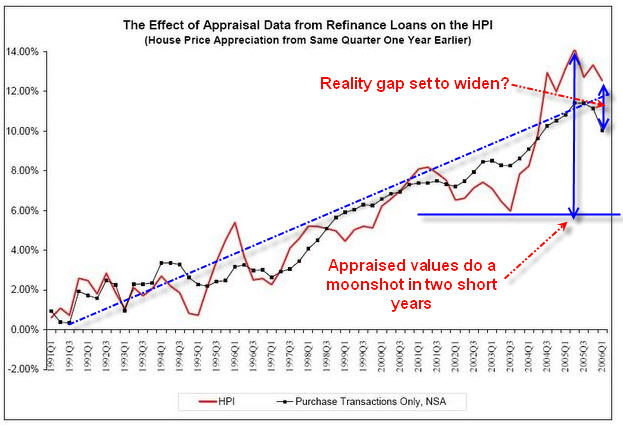
4) The HPI includes appraisal values. This is probably the most serious error and the
OFHEO even has a chart of it. That chart appears below.


That is a pretty big gap between reality (what a house sells for and its appraised value). It also does not include incentives that have recently skyrocketed. The dramatic rise in inventories strongly suggests that people can not get those appraised values.

Looking back, that gap likely accounts for some of the willingness of consumers to spend their every last dime and then some. Hmmm let's see: Appraisal values skyrocket and the saving rates goes negative. Are they at all related? Cause effect relationships are often hard to state with any degree of accuracy but there is no doubt there was a lot of cash out refis based on those appraised values. I expect that there will be some huge problems in relation to this fact somewhere down the road.

For now I believe we can safely conclude that home prices did not really up go anywhere close to 12% year over year. We can also conclude that comparisons going forward are likely to be extraordinarily brutal. Furthermore, to the extent that the Fed believes those HPI numbers, they may be inclined to keep their foot on the brakes far too long. I will have more on that point later.

It's time now to tackle question #2.

Q2: What is David Lereah really worried about?
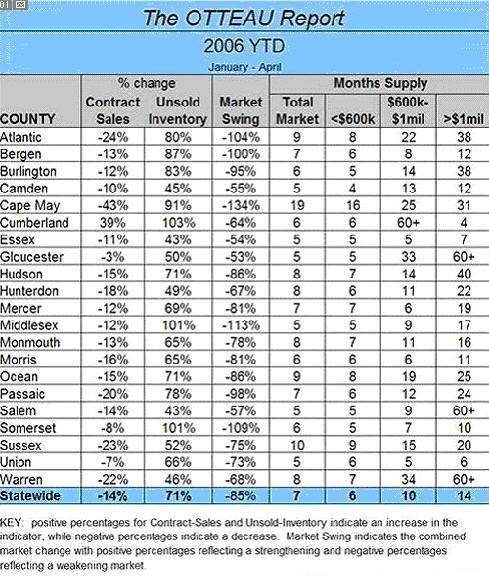
A2: Lereah knows things are rapidly deteriorating or he would not be so contradictory. But the three things that probably worrying him most are inventory, inventory, and inventory. The next four things he is worried about are falling sales, falling prices, rising foreclosures, and rising bankruptcies. Let's take a quick look at some recent inventory charts.

New Jersey
Check out the inventory numbers and the months supply


Orange County


Fairfax County Virginia


There is little atypical about any of the above charts.
Florida looks the same way and I am sure countless other places do too.

Beneath the facade I sense David Lereah is in a near panic.
How long he can remain an optimistic cheerleader rooting for a team down 20 points in the fourth quarter with under 2 minutes left remains to be seen. I am already ready for the next ploy: "Homes won't stay at these prices forever". He will of course be correct. Prices will head lower, much lower. We have only just begun to unwind the craziness of the last few years.

The Marin Real Estate Bubble Blog captured this recent image of David Lereah:


Mish Reflective Moment

The biggest battle in the war of 1812 was fought after the war was over and the peace treaty signed. The Battle of New Orleans , also known as the Battle of Chalmette Plantation, took place on January 8, 1815, at the end of the War of 1812, when the United States forces defeated the British. The Treaty of Ghent, which ended the war, had been signed over two weeks earlier, but the news had not yet reached the southern front.

The Fed is in a similar situation. They are now finally (after 16 rate hikes) worried about the battle that they should have been fighting three years ago.

Mike Shedlock / Mish
http://globaleconomicanalysis.blogspot.com/
Friday, June 9, 2006

Thank you, again, Ben Bernanke

Are the words "Thank you, again, Ben Bernanke" proof positive that Stephen Roach dove off the deep end of any semblance of sanity?

Following are some snips to consider Jun 09, 2006 article entitled Tough Love.
After years of excess accommodation, the US central bank may be trying to reclaim the "tough-guy" image that a credible monetary authority needs.

It’s been a long time since I said something positive about the Fed. That saddens me. The Board -- as insiders call the Washington-based Board of Governors of the Federal Reserve System -- was my first place of gainful employment after grad school. I spent seven wonderful years there in the 1970s, and there will always be a soft spot in my heart for this great institution. It has pained me no end to write of a Fed that lost its way in the bubble-infested waters of the past seven years. But now, for the first time in a long time, America seems about to get a meaningful dose of monetary discipline. Ironically, it could be tougher on the markets than on the economy. For investors, that’s a painful wake-up call, to be sure. But in the end, it’s absolutely essential in order to put an unbalanced, asset-dependent US economy on a sounder and more sustainable course. Three cheers for Ben Bernanke!

Of course, he hasn’t really done anything just yet. The Fed could disappoint -- and end up being all bluster and no action. Or there is always a chance it’s too late -- that America’s imbalances are so advanced, the only way out is the dreaded hard landing. But in my new role as the optimistic pessimist, I am willing to give Bernanke & Co. the benefit of the doubt. By talking tough in the context of only a fractional overshoot of inflation -- an overshoot that may be more statistical than real -- the Fed is sending an unmistakably clear message of a move to policy restraint. And by delivering that message in the context of down markets, the rhetoric of monetary discipline has an even stronger ring. If there’s ever been a time for America’s central bank to take on the markets, this must surely be it. Former Fed Chairman William McChesney Martin put it best in his legendary quip: "The job of the Federal Reserve is to take away the punchbowl just when the party is getting good." For years, the Fed has provided more than its share of refreshments at the biggest party of them all. Those days could now be drawing to an end.

This sudden outbreak of monetary discipline around the world very much fits the script of my newfound optimism on global rebalancing. The world’s biggest imbalance -- America’s current account deficit -- is a direct outgrowth of a property-bubble-induced shortfall of income-based saving. Lacking in domestic saving, the US must import surplus saving from abroad in order to grow -- and run massive current account and trade deficits in order to attract foreign capital. To the extent central banks have promoted asset-bubble-related global imbalances by overly accommodative monetary policies, an emerging bias toward monetary discipline is a very encouraging development on the road to global rebalancing. While it’s "tough love" for bruised investors, this may well end up being the requisite correction that clears the decks for the next upleg in the markets. Thank you, again, Ben Bernanke.
Quite honestly the fact that anyone is thanking the Fed for anything at this point makes me gag. Where were the Bernanke dissents to the Grenspan Fed over the last 18 years? Was there a single one? No, of course not. Nor are there any dissents today. Within the last couple of weeks all of the boys in the boys club suddenly got religion and spoke of the dangers of inflation. Please, this all makes me sick. There is no praise to be given. If Bernanke had any religion he would not have been kowtowing to Greenspan for his entire career then to Bush where he was monitored before his appointment. Bernanke is a coward in my opinion, acting out of fear of his reputation as “Helicopter Ben” rather than what he is facing as the Fed chairman today. At any over the past few years he could have voted to hike by 50 basis points or more. But the wimp that he is decides to talk tough just as the bubble is busting. Not only that but he has gotten at least 4 other sheep at the Fed to ring the bell on inflation worries, right as the biggest inflation bubble in the history of the world (housing) is busting.

Compare and contrast the nonsense from Roach with a piece written today by James Grant entitled Glitter/.
Gold is an August monetary asset but an undependable investment. Producing no income, it is inherently speculative. I am a value investor, but I am also a gold bull. I ought to try to explain myself.

Value investors buy stocks or bonds by the numbers. They compare price with value and buy if the discount is suitably deep. They turn a deaf ear to macroeconomic theorizing. Whether the gross domestic product is rising briskly or not at all is immaterial if a particular company is priced at less than its readily ascertainable net asset value.

Gold is something different. You buy it solely for macroeconomic considerations. I buy gold as a hedge against the stewards of paper money. I buy Krugerrands, the metal itself, suitable for burying in the turnip patch. I expect the price of the South African gold coins to keep going up, but I don't know how high.

There is much I don't know about gold. There is much that nobody can know--critically, for example, what the price ought to be. It's guesswork. If this is a cockamamie way to invest, I draw courage from the theory of central banking, which is more cockamamie still. These days it boils down to picking an interest rate and imposing that rate on the market. Some would call this "price-fixing." Can you name a single successful government price-fixing operation?
Whoa!
Let's stop right there.
For all the self serving praise of the Fed by Roach, can anyone anywhere name a single successful government price-fixing operation? If you can please step to the plate and hit this pitch out of the ballpark.

For now, I sense goldbugs are playing gold for the wrong reasons. That reason is inflation and monetary expansion. Bernanke simply may have no choice here. He is in an economic zugzwang of sorts. Because of past Fed policies (decisions he himself participated in), his choice is now between a severe recession now and a depression later. To the extent that banks have offloaded much of their exposure to Fannie Mae, various pension plans, foreign bagholders via agency debt, and the public at large, Bernanke is likely making a rational choice (if he has the guts to see it through). Is that really worthy of praise?

By taking the hit now, Bernanke also preserves the balance sheets of many major US corporations. Face it folks, the carry trade is unwinding. How far and how fast it goes depends on the resolve of Bernanke. Yet unlike Roach, I fail to see how the Fed is doing anything other than self preservation.

Of course we are a long ways away from seeing whether or not Bernanke is going to follow through with his threats. To the extent that corporate balance sheets are in far better shape than they were in 2001, he has that ability. For now, the gold market and various carry trade plays seems to believe him.

That carry trade unwind has much further to go. In essence gold has been rallying this year for the "wrong reason". Let all of the inflationists be shaken out of their gold on this pullback. My thesis is that gold will eventually start acting like money (an asset to be hoarded in the upcoming deflationary times).

For those that missed the latest runup, another chance may be nearby. A $100 pullback is not exactly peanuts but seasonality is an issue as well. You pay your money and you take your chances. For the record (which could change anytime soon and without notice) I am still on the sidelines. Most assuredly gold is a better buy than it was $100 ago. If Bernanke follows through with his threats, gold will likely get cheaper yet. If he does, then you can then buy gold for the right reason: deflation. Gold will act as money to be hoarded and the implosion of the housing bubble will force his hand to reverse course, furthering the advance of gold for the right reason: fighting deflation. Those that missed the latest runup have only one thing to say "Thank you, again, Ben Bernanke"

Mike Shedlock / Mish
http://globaleconomicanalysis.blogspot.com/

Thursday, June 8, 2006

Credibility, Jobs, and Bernanke

The Dayton Region was told to brace for a tidal wave of layoffs.
A tidal wave of layoffs is building in Montgomery County that will wash across the entire region, causing as many as 9,000 lost jobs, say officials at the county Job Center.

Seven plant closings and shift eliminations will end more than 2,600 jobs by the end of the month alone, said Lucius Plant, workforce development coordinator for the Job Center.

Another 500 layoffs will begin in August with the closing of Mead Westvaco offices in Dayton and Miami Twp. and 425 will occur by the end of the year with the closing of the Defense Financial and Accounting System in Kettering.

Plant estimates the region will see 3,616 layoffs from nine companies by the end of the year. But those closings will also likely cause layoffs among suppliers, he said.

Plant's figures do not include possible closings and layoffs at the five Delphi plants in the region, Plant told a group of 16 employment officials from 10 counties at a Wednesday meeting at the Job Center on Edwin C. Moses Boulevard.

"We think close to 9,000 people could be at risk if these things play out," Plant told the group. "These are folks who are going to end up coming to your doorsteps, your organizations, looking for services. We need to start thinking about this on a regional basis, not just as Montgomery County."

Plant urged officials to prepare for a surge in unemployed people looking for help and asked that the counties work together to share information.

"We're before the storm," he said, "but we're not a lot before it."

A major challenge the region faces, he said, is an older work force that may have a strong work history, but will face a job market very different from when they last sought a job.

Phil Masten, director of Greene County's Department of Job and Family Services, said he is worried about the timing of the layoffs.

"A lot of workers don't have time to figure these things out," Masten said.
Workers have no time to figure things out. No kidding. They were all told things were "rosy". Those workers are now going to face foreclosure and bankruptcy. This post sounds like it is about Dayton but it is not. Nor is it about autos or even manufacturing in general. This story will be replayed in every region strongly dependent on housing for jobs. The ripple effect will spill over into mortgage lending, title insurance, trucking of materials, and a dozen other related areas.

Credibility

Credibility (or the lack thereof) is the message behind Bush's job approval ratings. It is also the reason everyone is all of a sudden concerned about immigrants to the point of considering a wall along the Mexican border. The public can be lied to only so long as it is at least somewhat reasonable. The plain fact of the matter is government lies about inflation, jobs, the war in Iraq, Medicaid, and a host of other things is so far from believable that all credibility has been lost. Once credibility is lost it is hard to restore.

The same goes for Bernanke. Right now he seems to be playing "Macho Ben". When the market forces him to reverse course (and I believe it will sooner rather than later) what credibility he had will have been wasted.

Please consider Bernanke's October 8 2004 Speech What Have We Learned Since October 1979?
The question asked of this panel is, "What have we learned since October 1979?" The evidence suggests that we have learned quite a bit. Most notably, monetary policy-makers, political leaders, and the public have been persuaded by two decades of experience that low and stable inflation has very substantial economic benefits.

Central bankers have long recognized at some level that the credibility of their pronouncements matters.

The benefit of appointing a hawkish central banker is the increased inflation-fighting credibility that such an appointment brings. The public is certainly more likely to believe an inflation hawk when he promises to contain inflation because they understand that, as someone who is intrinsically averse to inflation, he is unlikely to renege on his commitment. As increased credibility allows the central bank to achieve low inflation at a smaller cost than a non-credible central bank can, the president may well find, somewhat paradoxically, that he prefers the economic outcomes achieved under the hawkish central banker to those that could have been obtained under a central banker with views closer to his own and those of the public.

Appointing an inflation hawk to head the central bank may not be enough to ensure credibility for monetary policy, however. As Rogoff noted in his article, for this strategy to confer significant credibility benefits, the central bank must be perceived by the public as being sufficiently independent from the rest of the government to be immune to short-term political pressures.
Personally I think it is perfectly clear the Fed has learned nothing since 1979. Perhaps a better way of putting it is whatever they learned has long been forgotten or abandoned. Proof of that statement is easy enough. All one has to do is look at the serial bubble blowing of the Greenspan Fed to see what a lie this all is. Greenspan (with no dissents from Bernanke) simply threw money at every problem they encountered. It became the very essence of the "Greenspan Put".

By fighting to restore his reputation in the wake of a disastrous speech about the "helicopter drop" theory of fighting deflation, Bernanke is now overdoing it. The long bond and a yield curve that once again has inverted says that Bernanke is wrong. The time for tough talk (and action) on inflation was three years ago. Three years too late Bernanke wants to restore the Feds's credibility.

"Bernanke the Hawk" is the image he wants to portray. Let's see what happens to his credibility when the market forces him to reverse course. The more he fights that reversal the bigger the deflationary problem he will face. This could get real interesting.

Mike Shedlock / Mish
http://globaleconomicanalysis.blogspot.com/