Pages

Wednesday, March 8, 2006

Hot On Homes

This post is a public service announcement in cooperation with the FCC.
In the event of an actual emergency please tune in to the station nearest you.

Following are some newscasters that might be giving the latest HOT News as well as emergency instructions for what steps you might need to take.
 

Hot On D.C. Hot On Denver


Hot On Oklahoma City Hot On Houston


Hot On San Antonio Hot On Dallas/Ft.Worth


Hot On Austin Hot On Dallas/Ft.Worth


Hot On Batton Rouge

Mish is pleased to provide this public service announcement in cooperation with the FCC.
In the event of an actual emergency please tune in to the station nearest you.

Mike Shedlock / Mish
http://globaleconomicanalysis.blogspot.com/

Tuesday, March 7, 2006

Poole Party (and other short stories)

It's time for a "Poole Party" and other "Words of Wisdom".
----------------------------------------------------------------------------------------------
CNNMoney is reporting Poole sees rising interest rates.

Poole: St. Louis Federal Reserve president says it's better to overshoot mark, then loosen, rather than let inflation get out of control.

Mish: Yeah, let's overshoot both directions. This is just more of the Greenspan philosophy of dealing with bubbles (bubbles the FED helped create) after they pop, then attempting to blow a bigger bubble in the wake of the crash. One more note, Poole sounds as confident about the economy as Greenspan did in March of 2000. We all know what happened then.
-----------------------------------------------------------------------------------------------
The Orlando Sentinel offers this headline Realtor: Home values in Florida to remain solid

Orlando Sentinel: We've seen the real-estate market in Orlando and Florida cool from last year's record pace. Is it going to continue to slow?

Beverly Pindling, Realtor: Continue to slow? I think what may happen -- I don't think you'll see a reduction in [intangible] value; let's put it that way. Value and price are different things. You probably won't see a reduction in value, but maybe in prices, meaning you can pay less but it's worth more. Value is how much that particular piece of property is worth to you.

Mish: Is this part of some new math curriculum sponsored by Bush?
-----------------------------------------------------------------------------------------------
A South Florida Sun-Sentinel reader is claiming Newspaper adding to housing slump in the following letter to the editor:

When one wields great power, as you do, it is imperative that they do it responsibly. This is a great public trust that I think that you are not living up to.

Reporting on the slump in the Florida home sales and prices and the damage caused by Hurricane Wilma can be informative or destructive. I believe that you are no longer reporting news but creating news by repeatedly hammering away at the negative aspects of living in South Florida. I think that what you are practicing now is irresponsible journalism and being part of the cause of the present real estate slump rather than part of the cure.

I'm sure that I speak for many Florida homeowners when I say thank you for doing such a wonderful job in adding to the slump in our housing market.

Mish: Of course there was no problem when the newspaper reported all of those year over year gains. Only good news is allowed. Otherwise shoot the messenger.
-----------------------------------------------------------------------------------------------
From a Dow Jones newswire
David Lereah, NAR's chief economist, said the latest reading shows a flattening out that is in line with "the soft landing we've been expecting" for housing market. "We are at a much more sustainable level of home sales now - a welcome cooling from the super-heated conditions that were driving exceptional price gains," Lereah said.

Mish: This is a soft landing? It seems to me we are in a freefall at 5000 feet somewhere over the grand canyon. When we hit the bottom the landing will be anything but "soft".
-----------------------------------------------------------------------------------------------
Brian O'Connor writing for the Detroit News says Slam the door on big bargains from home foreclosures.

Detroiters love a bargain.
Which is why I am warning you all to stay away from dabbling in foreclosed property.
After reporting last week that home foreclosures have doubled in the state -- and that Wayne County led the nation in foreclosures during January -- I received a stream of e-mails and calls from readers wanting to know where they could snap up the bargains.

The answer: Nowhere.

Equity is wrung out

The fact is that most of these foreclosures would never get to the sheriff's sale if there was any equity left. Either the owners have borrowed too much to buy them in the first place, or they've wrung out every dime of equity in loans, or the home values have declined to the point where the house is -- in the best case -- barely worth more than the bank is owed.

For starters, foreclosed homes don't auction for less than $1 over what the bank is owed, and you have to pay on the spot with a cashier's check. Then you'll wait six months and a day -- under state law -- to see if the homeowner can scratch up the dough to redeem the property or arrange a sale.

If the foreclosed property does finally pass to the successful bidder, chances are good that the property is not in what you'd call "move-in" condition. They're often strewn with trash or stripped down to the walls by desperate or malicious homeowners. In some cases, Schneider notes, bidders offer "cash for keys:" an upfront payment to prompt an owner to move out and walk away.

At the Wayne County Sheriff's auction I witnessed, 379 properties came up for auction. Three received bids, all for just $1 over what the bank had into the place. The rest all went back to the lenders.

The bottom line, it turns out, is that you won't find your dream house at the end of someone else's nightmare.

Mish: You have to read a lot of nonsense to find someone that makes any sense.
My advice.... Listen to Brian O'Connor.

Mike Shedlock / Mish
http://globaleconomicanalysis.blogspot.com/

Falling Family Incomes

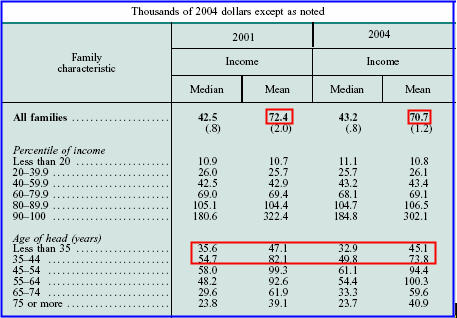
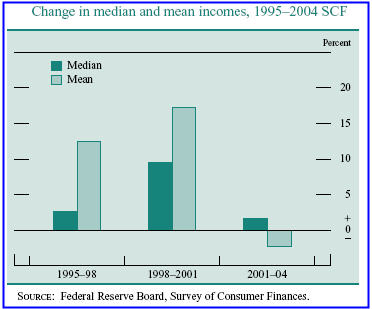
According to the Federal Reserve Board’s Survey of Consumer Finances over the 2001–04 period, the median value of real (inflation-adjusted) family income before taxes rose 1.6 percent, while the mean value fell 2.3 percent. These results stand in contrast to the strong and broad gains seen for the period between the 1998 and 2001 surveys and to the smaller but similarly broad gains between the 1995 and 1998 surveys.

In short, this was a recovery unlike any other. A Few charts should prove it:

Income 1995 vs. 2004


Income 2001 vs. 2004 by age group


Not only has mean real income fallen, it has fallen disproportionately on those aged 44 and under. Median income has also fallen for those aged 44 and under even though it has risen slightly across all age groups.

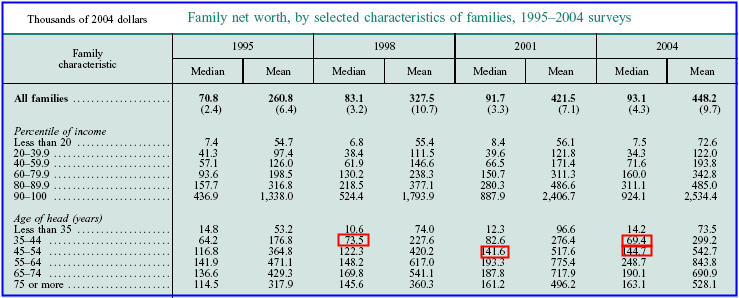
Net Worth 1995 vs. 2004
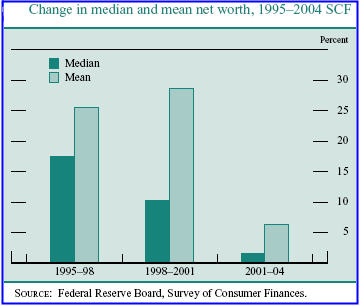


Net Worth 1995 vs. 2004 (click on chart for better view)
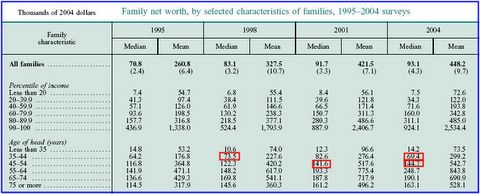


Net worth in the period 1995-1998 and 1991-2001 dramatically outpaced the rise from 2001-2004. Those in the 35-44 age group have less real net worth than the same age group did in 1998. That is negative real net worth over a 6 year period for a group of wage earners that should be nearing their peak earning years.

The Federal Reserve Report explains this complex set of statistics by three factors:
  1. Strong appreciation of house values and a rise in the rate of homeownership produced a substantial gain in the value of holdings of residential real estate.
  2. Despite the general recovery of prices in equity markets since 2001, the direct and indirect ownership of stocks declined, as did the typical amount held.
  3. The amount of debt relative to total assets increased markedly, and the largest part of that increase was attributable to debt secured by real estate.
Of those three factors I think number 3 above is the most important. As debt rose over the period, families devoted more of their incomes to servicing their debts, despite a general decline in interest rates. Also, the fraction of families with large required debt service payments relative to their incomes rose a small amount, and the fraction of families that had payments that were late sixty days or more in the year preceding the survey rose more substantially. These increases affected mainly the bottom 80 percent of the income distribution.

The report missed two key ideas:
  • The Empty Nest Effect
  • An Understated CPI
Notice how the largest gains in net worth were in the 55-64 age bracket. This is a time when the kids have not only moved out of the house but are likely out of college as well. That age group likely had a home, perhaps paid off or at least paid down over the prior 15-20 years. Instead of starting a family and taking on more debt, the group reaped the benefits of home price appreciation without having to withdraw savings to pay for ever escalating college costs for their children. The slowdown in the growth of net worth would have been even more dramatic except for the fact that rising home prices have helped make up for the lack of savings.

The other key factor is the CPI. As bad as the graphs look, they are in fact much worse because the CPI has been hugely understated for a long time.

CPI Chart from the FED
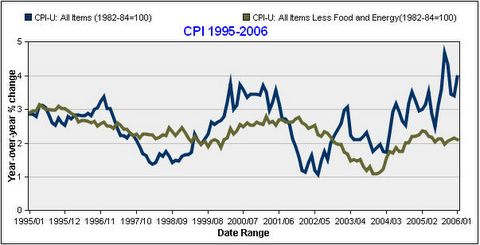


Does anyone believe that?
I don't and I am a devout deflationist.
The idea that annual inflation between 1995 and 2004 was 2-3% is preposterous.
Long time Mish readers might be thinking that is inconsistent with my deflationist views, but it is not. A credit crunch and a housing bust will indeed be very deflationary, but that is a look ahead. The CPI for the period in question is no doubt horribly understated.

What age group was most affected by higher CPI? Could it be families with kids with increased school expenses, medical expenses, food expenses, driving expenses, energy costs, etc., perhaps with one parent in a part time job to better accommodate the needs of the kids? With that in mind, note how college education costs have been skyrocketing. I am not sure how anyone manages to put their kids through college. Indeed many parents can't and kids are coming out of college with enormous debt levels facing wages that simply have not kept up with expenses.

Real Savings
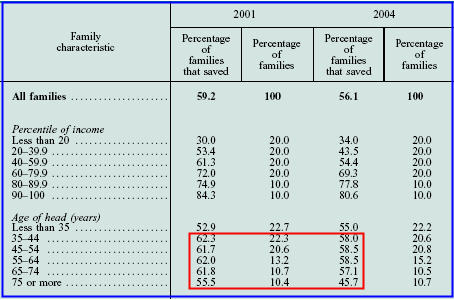


Notice the drop in savings rates across nearly all age groups. Even those whose real net worth has been rising the most (age 55-64) is showing a drop in savings. This shows how more and more people have been viewing their house as savings. Net worth is up, but so too is the debt side of the ledger. Falling home prices just might be about to shatter the dreams of those who thought forever rising home prices would continue to support consumption during retirement. Also interesting is the rise is savings in the age group under 35. Is this a result of marriage being delayed and women attempting to start a career first before starting their families?

The Rich Get Richer

A CBS news article on falling family incomes notes the discrepancy between the haves and the have nots.
The gap between the very wealthy and other income groups widened during the period.

The top 10 percent of households saw their net worth rise by 6.1 percent to an average of $3.11 million while the bottom 25 percent suffered a decline from a net worth in which their assets equaled their liabilities in 2001 to owing $1,400 more than their total assets in 2004.

"This is the continuing story of the rich getting richer," said David Wyss, chief economist at Standard & Poor's in New York. "Clearly, the gains in wealth are going to the top end."

Democrats used the new report to blast President George W. Bush's economic policies, contending it would be wrong to make permanent his tax cuts which primarily benefited the wealthy.

"These statistics show why, even though GDP is rising, most people do not feel better off," said Sen. Charles Schumer, a New York Democrat.

While surging home values have supported consumer spending in recent years, analysts worry about the economic impact if, as expected, the home price surge begins to slow this year.

"This report shows a race between factors boosting net worth such as home ownership and factors pushing the other way such as weak wage growth. Unless we start to see better income growth from jobs and wages, it is hard to see major gains in net worth for the typical family." said Jared Bernstein, senior economist at the liber Economic Policy Institute, a Washington think tank.
Nothing Succeeds Like Failure

Speaking on behalf of the "have nots" was Warren Buffett in the 2005 Berkshire Hathaway annual report
Too often, executive compensation in the U.S. is ridiculously out of line with performance. That won’t change, moreover, because the deck is stacked against investors when it comes to the CEO’s pay. The upshot is that a mediocre-or-worse CEO aided by his handpicked VP of human relations and a consultant from the ever-accommodating firm of Ratchet, Ratchet and Bingo – all too often receives gobs of money from an ill-designed compensation arrangement.

Take, for instance, ten year, fixed-price options (and who wouldn’t?). If Fred Futile, CEO of Stagnant, Inc., receives a bundle of these – let’s say enough to give him an option on 1% of the company – his self-interest is clear: He should skip dividends entirely and instead use all of the company’s earnings to repurchase stock. CEOs understand this math and know that every dime paid out in dividends reduces the value of all outstanding options.

Getting fired can produce a particularly bountiful payday for a CEO. Indeed, he can “earn” more in that single day, while cleaning out his desk, than an American worker earns in a lifetime of cleaning toilets. Forget the old maxim about nothing succeeding like success: Today, in the executive suite, the all too prevalent rule is that nothing succeeds like failure.

Huge severance payments, lavish perks and outsized payments for ho-hum performance often occur because comp committees have become slaves to comparative data. The drill is simple: Three or so directors – not chosen by chance – are bombarded for a few hours before a board meeting with pay statistics that perpetually ratchet upwards. Additionally, the committee is told about new perks that other managers are receiving. In this manner, outlandish “goodies” are showered upon CEOs simply because of a corporate version of the argument we all used when children: “But, Mom, all the other kids have one.” When comp committees follow this “logic,” yesterday’s most egregious excess becomes today’s baseline.
CEO Pay vs. the Average Employee

Those rising wage averages that we have seen have never been as skewed as that are today. Consider the following snip from a Speech by SEC Commissioner Roel C. Campos on February 13, 2006.
In 1982, the ratio between chief executives and the average employee was 42:1. In 2004, the ratio of the average CEO pay to that of the average non-management worker in the US was 431:1. There is certainly no evidence that today's executives in the U.S. are 10 times better than twenty years ago. The US ratio far exceeds any international comparison, which remain closer to the historical average. Although internationally there has been a trend towards increased "US-style" pay, according to a 2001 report by management consultants Towers Perrin the same ratio in other heavily developed nations was 25:1 in the case of the UK, 16:1 in France, 11:1 in Germany and as low as 10:1 in Japan (as compared to 531:1 in the US in that same year).

Of course, one must recognize that some of the disparity has been due to governmental constraints such as the restriction on granting of stock options. In Japan and Korea, for example, it was not until 1997 that such restrictions were lifted. Even so, the 10:1 ratio in Japan versus the 531:1 ratio in the US in 2001 is stunning.
Insider Bailing

Take a look at KBH Insider Sales for just one example of insiders bailing on massive stock options while touting stock buybacks to investors. You can find hundreds of companies doing the same thing if you look.

How does this affect the "average Joe"?
One of the ways is that the averages are skewed. Stock options, mergers, bonuses, leveraged buyouts, and insane CEO compensation packages all are helping those on the top end to get enormously wealth. Average salaries are rising. But "Average Joe" is not seeing a dime of it. We have a trickle down economy that is melting up for the top 5-10% while subtracting dollars from "Average Joe" to pay for it. Add in understated inflation and it's no wonder the savings rate has been negative for a year.

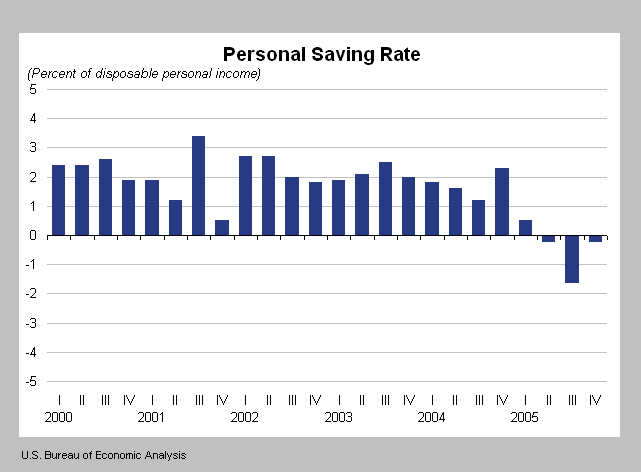
Personal Savings Rate
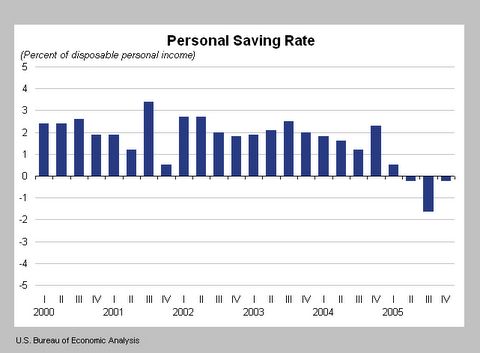


We have not had a falling savings rate on a yearly basis since 1933. This is clearly a sign of stress. It can only get worse as interest rates rise and housing stalls. Expect more bankruptcies and foreclosures because more of each are coming.

Snow Job

On March 3rd, Treasury Secretary Snow proclaimed Failure to save seen as confidence in future paychecks.
In a telephone interview with The Chronicle, Snow said that he thinks wages now are at a "tipping point" where they will start rising.

Snow said a detailed report from the Federal Reserve last week showing that average household incomes were stagnant from 2001 to 2004 was based on out-of-date data.

Snow also put a positive spin on Americans' negative savings rate. Recent studies have shown that in 2005 average spending outpaced earnings for the first time since 1933 as people financed consumption by dipping into savings or taking on debt.

"One way to look at it is that people tend to consume out of their expected long-term income," he said. "The strong consumption could be interpreted, probably should be interpreted, as a vote of confidence in the direction of the economy and the fact that people feel good about their prospective earnings, the sustainability of their jobs and the strength of the job markets."
The idea that a negative savings rate can be interpreted as "people feel good about their prospective earnings, the sustainability of their jobs and the strength of the job markets" is one of the most absurd statements he has ever made. Consumer confidence is actually falling, housing has stalled, and higher interest rates are not helping cash strapped consumers.

The lies and distortions coming out of this administration are simply staggering. Many people are spending every dime and more, not as a vote of confidence but because they have to in order to put food on the table and clothes on their backs, and heat their house. Others are just simply living beyond their means encouraged by an explosion in credit granted to anyone that can breathe. If ever there was a "vote of no confidence" it would be the bankruptcy reform act of 2004. Banks and other lenders are clearly worried about not being paid back. As well they should be.

The Gini Index

Stephen Roach hit the nail on the head on March 3rd with Globalization's New Underclass.
Billed as the great equalizer between the rich and the poor, globalization has been anything but. An increasingly integrated global economy is facing the strains of widening income disparities -- within countries and across countries. This has given rise to a new and rapidly expanding underclass that is redefining the political landscape. The growing risks of protectionism are an outgrowth of this ominous trend.

It wasn’t supposed to be this way. Globalization has long been portrayed as the rising tide that lifts all boats. The surprise is in the tide -- a rapid surge of IT-enabled connectivity that has pushed the global labor arbitrage quickly up the value chain. Only the elite at the upper end of the occupational hierarchy have been spared the pressures of an increasingly brutal wage compression. The rich are, indeed, getting richer but the rest of the workforce is not. This spells mounting disparities in the income distribution -- for developed and developing countries, alike.

With per capita income of $38,000 and $1,700, respectively, the US and China are at opposite ends of the global income spectrum. Yet both countries have extreme disparities in the internal mix of their respective income distributions. This can be seen in their so-called Gini coefficients -- a statistical measure of the dispersion of income shares within a country. A Gini Index reading of “0” represents perfect equality, with each segment of the income distribution accounting for a proportionate share of total income. Conversely, a reading of “100” represents perfect inequality, with the bulk of a nation’s overall personal income being concentrated at the upper end of the distribution spectrum. In other words, the higher the Gini Index, the more unequal the income distribution. The latest Gini Index readings for the US (41) and China (45) are among the highest of all the major economies in the world -- pointing to a much greater incidence of inequality than in economies with more homogeneous distributions of income, such as Japan (25), Europe (32), and even India (33).

America’s Gini coefficient has been on the rise for over 35 years -- moving up from about 35 in 1970 to over 40 today. What is new is how America’s income distribution has become more unequal in a period of rapidly rising productivity growth -- a development that has been accompanied by an extraordinary bout of real wage stagnation over the past four years. Economics teaches us that in truly competitive labor markets such as America’s, workers are paid in accordance with their marginal productivity contribution. Yet that has not been the case for quite some time in the US. Over the past 16 quarters, productivity in the nonfarm US business sector has recorded a cumulative increase of 13.3% (or 3.3% per annum) -- more than double the 5.9% rise in real compensation per hour (stagnant wages plus rising fringe benefits) over the same period.

First in manufacturing, now in services, the global labor arbitrage has been unrelenting in pushing US pay rates down to international norms. But the real wage compression in the US has not been uniform across the income spectrum. In large part, that has occurred because increasingly broad segments of the American labor market are now exposed to a uniquely powerful competitive force -- the IT-enabled arbitrage. Courtesy of the hyper-speed of sharply accelerating Internet penetration, the global labor arbitrage has pushed into areas that historically have been unaccustomed to wage competition.
Unlike Treasury Secretary "Blue Skies No Snow" I see no reason for this to change. Corporate profits (and bonuses for the haves) soared with every outsourcing of jobs to India and China. Average Joe went deeper in debt while the CEOs and insiders made out like bandits on stock options. Average Joe lost his job at GM and Ford (or is about to) and will be happy to have a job at Walmart instead.

This recovery produced lots of firsts
  • Negative Savings Rates
  • Negative Real Wages
  • Poor expansion of private sector jobs
  • Rising Debt
  • No Trickle Down Flows
All of the above can be attributed to an economy whose only real engine of growth was a strong housing sector fueled by low interest rates, ever lowering credit standards, cash out refis to support consumption, and rampant speculation.

The housing boom is all but over and Secretary Snow is right about one thing: This economy is at a tipping point. Unfortunately he is wrong about the direction. From where I sit, it looks ready to fall off a cliff.

Mike Shedlock / Mish
http://globaleconomicanalysis.blogspot.com/

Monday, March 6, 2006

Dust Bowls and Hurricanes

Accu-Weather meteorologists are asking Is America facing yet another dust bowl?
Accu-Weather.com meteorologists have warned oceanic conditions similar to those that triggered the ruinous "Dust Bowl" drought again appear to be in place. Conditions similar to those that led to 1930s drought.

The exceptionally warm Atlantic waters that played a major role in the record-breaking 2005 hurricane season, coupled with cooler-than-normal Pacific waters, are weakening and changing the course of a low-level jet stream that normally channels moisture into the Great Plains.

Effects are starting to be felt in "America's breadbasket," as the southern Great Plains region is already suffering from higher temperatures and a prolonged lack of precipitation.

Why could a new Dust Bowl drought occur?

The low-level jet stream — a fast-moving current of winds close to the Earth's surface — travels from east to west across the Atlantic, then typically curves northward as it crosses the Gulf of Mexico, bringing moisture to the Great Plains.

Abnormal sea-surface temperatures have caused this low-level jet stream to continue westward and to weaken, which is preventing much-needed moisture from reaching the agriculturally critical region.

The shift in the jet stream is also allowing a southerly flow from Mexico to bring much drier air northward into the Plains.

Besides dramatically reducing precipitation for the region, the changes brought about by the abnormal sea-surface temperatures will also result in higher surface temperatures in the Plains.

"When surfaces are wet, energy from solar radiation both evaporates moisture and heats the ground," said AccuWeather.com Chief Meteorologist Elliot Abrams. "When no moisture is present, all that energy is channeled toward heating the ground, and the warm-er ground heats the lower atmosphere.

“The combination of low moisture and higher temperatures would be a crippling one-two punch for the Great Plains should these conditions persist, much like what occurred during the Dust Bowl drought."

The Dust Bowl drought

The Dust Bowl, which lasted from 1931-1939, was a severe drought that struck a wide swath of the Great Plains.

It was a catastrophic blow to the U.S. economy, which was already staggering under the weight of the Great Depression.

The Dust Bowl was the worst drought in U.S. history, eventually covering more than 75 percent of the country.

Solar radiation heating the parch-ed and blighted land caused temperatures in the region to rise to record-breaking levels.

"1936 was the hottest summer ever recorded across much of the Midwest and East," said Abrams. "Many of the single-day and monthly record-high temperatures across the eastern two-thirds of the country are from that year."

The Dust Bowl was also noted for the huge dust storms that billowed across the Great Plains and swallowed millions of acres of farmland at a time. While a Dust Bowl-level drought could occur again, it is highly unlikely that the nation will see a return of the dust storms.

"The dust storms fed off the over-plowed and over-grazed lands of the Great Plains," said Dale Mohler, AccuWeather.com expert senior meteorologist and a forecaster for the agricultural industry.

"The agricultural practices at the time, combined with a long period of drought, caused severe damage to farmland in the region. Eventually the topsoil dried up to the point where it was swept away as great clouds of choking dust that stretched for miles."

Continued Mohler, "Today's agricultural practices, such as crop rotation and improved irrigation, as well as drought-resistant hybrid crops, would likely prevent the landscape from being as ruined as it was during the 1930s.

For example, Illinois endured a terrible drought in 2005, but the state's corn yield was close to normal. However, a multiyear drought in the Great Plains would still be devastating for the nation."

The hurricane connection

"It is not a coincidence that the Dust Bowl years of the 1930s were marked by years of tremendous hurricane activity," said AccuWeather.com Hur-ricane Center Chief Forecaster Joe Bastardi.

"For example, the record-shattering 2005 hurricane season was the first to eclipse 1933 in number of tropical cyclones, and that may only have been because we didn't have satellites in the 1930s to identify the major storms that failed to reach the U.S. coast."

Hurricanes are fed by warm waters. This year's warm Atlantic waters — which are now setting up a possible major drought in the U.S. — played a major role in the 2005 season's numerous and powerful storms.

Conversely, because the Pacific has been relatively cool — another prerequisite for the return of a Dust Bowl-like drought — this year's Pacific hurricane season was tame from historical perspective.

Added Bastardi, "While we cannot yet tell how long this current pattern will last, if you trust history, then the 2005 hurricane season just may portend the return of a major drought to the Great Plains."
Drought Resistant Corn

Today's corn and soybean crops however, are far more drought resistant than varieties even as recent as 10 years ago. Currently corn inventories are near record levels even in the face of last years' mild drought.

An October 30th 2005 article in the DesMoines Register called Corn crop liked it hot states high yields prove today's seeds tolerate drought far better than farmers ever expected.
Across the Corn Belt, farmers are finding that last year's exceptional yields were no fluke. As they finish the fall harvest, many are reporting high-yielding corn and soybean crops — even in areas where excessive heat and prolonged dryness last summer diminished yield expectations.


View looking straight down on a huge corn pile in Jefferson.

Crop experts credit farm management practices, timely rains and luck for the production of what are expected to be the second-largest U.S. corn and soybean crops ever. For instance, farmers do far less tillage, which helps preserve soil moisture.

But growers, agronomists and market analysts also point to crop genetic improvements, particularly increased drought tolerance, as a key to this year's unexpected bounty.

"There is no doubt that we have to thank the corn breeders for getting the kind of corn yields we have gotten this year, despite the drought," said Palle Pedersen, an Iowa State University Extension agronomist.

Kan Wang, a plant molecular biologist at Iowa State in Ames, agreed that genetic improvements are the main contributor to increased yields. But she also said that corn's full potential is much higher than today's highest yields. One of the biggest barriers is environmental stress.

"The potential is there, but we are hampered by all of these factors we have no way to control," said Wang, whose research includes the study of abiotic stresses, such as drought, on crops.

This fall, many farmers in eastern and southeastern Iowa, areas hit hard by drought last summer, have harvested dismal yields. But many also have seen wide variation, with some reporting corn yields of more than 150 bushels per acre. In Illinois, the epicenter of this year's drought, the harvest has yielded similar reports. In addition, 2005 soybean yields surged past previous projections throughout the Midwest, especially in Iowa, where farmers have harvested their largest soybean crop ever, according to the U.S. Department of Agriculture.

Mark Carlton is an Iowa State Extension field crop specialist whose territory covers eight southeastern Iowa counties.

"I was totally surprised at the yields that were coming in, both corn and soybeans," Carlton said. "I think corn hybrids are just bred to stand more stress than they were 15, 20 years ago."

He had predicted that Henderson could expect to harvest 125 bushels per acre. But that was before early August, when rain fell on the farmer's fields — about six inches over 10 days.

"That corn turned green after it rained," Henderson said. "I don't think I'd ever seen that — corn turning green after it had turned brown."

Like many growers, Henderson credits genetic improvements with the crop's performance.

"I think the genetics are the main thing," he said. "If we were planting the same genetics we planted years ago, we probably wouldn't have anything."
Then again a one year drought that received some timely rain and a prolonged 5-6 drought just might be another thing altogether. If this is indeed the start of prolonged weather shift it will affect the hurricane states, gulf of Mexico gas and oil capacity, and it certainly will not help the drawdown of the water table in the central plains, Arizona, and Nevada.

Because farming practices are different, however, out and out dust bowl storms may not be likely. Nonetheless the economic consequences of a prolonged drought would no doubt increase tensions over water rights as well as call to question our practice of foolishly watering the desert to grow crops and golf courses where neither really belongs.

Hurricane Damage Predictions

MSNBC is reporting U.S. storm forecasters raise damage predictions.
Burned in 2005, modelers expect higher costs in coming years. After failing to predict how costly Hurricane Katrina would be last year, companies forecasting catastrophes are now saying U.S. damage from large storms will rise as much as 60 percent in some regions in coming years.

This boost in anticipated hurricane losses could also push the cost of insuring coastal areas much higher and have serious implications for the insurance industry.

“Some companies (buying insurance) may be stunned by how much rates will go up,” said James Auden, an insurance analyst with Fitch Ratings. Insurers are also seeking to raise premiums for home owners.

Storm modeler Risk Management Solutions said hurricanes could cause 50 percent more damage in the future.

Eqecat, another catastrophe forecaster, expects the storm loss potential for the Atlantic and Gulf coasts to rise by 20 percent to 30 percent and costs in Florida could surge 50 percent to 60 percent.

As expectations for losses rise, insurers will have to retain more capital to pay for them, said industry analysts.

Higher water temperatures in the Northern Hemisphere are expected to increase the number and size of storms for the next 10 or 15 years. At the same time, increased development of coastal areas is magnifying the damage when storms hit.

“We are increasing our view of the likelihood of severe hurricanes and the severity of the loss in the event of those hurricanes,” said Hemant Shah, chief executive of RMS.

Catastrophe ‘twice as likely’
Tom Larsen, senior vice president of Eqecat, said: “There’s no guarantee of a catastrophic event, but it is twice as risky as it was a year ago,” he said.

Hurricane Katrina, which caused the inundation of New Orleans, was the nation’s most costly disaster ever, with more than $40 billion of insured losses.
Prepare for Hurricanes

The US hurricane center chief says Prepare now for coming storms.
Max Mayfield, director of the National Hurricane Center, is warning coastal residents to prepare right now for the hurricane season that begins June 1.

The next season may be worse than the past two, which resulted in an increase in the number and intensity of hurricanes that hit U.S. shores. The reasons: a historic cycle, the advent of La Nina -- unusually cold Pacific Ocean temperatures that spawn more hurricanes in the Atlantic -- and, possibly, global warming or other environmental causes.

Mayfield's team and the National Weather Service were the only federal agencies praised by a recent congressional report on the government's response to Hurricane Katrina. "Many who escaped the storm's wrath owe their lives to these agencies' accuracy," the report said.

Mayfield, 57, discusses the tragedy of Katrina and other extreme weather that may be coming.

Question: Hurricane Katrina has been called a 100-year storm, something so rare that it would only occur once a century. But could another Katrina develop soon?

Answer: Absolutely yes. And the message from the National Hurricane Center is very consistent. We are urging every individual, every business, every community to have a hurricane plan and have it in place now before the hurricane season gets here. Everybody on the Atlantic Coast, the Gulf Coast and the Caribbean.

Q: What about La Nina?

A: We don't know yet. It's too early to tell. La Nina means that we have more and stronger hurricanes in the Atlantic. We don't know if (La Nina) is going to last into peak hurricane season yet.

Q: What happens if another hurricane hits the Gulf Coast?

A: There's special concern now with the people living in Mississippi and southeast Louisiana. Many are living in trailers and tents. They're going to need a longer lead time to evacuate. They need to know, those people who are in temporary housing, they need to know right now where they would go because another hurricane is very, very possible.
Are Hurricanes Related to Global Warming?

Environmental Magazine is asking Stormy Weather: Can We Link it to Global Warming?
E’s Jennifer Vogel took on the subject of global warming and hurricanes in the May/June issue this year: “’There are a number of factors that go into making hurricanes,’ says Ruth Curry, research specialist at Woods Hole Oceanographic Institute. Those factors include El Niño cycles, upper stratospheric circulation patterns and the amount of rainfall in the Sahel region of Africa. Sometimes they combine to create conditions ripe for hurricanes and sometimes they work against each other. The 2004 hurricane season is primarily attributed to alignment of these three critical elements.

“The general scientific consensus on climate change and hurricanes is this: Hurricanes won’t necessarily become more frequent, but they will become more intense. While ocean and atmospheric circulation is the engine of a hurricane, heat is the fuel. ‘In order to form, a hurricane must have ocean temperature of at least 80 degrees down to a depth of 164 feet,’ says Curry. ‘Sea surface temperatures all over the tropics are running 1.8 to 3.6 degrees above normal. This is due to global warming.’ Thus, when other factors line up to form a storm, a warmer ocean means it will be all the more powerful and destructive.”

And that is indeed what some scientists are now saying (though others remain skeptical). Katrina was one of the strongest hurricanes ever encountered in the Gulf of Mexico, and it wasn’t alone. A study in the July issue of Nature reported that large tropical storms have increased by 50 percent in both the Atlantic and Pacific over the past 30 years. “These have been linked to rises in the temperatures of the ocean surfaces and warmer air temperatures,” said the Times of London’s online edition.

Kerry Emmanuel, an atmospheric researcher at the Massachusetts Institute of Technology (MIT) and the author of the Nature paper, told Scripps Howard News Service this week, “The intensity of hurricanes depends both on how much heat can be transferred from the ocean to the atmosphere—which depends on the temperature of the ocean—and on how high air rising in the eyewall can go. This depends on the temperature profile of the atmosphere.” Emmanual added, “Future warming may lead to an upward trend in tropical cyclone destructive potential, and, taking into account an increasing coastal population [also] lead to a substantial increase in hurricane-related losses in the 21st century.”

NOAA simulations indicate that global warming over the next 80 years could increase hurricane wind speeds an average of five to 10 percent, which means a jump of half a category in hurricane-intensity measurement. According to the Los Angeles Times, “Hurricane activity in the Atlantic has been higher than normal in nine of the last 11 years, said the National Oceanic and Atmospheric Administration. [In August], the agency raised its already-high hurricane forecast for this year to 18 to 21 tropical storms, including as many as 11 that would become hurricanes and five to seven that would reach major-hurricane status. That could make 2005 one of the most violent hurricane seasons ever recorded. A typical storm year in the Atlantic results in six hurricanes.”

The behavior of the jet stream is also seen as a key factor in exacerbating the effects of storms. Wayne Elliott, a forecaster in the Meteorological Office in Exeter, England, notes that the stream did not come as far south as it was expected to do last fall, resulting in drought in Iberia and an unsettled northern Europe. “Such behavior is consistent with predictions by scientists who argue the climate is changing,” Elliott said. “Global warming could be the key.”

There have been a series of unusual weather events in the U.S., too. In a Boston Globe op-ed piece, Boiling Point author Ross Gelbspan wrote that anomalies this year included a two-foot snowfall in Los Angeles, a severe drought in the Midwest that dropped water levels in the Missouri River to their lowest on record, and a lethal heat wave in Arizona that killed more than 20 people in one week with temperatures over 110 degrees Fahrenheit.

“The hurricane that struck Louisiana yesterday was nicknamed Katrina by the National Weather Service,” Gelbspan wrote. “Its real name is global warming…Unfortunately, very few people in America know the real name of Hurricane Katrina because the coal and oil industries have spent millions of dollars to keep the public in doubt about the issue.”
La Nina

Space Daily reports Envisat Detects La Nina Beginning


The Pacific as observed by ESA's satellite Envisat on 19th February 2006.

Shifts [in global atmospheric circulation patterns] will affect the position and weaken the intensity of the global jet streams and the behavior of storms occurring beyond the tropics in both hemispheres. There should be a summer decrease in hurricane activity in the eastern tropical North Pacific, and a corresponding increase in the number of hurricanes in the tropical North Atlantic.
Whether or not one chooses to believe global warming is the culprit, there is a reasonable amount of evidence to suggest that another bad hurricane season is coming up along with a summer drought in the crop belt. Insurance rates seem to be headed higher in the Florida condo belt. That will certainly not help the horrendous negative cash flows on rental properties in the hurricane zone, nor will dust bowls or drought help real estate values in the desert. Most of the public it seems does not like golfing in a continuous sand trap. How well crop yields hold up is another factor.

Weather Predictions

Then again predictions are one thing what happens is another.
I leave you with Mark Twain: On Weather and Climate.

Mark Twain (Samuel L. Clemens) has often been quoted as saying: "Everybody talks about the weather but nobody does anything about it." (although it appears his collaborator on The Gilded Age, Charles Dudley Warner, actually wrote the statement).

Mike Shedlock / Mish
http://globaleconomicanalysis.blogspot.com/

Saturday, March 4, 2006

Buyer's Strike

What's that loud Pop Pop Popping sound I am hearing?
No, it's not corks popping over home sales.
It's the sound of bubbles bursting everywhere.
Buyers have gone on strike.

The New York Times is reporting sellers are Hoping for Best.
Many buyers, having heard that the real estate market is a bubble in danger of popping, are refusing to offer the asking price on a house, convinced that it will soon drop. But many sellers are not blinking either, thinking that offers will improve when the weather does and biding their time until then.

As a result, the housing market is now in a deeply confusing state, with average prices still rising even though homes are taking much longer to sell and the number on the market has soared. Sometime soon — probably in the spring, the peak sales season — one side or the other will have to capitulate, many economists and industry executives predict.

"In my opinion, the jury on housing is still out," said Antonio B. Mon, the chief executive of Technical Olympic USA, a home builder. "The period from now until May will tell the tale."

Many real estate agents argue that the current slowdown is merely a pause, pointing out that interest rates remain low and that Americans still seem convinced that houses are a great investment. Buyers, on the other hand, are hoping that the rising number of unsold homes is a signal that a slump is coming.
Once again we see optimism in the face of reality.
The jury is not still out. Here is the reality: It's Over.
By the way, one side or the other does not have to capitulate.
Who does not have a house that wants one and can afford one?
Transactions are likely to off the cliff here even if sellers dramatically lower prices.

Central Valley California

Action news is reporting the Central Valley housing boom is over.
The median price of an existing home in the Central Valley in January of this year was $347,000. That's a 13% jump from the same time last year, when the average price was $307,000.

Valley home prices have been going up so fast, your home is still worth more than it was a year ago.

But when Action News broke down the numbers, we found that in the past couple months, the bubble appears to be bursting. To realtors, it's a market adjustment. But to some analysts, it's a full-on correction.

Local housing prices have come tumbling down over the last two months, erasing months of drastic increases.

Just two months ago, the median sale price for homes in Clovis' 93611 zip code was $439,000. But in just 60 days, those homes plummeted $51,000, to $388,000.

"You can drive through any brand new subdivision. You will see just as many for sale signs and for rent signs as you see people living in the homes," said Joan Jolly, from the Fresno Association of Realtors.

Realtors say the adjustment is great news for buyers, who are all of the sudden paying a lot less for the same homes.
Great news for buyers huh?
Why is it there is "never a better time to buy"?
Here's more reality. Even though some prices are down dramatically over the last 6 months, affordability is still near all time lows. Rolling back the last 6 months of price increases will not cut it. We have 2-3 years of home price rises to roll back.
That might be the optimistic view.

California Population Growth

The Sacramento Bee is reporting Region, state experiencing slowing growth rates.
Lately, Sacramento County can hardly replace residents as fast as it loses them.

Last year, the county's population grew at a slow pace not seen since the late 1990s, according to estimates released Thursday by the Demographic Research Unit of the state Department of Finance.

The trend hit most surrounding counties and the rest of the state, too.

As of July 1, 2005, 1.38 million people lived in Sacramento County, up 1.6 percent from the previous year. That's the slowest rate of growth since 1998, state figures show.

The biggest drop came in domestic migration: The number of people leaving for other parts of the United States almost matched the number who came here. International migration remained steady and births continued to outpace deaths.

Even Placer County, which is growing faster than almost every other county in the state, saw its growth rate slip last year.

Ditto for California as a whole - lower domestic migration brought down the growth rate. California lost slightly more people to other states than it drew last year.

It was the fourth year in a row that growth had slowed in Sacramento County, and the fifth consecutive year in a row growth had slowed statewide.
The San Diego Union Tribune is also reporting slow population growth last year.
California's population growth last year continued to slow as more people exited the state than moved here, fueled in part by the steady rise in already high housing prices.

San Diego County posted its slowest rate of population growth in a decade while its neighbor, Riverside County, recorded the fastest rate of increase in the state, growing by 4.41 percent, according to a report released yesterday by the state Department of Finance.

By comparison, San Diego County's population grew at a rate of just under 1 percent – a gain of 29,297 people – between July 2004 and July 2005, the Finance Department reported. The county's population now stands at 3,057,000.

Most of the county's growth was due to births, along with a continued influx of immigrants that compensated for the smaller number of people moving here from other parts of the state and elsewhere in the country.

State demographers found that domestically, 12,389 more people left the county than moved in last year, compared with 7,165 a year earlier. Immigration numbers in the county, however, remained relatively unchanged.

“I think the rose is off of California as the land of opportunity,” said Shaffer, senior demographer with the San Diego Association of Governments. “The state is experiencing some of the same problems that older areas in the country are experiencing. We've got infrastructure problems, we're starting to fill up, we don't have enough roads, not enough sewer capacity.
Gee what happened to the mantra "Everyone wants to live in California?"
Here is more reality: Home prices simply can not forever rise beyond people's ability to pay for them. "The number of people leaving for other parts of the United States almost matched the number who came here." California is growing only because of favorable birth rates. How much of that growth can be attributed to children of illegal aliens?

Massachusetts house sales plummet

The Boston Herald is reporting Roof Collapses on Housing Boom
Massachusetts house sales plummeted 21 percent last month, stoking fears that the housing bubble may have burst and could send shock waves across the economy. It was the biggest year-over-year sales drop in almost 11 years - as Realtors recorded the slowest January since 1996. What's more, one of the worst fears of homeowners appears to be coming true: House values have dropped nearly 8 percent since August.

The screeching slowdown "has ramifications far beyond the real estate market," said John Bitner, chief economist at Boston-based Eastern Bank.

The Massachusetts Association of Realtors reported yesterday that only 2,345 houses changed hands last month.

That's down more than 20 percent from January 2005's volume and an even steeper 34.4 percent from December levels.

Wellesley College economist Karl Case said the latest figures show "evidence of a bubble, but housing-market bubbles don't unwind the way stock-market bubbles do."

Case said house prices rarely "pop." Rather, he said would-be sellers often take properties off of the market rather than accept low-ball offers.

Bitner noted that "cash-out" refinancings and other hallmarks of the recent housing boom gave consumers plenty of money to spend.

But now, the economist warned, a pullback could "really (hurt) consumer spending and that accounts for 70 percent of our economy."
The above article is unique for attempting face up to reality.
Here is the key point: The screeching slowdown "has ramifications far beyond the real estate market."

Is the real estate market normal?

Harold Bubil at the Herald Tribune is asking So this is 'normal?'
Is the real estate market really "normal," as a Realtor was quoted as saying in the newspaper the other day?

A look at the sales and listings statistics leads me to believe that a market that was unusually tight a year ago is now unusually loose. A year ago, there were few houses for sale and panicked buyers grabbed them immediately.

Now there are a high number of houses for sale and so few buyers that there's a 20-month supply on hand in Sarasota, according to figures from the Sarasota MLS.

Economist John Tuccillo says a balanced market has a six-month supply.

The situation is similar in Manatee County. In January 2005, 776 houses were listed and 223 sold (28.74 percent). In January 2006, 2,627 houses were listed and 166 sold (6.32 percent).

"That's a 15.8-month supply," said Michael Saunders & Company Realtor Ruth Lawler, who has sold Manatee County real estate for decades. "What we are seeing on a daily basis is more and more supply.

"Normal is what you are used to," she said, adding, "I've never seen the market change so rapidly in such a short period of time."

Now, at the current rate of sales, it would take almost two years to clear the boards -- if no other listings came on the market in the meantime.

"We are having price reductions every single day, and we're talking tremendous amounts, as many price reductions as we have homes on the market," said Lawler. "It's got to affect the price."

But, you say, the headline in the paper said, "Prices up." Just because the median sales price goes up, that doesn't mean home values are appreciating across the board. It just means that the houses that actually sold were more expensive than the houses that sold last year at this time. The number is skewed by expensive new homes that are selling. There just aren't many cheap houses on the market.

But Tuccillo, a Sarasotan who is former chief economist of the National Association of Realtors, says the housing market remains on strong footing.

"There's no way you can't interpret this as a slowing down of the market," he said. "But no market goes to pot unless the underlying economy goes to pot, and that's not happening here. We're going through a cycle. This is a marginal change downward and the market will stabilize."
"We're going through a cycle. This is a marginal change downward and the market will stabilize."

I have three news headlines for you Mr. Tuccillo:
  1. This is NOT a "marginal change down". This is a bubble busting change.
  2. Yes, housing is cyclical. But it should be obvious to everyone that it has peaked. It is a long long way down from here.
  3. The underlying economy is going to go to pot, led by a slowdown in housing.
Foreclosures in Ohio

The Dayton Business Journal is reporting Montgomery County foreclosures most since 1997.
The highest monthly number of foreclosures on record since 1997 were filed in February in the Montgomery County Common Please Court.

Montgomery County Clerk of Courts Dan Foley announced Tuesday that 411 mortgage foreclosures were filed during the month. That's the highest number filed since a computerized case management system was implemented in 1997.

In 2005, the county had 4,050 foreclosures, up 207 percent from 1997.
Northern Virginia, Maryland, DC

The Northern Virginia MarketWatch is reporting Listing Inventory Soars.
The number of available homes on the market in Northern Virginia has jumped significantly, with triple the number of homes on the market now as this time last year. Here's an interesting tidbit: there were more condos on the market at the end of January 2006 than there were properties of all types at the end of January 2005!

So that means the good times are over for sellers, right? Nope, there's no reason for sellers to panic. The jump in inventory, while significant when compared to 2002-2005, is still well below the typical number of homes throughout the 1990s and into the early part of the current sellers' market.

The overall supply of homes on the market at the end of January was 3.0 months, which is four times the supply of last January.

Again, there is no doubt that the market has softened in many respects. But a 3 month supply is still considered to be indicative of a modest sellers' market. When viewed in any historical context, this is still low supply. Most major metropolitan areas would envy the current state of our market.
The bullish commentary is from a mortgage broker.
The charts however speak for themselves.
Here are two of them:


As more homes come on the market faster than they are being sold, let's watch that months supply going forward. The high end market (over $1 million) has already gone from 3.65 months of inventory to over 9 months of inventory. If sales volume drops while inventory is added (both seem likely) expect those inventory numbers to skyrocket from the top down.

The pool of greater fools has finally exhausted itself.
The result is a Buyer's Strike.

Mike Shedlock / Mish
http://globaleconomicanalysis.blogspot.com/

Friday, March 3, 2006

Peak Water Revisited

On February 16th I wrote about Peak Water.

Here are two of the comments I received in regards to the above:
Peak Water?? That is more ridiculous than peak oil. Supply is as always a function of price. Cheap water may not be that abundant, but given a market price for water, people will consume to their marginal benefit. Let the free market free and quit the doom and gloom about peak water. In case you haven't noticed, the earth is over 3/4 water...
Nate | 02.17.06 - 11:19 am | #

Mish, you're sounding more like one of those TV news producers who can't do a broadcast without stealing the work of the local newspaper reporters. How about coming up with something original, something you can call your own? This so-called "world economic view" of yours is about as fresh as yesterday's headlines.
By the way, what's your point in calling attention to a potential water crisis in the West? Is that supposed to be enlightening? When the acquifers dry up in Nevada and Arizona it won't come as a surprise to the locals. The Mormons live in one of the driest climates in the world yet have been able to sustain a high standard of living for over 150 years.
Bubble Boy BubbleMania | 02.16.06 - 11:11 pm | #
Those were the public ones.
Some of the private ones I do not care to print.

Anyway it seems Peak Water is back in the news today.
The Arizona Republic is reporting High country lacks snowpack for first time since '30s

To Nate and BubbleBoy .... here is the date on the above article: Mar. 3, 2006 04:18 PM

Let's take a look at some highlights.
High in the San Francisco Peaks outside Flagstaff, in a small basin 10,000 feet above sea level, a survey team scouting for snow this week found just 4 inches where there should have been more than 50.

Four very lonely inches.

Almost everywhere else across the state's high country, the teams found nothing but dead leaves and parched pine trees on days that usually mark winter's peak, alarming new evidence that Arizona is in the throes of its driest winter on record, perhaps the driest in centuries.

How dry is it? At 29 of 34 snow measuring sites monitored by the U.S. Natural Resources Conservation Service in Arizona, there was no snow Wednesday. That's the barest the survey sites have been going back to the earliest records in the late 1930s.

"Arizona is off the bottom of the charts," said Tom Pagano, a hydrologist for the service in Portland, Ore. "This year is unlike anything we've ever seen before."

Snowpack is critical for Arizona's water supplies, feeding the streams and reservoirs that supply Phoenix, Flagstaff and dozens of other communities. Those reservoirs have been buffeted by a regional drought entering its 11th year, a stretch punctuated four years ago by what many scientists thought was the driest year ever.

"We were all thinking that 2002 had been a once-in-a-lifetime event, that it would never happen again," Pagano said. "So far, this year is worse than 2002."

Warmer, drier weather in February has even taken a toll on the Colorado River, which had been headed for a second above-normal runoff year. The snowpack on the river dropped to 94 percent of average for March 1. Forecasters now expect flow into Lake Powell, the key measure of the river's production, to reach just 91 percent of average, which will slow recovery from record-low water levels on the river.

"If we hadn't had a wet winter last year, we would be in so much trouble now in regard to water supply, I wouldn't even want to speculate," said Dallas Reigle, senior hydrologist for SRP.

Though scientists will debate why this drought has deepened, they know how: The winter storm track veered sharply to the north. Today marks the 136th consecutive day without rain at Sky Harbor International Airport. The November-through-February period was the driest on record for Phoenix. Flagstaff has received just 1.6 inches of snow since fall; the average is 72.5 inches.

Air quality
The Valley's air quality has suffered mightily in the dry winter. The air filled with dust and other particulates that in a typical winter would be washed away by rain or scooped out by storm systems.

With no rain and few storms, unhealthful conditions flourished. The Arizona Department of Environmental Quality has issued a stunning 24 high-pollution advisories since Nov. 1, and the air has exceeded the federal standard for coarse particulates 29 times. Last year when storms drenched Arizona, the Valley exceeded the standards twice, and the department issued no pollution advisories.

"We've never really seen anything like what we've gone through this season," said Steve Owens, the department's director.
Look. let's be perfectly honest here.
I had no idea that this draught would continue like it has. It might continue for 10 more years or it might flood next year. What we do know however is that home building is continuing at a pace that presumes there will not be a water problem not only now, but at population densities 2-5 times as great in some locations. That of course is the gamble. There is a lot of evidence that suggests a climate change and there is also evidence that suggests that underground reservoirs will be in trouble 10-20 years or so down the line. I guess the question is this: How much do you want to bet on it?

Take a look at some of the comments to that article:
Thank goodness for bottled water. As for Mountain lions eating poodles I personally don't like poodles. However if you live on the fringes of town you do need to keep your animals indoors right now. Just think, at one time all of you who are faulting those who live on the fringes of town now live in a home that was once considered on the fringes. Maybe we ought to implode the cities starting with the oldest parts first and move out. Nothing like urban renewal.smiling smiley I hope you all realize I am joking for the most part.. in all seriousness we have never in this state faced a drought like this one. No one knows what is in store. We must do what we can to prevent fires especially in the mountains. And pray for rain. (Jim3786, March 3, 2006 04:21PM)

I am sick of watching my neighbors sprinkler every morning on his front yard, drenching it for no other reason then to look pretty. Hey, if there is not enough water to sustain your trees and grass then you do not need them! I do not water my lawn, if it dies then so be it, but I will not be responsible for contributing to the draining of reservoir water desperately needed by wildlife. The bears and pronghorn and eagles aren't taking 30 minute showers every day in the water. They don't dump water so their tree will be greener then the neighbors. They use it to survive, and that's it. Perhaps we need to too. My feeling- if you bought a new build on the fringes of the Valley- N. Scotts, Gold Canyon Ranch, Queen Creek, Surprise, Buckeye- and a mountain lion comes in your backyard to drink from your pool and snack on your poodle, well you shouldn't have moved so close to him! Don't shoot him, go buy some Meow Mix so the next time he won't chew on your other poodle.
(Julie9673, March 3, 2006 01:36PM)

I find it interesting that the drought of 2002 was not enough of a wakeup call to the city of Phoenix and the surrounding communities. It seems that as long as water comes out of the faucet, people will just let it run in the streets. So why does the Phoenix collective still seem to think that lakes, lawns, and golf courses are such a great idea? The shallow lakes and ponds that dot the valley are nothing but evaporating pools, starving us of water and adding to muggy summers. The rapid expansion of asphalt and concrete has created a permanent high pressure heat island, that literally forces storms to find a path around the city. In all of this time since 2002, I have heard little mention of draining the lakes, losing the lawns, and owning up to the idea that we live in the desert, and not Minnesota. The time for water conservation was fifty years ago. Phoenix now has a full blown addiction to sprinklers and needs to spend some time in rehab.
(Ron3570, March 3, 2006 10:34AM)

I find this hilarious, when you look back on an article the Arizona Republic printed from an "expert" last year that said calling for water rationing, draining lakes and pools and stoping construction was going over board. Perhaps they need a follow up story and get that expert to comment now!
(Julie9673, March 3, 2006 01:36PM)

People who come to live in the the desert should be prepared to do just that. This is an extremely fragile ecology that is being destroyed by the hubris that man can create an unlimited oasis and not have to someday pay the price. Nature always rules, eventually. Some of these posts blame pools and lawns, but the fact is the amount of water it takes to support one person is more. Yet hundreds of new homes continue to be built daily and thousands of people migrate here every year with no restrictions. Has there ever been a proposed development here that got denied? I doubt it. You can't keep sticking more straws in the same glass and expect it to never empty. This unchecked growth has got to stop or we will be looking at the flip side of Katrina - a dehydrated ghost town with miles and miles of worthless, empty houses, but not before desperate people start victimizing one another. Anyone who doesn't believe it's coming is just fooling themself.
(Annice9818, March 3, 2006 12:48PM)

this is bullshit. People just wash their cars and let water run out into the street like it is @#$%&' nothing. My water bill is climbing like a mother @#$%& and I cant afford it. They need to stop building those god @#$%& golf courses and lake communities. You know what.. better yet.. JUST STOP FUCKING BUILDING!!! This city is too @#$%& big as it is. Bullshit. This country is @#$%& up.
(fufu2123, March 3, 2006 10:59AM)
Mish note: You will not find that last comment in the link above.
It was deleted by the editor of the Arizona Republic but fortunately not before it was captured forever more on the Mish board.

In the meantime home builders keep building and people keep buying homes in the desert. Warm weather may be nice, but not if the water runs out.

Peak Water? You tell me. How much are you willing to bet against it?

Mike Shedlock / Mish
http://globaleconomicanalysis.blogspot.com/

Wednesday, March 1, 2006

Florida Bubble Busts Wide Open

Sarasota Bradenton
The Herald Tribune is reporting a 48% home sales drop in Sarasota-Bradenton.
The high season peaked in mid-February but so far there is little evidence of a long-awaited and often-predicted real estate recovery.

In fact, the Sarasota-Bradenton market had the dubious distinction of being the Florida market with the biggest decline in sales during January: a precipitous 48 percent drop when compared with the same month a year ago -- more than double the state's 19 percent decline.

The Charlotte County-North Port market saw its sales drop 18 percent during the same time frame, the Florida Association of Realtors reported Tuesday.

But values held steady. Sarasota-Bradenton posted a 23 percent increase in median sales price to $353,500 while its neighbor to the south climbed 16 percent to $227,400 when comparing January with the same 2005 month.

"I can tell you the buyers are here," said Scott Sosso, president of Sarasota-based Prudential Palms Realty, which saw its closings dip 10 percent during January. "The problem is with the sellers who don't have their homes priced correctly."

Sarasota-Bradenton saw sales of existing condominiums drop 41 percent, though, as in homes, prices continued their upward momentum, rising 29 percent to $305,400 when compared with the same month last year.

In Charlotte County-North Port, the condo action was far more anemic, dropping a whopping 92 percent as prices swooned 18 percent to $165,000.

"You have to look at the bigger picture," said Felix Power, president of the Sarasota Association of Realtors. If you compared last month's sales with those in the same month during 2003 and 2004, things look pretty "normal."

Budge Huskey, Coldwell Banker's Sarasota-based Florida president expects things to get better, soon. "You can't keep Florida down for long."
Palm Beach County
The Palm Beach Post is reporting Palm Beach County has a mini-blood bath going.
Wednesday, March 01, 2006
Maybe the housing bubble hasn't burst, but it's losing air fast.

The median price of an existing home sold in Palm Beach County in January fell to $393,700, well below the November peak of $421,500 and the first time the typical home has sold for less than $400,000 since July.

Meantime, sales volumes plunged as buyers — wary that prices will keep falling and a better deal could be around the corner — waited out the slowdown. The number of sales in Palm Beach County plummeted 39 percent compared with a year ago, the Florida Association of Realtors said Tuesday.

"Palm Beach County has a mini-blood bath going," said David Dweck, a Boca Raton real estate agent and investor who heads the Boca Real Estate Investment Club.

Dweck expects home prices to continue to fall in the coming months as the number of sellers outstrips the number of buyers. Yet Dweck predicts a correction rather than a crash, and he said South Florida real estate still makes sense as an investment.

"People are going to keep coming here from the Northeast, from Europe and from South America," Dweck said. "When the dust settles, there'll still be 10 percent to 12 percent annual appreciation."

The price dip in the Treasure Coast was less dramatic. The median home price in Martin and St. Lucie counties was $261,500 in January, down slightly from December and 3 percent below September's record high of $269,400.

Sales volumes also fell in the Treasure Coast, dropping 44 percent compared with a year ago.
Broward County
The South Florida Sun-Sentinel is reporting The boom is gone: Home sales fall 36% in Broward.
South Florida's five-year housing boom is over.

Prospective home buyers are finding prices falling to more affordable levels. Sellers are waiting impatiently as their houses sit on the market for weeks and months, only to receive tepid interest before reducing their asking prices.

"We're entering a new part of the cycle," said Brad Hunter, a West Palm Beach housing analyst. "We're in the process of returning to reality."

January sales of existing single-family homes declined dramatically in Broward and Miami-Dade counties compared with January 2005, the Florida Association of Realtors said Tuesday. The number of home sales fell 36 percent in Broward to 552 -- the fewest used homes sold in the county in one month since the Orlando-based state Realtors group started tracking home sales and prices in 1994. In Miami-Dade, home sales in January dropped 28 percent from a year ago to 580.

The real estate slowdown also has spread to the once-frenetic condominium market. The state Realtors association Tuesday reported monthly condo sales for the first time. Existing condo sales for January dropped 21 percent in Broward and 13 percent in Miami-Dade, compared with the same period last year. The median price rose 31 percent to $211,500 in Broward and 11 percent to $259,000 in Miami-Dade.

Despite the slowdown, Hunter doesn't foresee a bubble bursting and said the housing market should remain strong through the rest of the year.
Naples
Naples News is reporting Naples home sales down 31 percent.
Naples home sales down 31 percent
Hardly surprising, and certainly not devastating.
Naples home sales plunged 31 percent in January 2006 compared with January 2005, while condominium sales dropped 41 percent in those same months.

In Lee County, sales of existing homes fell 9 percent in January compared to the same month a year ago. The $287,200 average price of Lee County homes sold in January was 31 percent higher than 12 months ago, but down almost 11 percent from the $322,000 average price in December.

But seasoned Southwest Florida brokers and residents said the sales slowdown was inevitable.

"Tell them the sky is NOT falling," said Jo Carter, president of the Naples Area Board of Realtors and Association of Real Estate Professionals Inc., a 5,000-member professional group. "We are not at all discouraged."

Downing-Frye Realty broker Joe Ziegler was nonplused by the sharp statistical decline but agreed that some of the older, higher-priced homes might not sell too quickly.

Add the fear that newspapers strike in the heart of potential buyers, and one is bound to see numbers decline, Ziegler said, and laughed.

“As interest rates go up, less people qualify for (increased) level (of borrowing but) secondly, people are a little more cautious right now,” Ziegler said.

The headlines in the media are responsible for that, he said.

“Last year we had a hard time finding anything to sell,” [Carter] said Tuesday of her real estate practice, Jo Carter & Associates. Also, Carter said statistics can be easily manipulated. “I hate statistics. They can be so deceiving,” she said.

She prefers to gauge business by looking at her current multiple listing service system. Those are numbers she believes. Naples is always going to be in demand,
"We live in paradise," she said.
Lee County
The News-Press is reporting Lee existing-home sales, prices drop in January.
Prices and the number of sales for existing single-family homes in Lee County fell sharply in January as the inventory of unsold houses soared.

The median sales price was $287,200, down 10.9 percent from December's $322,300. Sales declined 30.7 percent from 1,084 to 751.

Compared to a year ago, Lee County's January median price was up 31 percent and the number of sales declined 9 percent.

Meanwhile, said Fort Myers-based real estate broker Denny Grimes of Denny Grimes & Co., "The inventory's still climbing. There are more than 11,000 houses on the market, triple what it was at the low point in the second quarter of last year."
Summary
  • Sarasota-Bradenton - 48 percent drop in home sales
  • Sarasota-Bradenton - 41 percent drop in condo sales
  • Charlotte County North Port - 18 percent drop in home sales
  • Charlotte County North Port - 92 percent drop in condo sales
  • Palm Beach County - 39 percent drop in sales
  • Martin and St. Lucie counties - 44 percent drop in sales
  • Broward County - 36 percent drop in sales
  • Broward County - the fewest used homes sold in the county in one month since 1994 Miami-Dade County - 28 percent drop in sales
  • Naples - 31 percent drop in sales
  • Lee County - 9 percent drop in sales
Denial
  • "You have to look at the bigger picture," said Felix Power, president of the Sarasota Association of Realtors. If you compared last month's sales with those in the same month during 2003 and 2004, things look pretty "normal."
  • Budge Huskey, Coldwell Banker's Sarasota-based Florida president expects things to get better, soon. "You can't keep Florida down for long."
  • "People are going to keep coming here from the Northeast, from Europe and from South America," Dweck said. "When the dust settles, there'll still be 10 percent to 12 percent annual appreciation."
  • "We're entering a new part of the cycle," said Brad Hunter, a West Palm Beach housing analyst. "We're in the process of returning to reality." Despite the slowdown, Hunter doesn't foresee a bubble bursting and said the housing market should remain strong through the rest of the year.
  • "Tell them the sky is NOT falling," said Jo Carter, president of the Naples Area Board of Realtors and Association of Real Estate Professionals Inc., a 5,000-member professional group. "We are not at all discouraged."
  • “As interest rates go up, less people qualify for (increased) level (of borrowing but) secondly, people are a little more cautious right now,” Ziegler said. The headlines in the media are responsible for that, he said.
  • “Last year we had a hard time finding anything to sell,” [Carter] said Tuesday of her real estate practice, Jo Carter & Associates. Also, Carter said statistics can be easily manipulated. “I hate statistics. They can be so deceiving,” she said. She prefers to gauge business by looking at her current multiple listing service system. Those are numbers she believes. Naples is always going to be in demand, "We live in paradise," she said.
  • "I can tell you the buyers are here," said Scott Sosso, president of Sarasota-based Prudential Palms Realty, which saw its closings dip 10 percent during January. "The problem is with the sellers who don't have their homes priced correctly."
There are so many "pearls of wisdom" in the above collection of comments but this following just has to be one of the all time classics:

"I can tell you the buyers are here. The problem is with the sellers who don't have their homes priced correctly."

Mike Shedlock / Mish
http://globaleconomicanalysis.blogspot.com/